

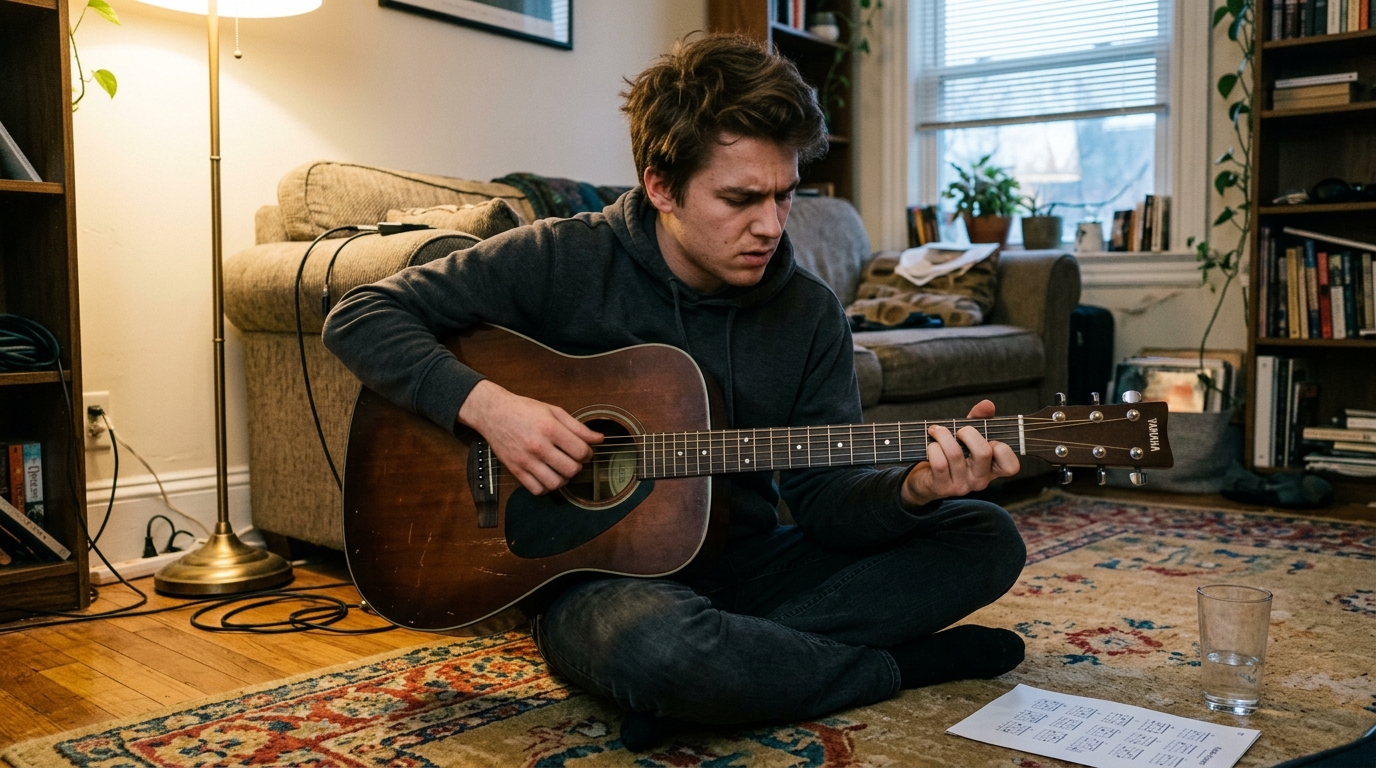
Changing chords cleanly is the first real wall every beginner hits. The D chord is usually where that wall appears. You have learned E and A, the shapes feel okay. Then you try adding D and the whole thing falls apart. The transitions slow down, strings buzz, and the rhythm disappears. This is completely normal, and there is a specific fix for it. In this article, you will learn exactly where to place your fingers for the D chord, understand why changing chords trips beginners up. Practice a focused method for making E, A, and D transitions feel automatic. This three-chord combination powers thousands of songs across rock, folk, country, and pop. Nail it here and you are genuinely ready to play real music. For the full picture of where this fits in your development, check out the complete beginner roadmap.
Where Your Fingers Go for a Clean D Chord
The D chord is a compact, three-finger shape on the top four strings. Start by ignoring the low E string and the A string entirely. Those two strings do not ring in a standard open D voicing.
Place your index finger on the third string, second fret. Next, put your middle finger on the first string, second fret. Finally, put your ring finger on the second string, third fret. Your fingers form a small triangle shape near the body of the neck.
Strum from the fourth string (the D string) downward. That clean, bright sound is the open D chord. Because the shape is tight, beginners often accidentally mute the first or second string with the underside of a finger. Check each string individually at first, then strum all four together.
Why the D Shape Feels Awkward at First
The D chord asks your ring finger to do more work than it did in E or A. For most beginners, the ring finger is the weakest and least coordinated finger on the fretting hand. So the shape itself demands more from a finger that has not built up strength yet.
In addition, the strings you strum for D are physically closer together than for E or A. Missing a string or clipping the A string by accident is easy to do. Therefore, a lighter, more controlled strum is helpful here while you are building the shape memory.
For example, try pressing down the D chord without strumming at all. Just form it, hold it for five seconds, release your hand completely, and then reform it. Repeating this alone will accelerate your muscle memory faster than you might expect.
FREE Download of all 34 of these beginner
Why Changing Chords Is the Real Challenge
Playing a chord shape in isolation is one skill. Changing chords in time is a different skill entirely. Most beginners get stuck because they try to move one finger at a time. As a result, the transition takes three times longer than a beat allows.
The key shift in thinking is this: lift all your fingers together and land them together. Instead of moving fingers one by one, train your hand to travel as a unit. This feels strange at first, because it is genuinely a new motor pattern.
Also, it is worth understanding that chord changes slow down because the brain is still building the neural pathway between two shapes. Specifically, the brain needs to automate the move so you do not have to consciously direct each finger. Deliberate repetition is how you accelerate that process.
If you have already been working on E and A from the previous lesson, you know that the E-to-A shift has its own logic. Adding D creates a longer chain, and the transitions compound. That is why a focused change practice method matters so much here.
A Deliberate Practice Method for Smooth Transitions
Here is the method Jeff teaches for changing chords. Set a timer for 60 seconds. Spend that full minute doing only one transition, for instance, D to A. Do not switch between all three chords yet. Just repeat D to A, over and over, lifting fingers together, landing fingers together.
First, do not use a metronome during this drill. Instead, go as slowly as you need to land the shape correctly. Slow and clean beats fast and sloppy every time. After two or three sessions, the move will speed up naturally.
Then, once D to A feels fluid, practice A to E the same way. Next, practice E to D. Finally, start linking all three in a cycle: E, A, D, back to E. Only then should you introduce a metronome, starting at a tempo where you can make every change on time.
This targeted approach is more effective than just playing through a song and hoping the changes tighten up. Because each transition is a separate motor skill, each one needs its own focused attention.
FREE Download of all 34 of these beginner
The Three-Chord Progression That Opens Everything Up
E, A, and D together form one of the most common chord progressions in popular music. In fact, this combination or a variation of it appears in everything from classic rock anthems to country radio staples to folk campfire songs.
Once you can move between these three chords in time, even at a slow tempo, you are ready to play actual songs. That is not an exaggeration. Thousands of songs use only these chords, and the skills you have built here are directly transferable.
Also, notice how the strumming foundation you built earlier suddenly makes more sense in this context. Strumming patterns and chord changes work together. Strong changes let you focus your attention on rhythm rather than scrambling to form shapes.
When you feel ready to put this into practice with a real song, learning “Wild Thing” is the natural next step. That song uses E, A, and D exactly as you have been practicing them.
From Three Chords to Real Music
Changing chords smoothly between E, A, and D is the bridge between beginner exercises and actual playing. The finger placement for D is learnable in a single session. The transitions take more time, but the deliberate practice method here gives you a clear path.
Most importantly, do not wait until the changes feel perfect before trying a song. Play them imperfectly at a slow tempo, and let real music motivate your practice. Return to the full beginner guide anytime you need to see how each skill connects to the next step in your journey.
Learn to play 27 songs with TrueFire’s Beginner Method!Start →
About the Education Team
Four music-industry veterans with decades of combined experience in music education, curation, and production at TrueFire and ArtistWorks. The TrueFire Studios Education Team plans and edits this content and works with our master-musician faculty to keep it accurate and genuinely useful.
Featured Contributor
Jeff Scheetz is TrueFire’s Director of Education and a veteran touring guitarist who has shared stages with the Scorpions, .38 Special, ELO, Eric Johnson, and Steve Vai. With eight albums of original music, numerous TrueFire courses, and 300-plus clinics worldwide, he blends blues, rock, and instructional clarity built over decades of teaching.