

Open chords are the backbone of
Why Open Chords Like E and A Are a Beginner’s Best Friend
Open chords use at least one unfretted string, which means part of the
In addition, both chords show up in I-IV-V progressions, which are the harmonic engine behind countless classic songs. Because of that, a small amount of practice goes a long way. Once you can reliably form these two shapes, you are already equipped to play along with real music.
For context, you already covered the first two beginner chord shapes in the previous post. Therefore, you have some fretboard familiarity before diving into E and A major. These new chords will feel familiar in terms of hand position, but each has its own fingerprint worth understanding closely.
FREE Download of all 34 of these beginner
Finger Placement for the Open E Major Chord
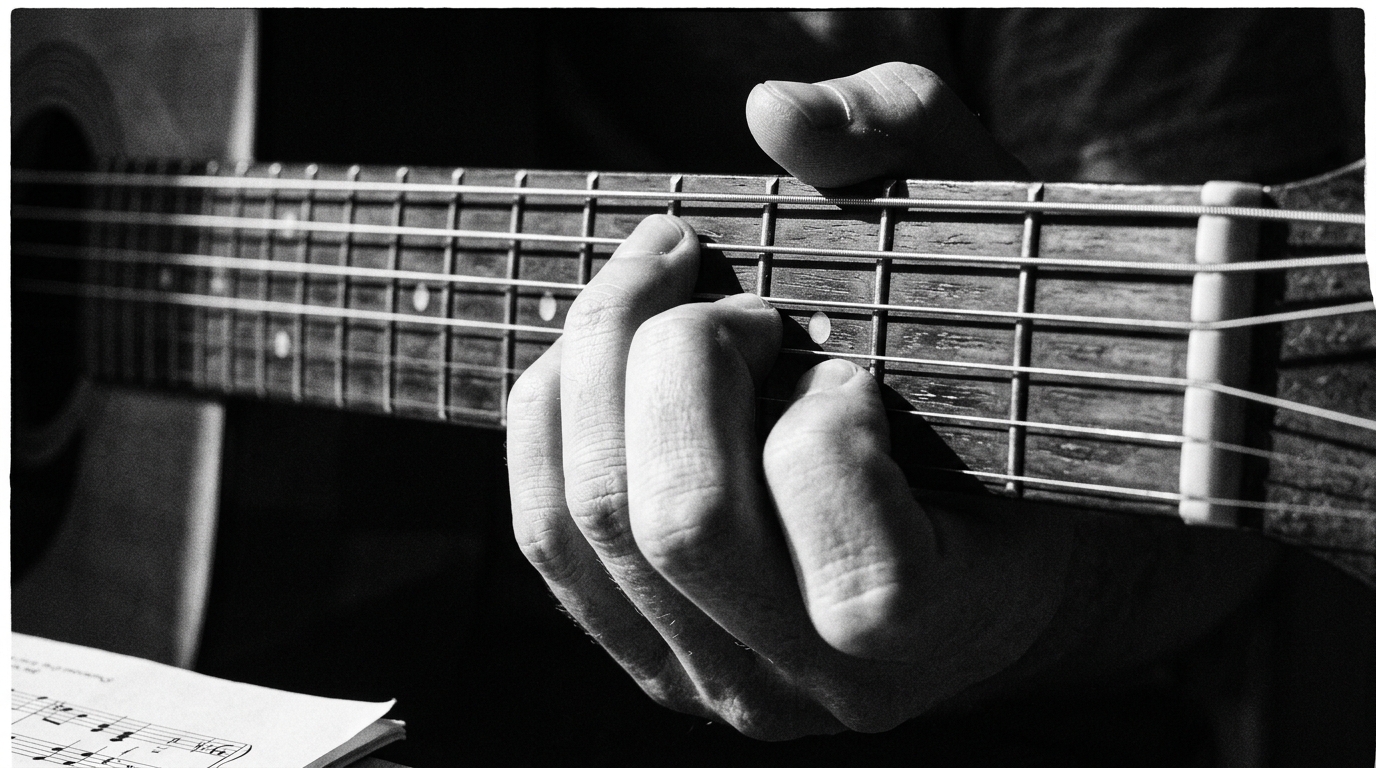
The E major chord uses all six strings, so getting every finger in the right place matters. First, place your first finger on the first fret of the G string (string 3). Next, put your second finger on the second fret of the A string (string 5). Then, place your third finger on the second fret of the D string (string 4).
Your fingertips should press close to the fret wire, not in the middle of the fret space. Because of this positioning, you get a cleaner tone with less buzzing. Press firmly, then strum all six strings and listen carefully.
If any note buzzes or sounds muted, check these things one at a time:
- Are your fingers arched enough so they are not touching neighboring strings?
- Is each fingertip pressing close to the fret wire?
- Is your thumb sitting behind the neck rather than wrapping over it?
Fix one thing at a time, then strum again. In short, patience here builds muscle memory that sticks.
Common E Chord Mistakes and How to Fix Them
One of the most common issues is a muted open B string (string 2). This happens because the first finger accidentally leans against it. Instead, arch your first finger more deliberately so the B string rings open and clear.
Another frequent problem is a weak, buzzing G string. For example, if your second finger is sitting too flat, it will accidentally dampen the string next to it. Curl it more so only the very tip makes contact. As a result, that G note will ring clean, and the whole chord opens up.
The E major shape is also a building block for barre chords later on. So, every correction you make now will carry forward and make barre chords easier down the road.
Finger Placement for the Open A Major Chord
The A major chord is where things get a little tight. Specifically, you need to place three fingers on the second fret across strings 4, 3, and 2 (the D, G, and B strings). The low E string (string 6) is muted or skipped, and the open A string (string 5) and high E string (string 1) both ring freely.
There are two common approaches. First, you can use fingers 1, 2, and 3 across those three strings in order. Second, some players prefer to barre all three strings with one finger, usually the first. Both approaches work, so experiment and see which feels more natural.
Most importantly, keep your fretting hand relaxed. Because the A chord clusters fingers so close together, tension creeps in quickly. Shake your hand out between practice attempts and return with a lighter grip.
Getting a Clean Sound on the A Chord
The hardest part of the A chord is keeping the high E string (string 1) open and ringing clearly. Because all three fingers are so close together, one of them often brushes that string and mutes it accidentally.
To fix this, tuck your fretting elbow slightly toward your body. This rotates your wrist and naturally arches your fingers more. As a result, the high E string has more clearance above your knuckles.
Also, watch that your first finger is not touching the open A string (string 5) above it. That string needs to ring free as well. In fact, two out of the chord’s six notes come from open strings, so protecting them matters as much as fretting the others correctly.
FREE Download of all 34 of these beginner
Moving Between E and A: Your First Chord Change
Once both chords sound clean individually, the next challenge is switching between them smoothly. First, practice each chord shape without any strumming. Just form the shape, release, and form it again. Then alternate between the two shapes at a slow, steady pace.
A useful trick is to find the “pivot” note or finger position that can guide the transition. For example, notice how your fretting hand shifts only slightly when moving from E to A. Because the shapes are similar in hand position, the movement is smaller than it might feel at first.
Meanwhile, keep your strumming hand moving even if your fretting hand is not quite in position. Keeping that rhythmic pulse alive trains both hands to work together. For more detail on right-hand timing, revisit the strumming patterns breakdown.
Putting E and A to Work in Real Songs
These two chords are not just exercises. They are genuinely found in hundreds of songs across virtually every genre. For instance, rock classics like “Smoke on the Water,” countless 12-bar blues progressions, and country songs all rely heavily on this chord pair.
In addition, once you add a third chord to the mix, the full picture comes together. The D chord and smooth chord changes guide picks up exactly where this post leaves off, showing you how to build a complete three-chord progression. From there, your first real song on guitar will show you how to apply all three chords in a performance context.
For now, focus on clean individual shapes first, then consistent transitions. Because these two open chords appear so frequently, the time you invest in them right now keeps paying off every time you pick up the
Learn to play 27 songs with TrueFire’s Beginner Method!Start →
About the Education Team
Four music-industry veterans with decades of combined experience in music education, curation, and production at TrueFire and ArtistWorks. The TrueFire Studios Education Team plans and edits this content and works with our master-musician faculty to keep it accurate and genuinely useful.
Featured Contributor
Jeff Scheetz is TrueFire’s Director of Education and a veteran touring guitarist who has shared stages with the Scorpions, .38 Special, ELO, Eric Johnson, and Steve Vai. With eight albums of original music, numerous TrueFire courses, and 300-plus clinics worldwide, he blends blues, rock, and instructional clarity built over decades of teaching.