


The easy B chord replaces one of the most crowded barre shapes on guitar with just two fingers. Since it uses only the top three strings, there’s no full barre and no awkward bend in your ring finger. Even so, it’s a true B major chord, so it fits any song that calls for B.
Why the B Chord Is So Hard
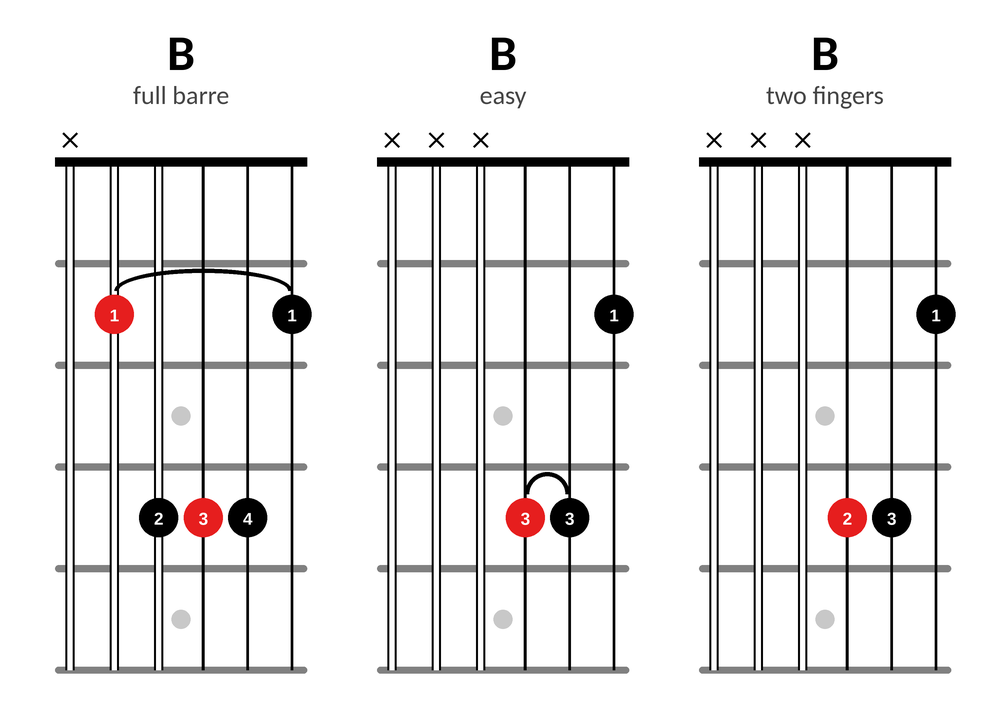
There’s no simple open B chord, so most charts show it as a barre at the 2nd fret. First, your index finger presses five strings. Then three more fingers squeeze into the 4th fret on the D, G and B strings. In short, that’s a lot of fingers in a very small space.
Here’s the full shape, listed from the thickest string (low E) to the thinnest (high E). Its shape code is x 2 4 4 4 2.
- Low E string: don’t play it.
- A string: 2nd fret, index finger (barre).
- D string: 4th fret, middle finger.
- G string: 4th fret, ring finger.
- B string: 4th fret, pinky.
- High E string: 2nd fret, index finger (barre).
Some players use one finger flat across the D, G and B strings instead. However, the high E string still has to ring underneath it, so that version is just as tricky.
Where You’ll Need a B Chord
B is one of the three main chords in the key of E, along with E and A. Since E is one of the most popular keys for guitar, B shows up in a lot of rock, blues and country songs.
How to Play the Easy B Chord
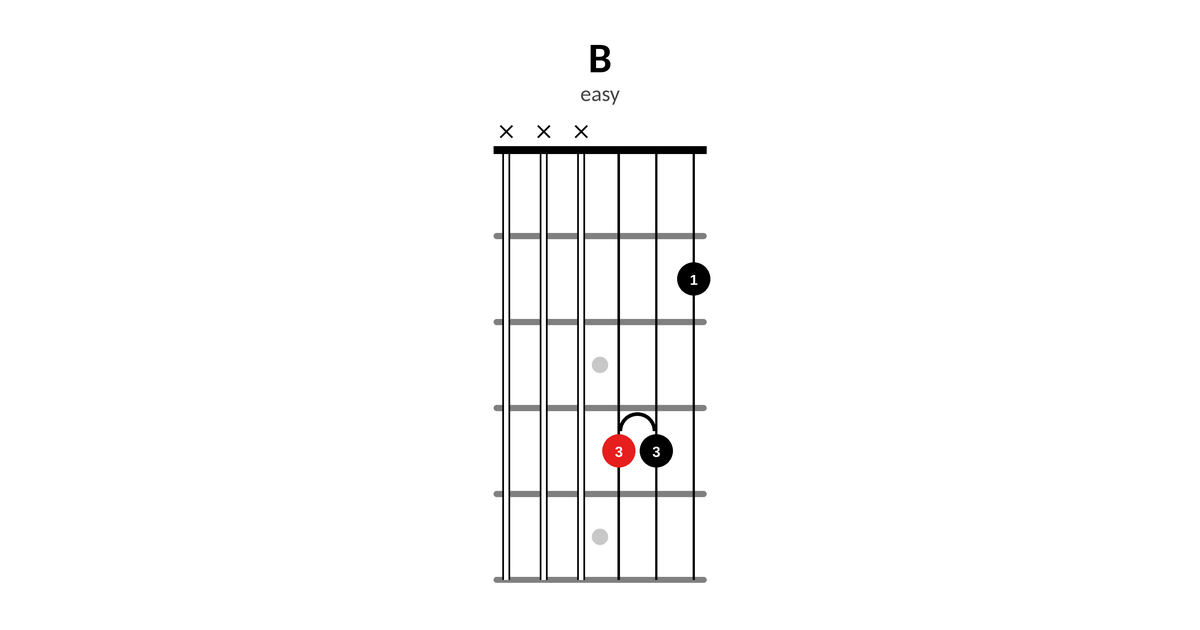
By comparison, the easy version keeps only the top three strings. Its shape code is x x x 4 4 2.
- Low E, A and D strings: don’t play them.
- G string: 4th fret, ring finger.
- B string: 4th fret, ring finger (flat across both strings).
- High E string: 2nd fret, index finger.
If laying one finger across two strings feels odd, use two fingers instead. Put your middle finger on the G string and your ring finger on the B string, both at the 4th fret. Then strum only the top three strings, starting at the G string.
What’s in the Easy B Chord
A B major chord is built from three notes: B, D-sharp and F-sharp. The easy B chord has all three. The G string gives you B, the B string gives you D-sharp, and the high E string gives you F-sharp.
In the diagrams, the red dot marks B, the root of the chord. That note sits on the G string, so it’s the lowest note you’ll hear.
Easy B vs. Easy Bm: One Note Apart
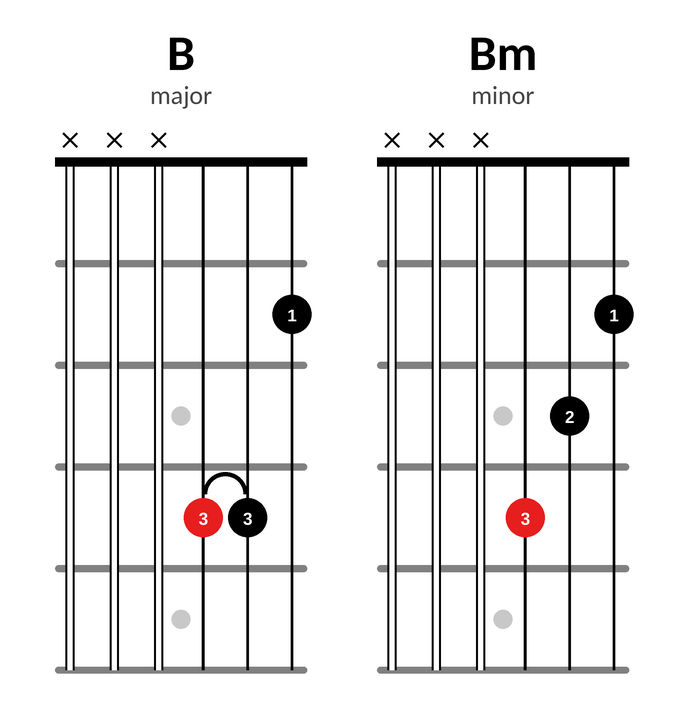
Move one note, and the easy B chord turns into B minor. Simply lower the B string note by one fret, from the 4th fret to the 3rd. The shape becomes x x x 4 3 2.
That single fret turns D-sharp into D, which changes the chord from major to minor. Meanwhile, the G and high E string notes stay the same. For the best fingering, see our guide to the easy Bm chord.
Play the Easy B Chord With E and A
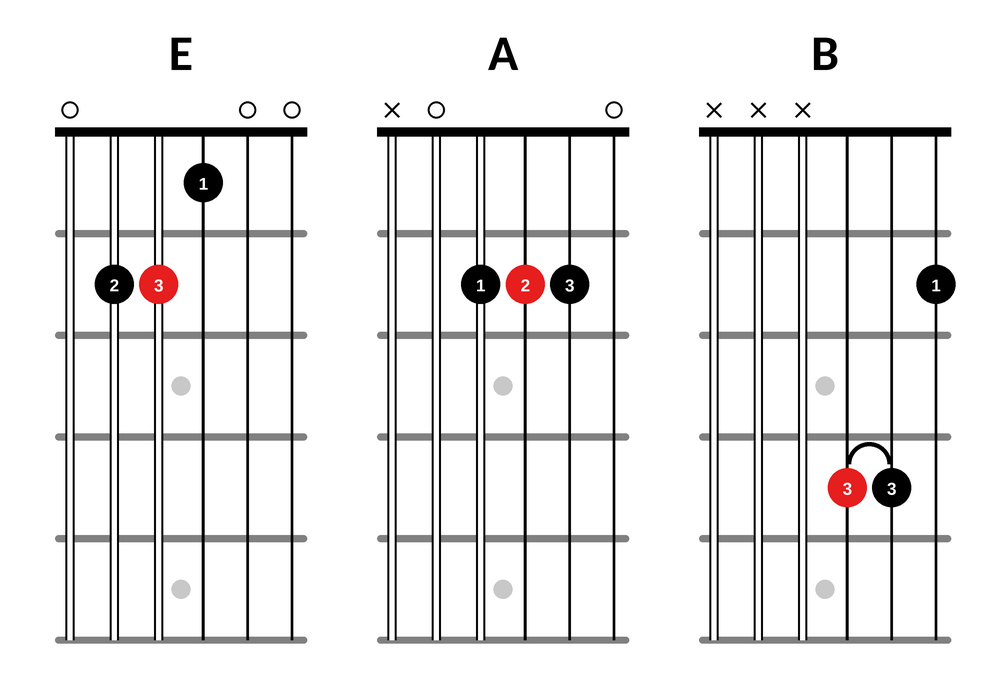
Now put it to work in the key of E. Play E, A and B, four beats each, then return to E. This simple loop is the backbone of countless rock and blues songs.
- E: 0 2 2 1 0 0.
- A: x 0 2 2 2 0.
- B: x x x 4 4 2.
At first, strum all six strings for E and five for A, then just the top three for B. Next, try strumming only the top three strings on all three chords. Because the top three strings of open E and open A are triads too, the whole progression will sound light and even.
Practice the A to B Change
The change from A to B is the hard part, since no fingers stay in place. So practice it on its own. Strum A for four beats, then B for four beats, for one minute. Then cut it to two beats each. Keep your hand relaxed, and look at the 4th fret before you move.
The Open B7 Chord: Another Easy Option
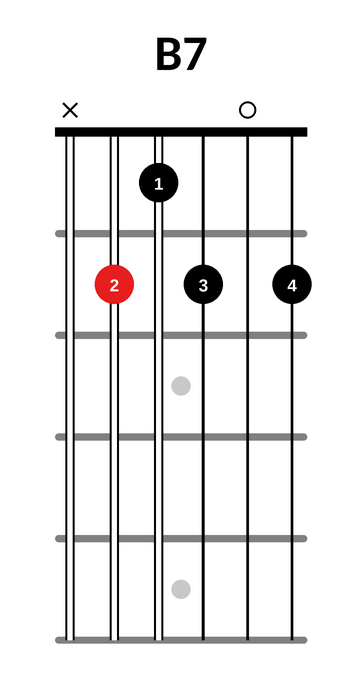
In many songs in the key of E, especially blues and country, B7 can stand in for B. It’s an open chord with no barre at all. Its shape code is x 2 1 2 0 2.
- A string: 2nd fret, middle finger.
- D string: 1st fret, index finger.
- G string: 2nd fret, ring finger.
- B string: open.
- High E string: 2nd fret, pinky.
B7 adds one extra note, A, to the B chord. That note gives it a bluesy pull back toward E. So use B7 when you want that pull, and the easy B chord when a song calls for a plain B.
Common Easy B Chord Mistakes
A few small problems cause most of the trouble with this shape.
- The high E string is muted. Your flat ring finger may be touching it. Let the finger end on the B string, so the high E rings freely at the 2nd fret.
- The B string buzzes. Press close to the fret wire. If it still buzzes, switch to the two-finger version.
- The low strings ring. Start your strum at the G string, and keep the stroke short.
- The chord sounds thin. Actually, that’s normal for a three-string chord. If you want more, strum firmly and let the notes ring.
Keep Going With Easy Triads
Here’s a fun next step. Slide the easy B chord up one fret, and you get C major (x x x 5 5 3). That move powers a famous progression in our guide to the easy Cm chord. For the big picture, read our pillar guide to easy guitar triads.
When you’re ready for the full barre, our guide on how to play the B chord covers it step by step. Also, if E and A still need work, start with our guide to the open E and A major chords.
Explore 14 Comprehensive TRIAD Courses on TrueFire!Start →
Continue Learning
Explore the rest of this series:
- Easy Guitar Triads: Play Any Chord With Just 3 Strings
- Easy F Chord: Skip the Barre With This 3-String Shape
- Easy Bm Chord: A 3-Finger Shape That Sounds Just Right
- Easy Fm Chord: Play F Minor With One Finger
- Easy Cm Chord: A Simple 3-String Shape for C Minor
About the Education Team
Four music-industry veterans with decades of combined experience in music education, curation, and production at TrueFire and ArtistWorks. The TrueFire Studios Education Team plans and edits this content and works with our master-musician faculty to keep it accurate and genuinely useful.