


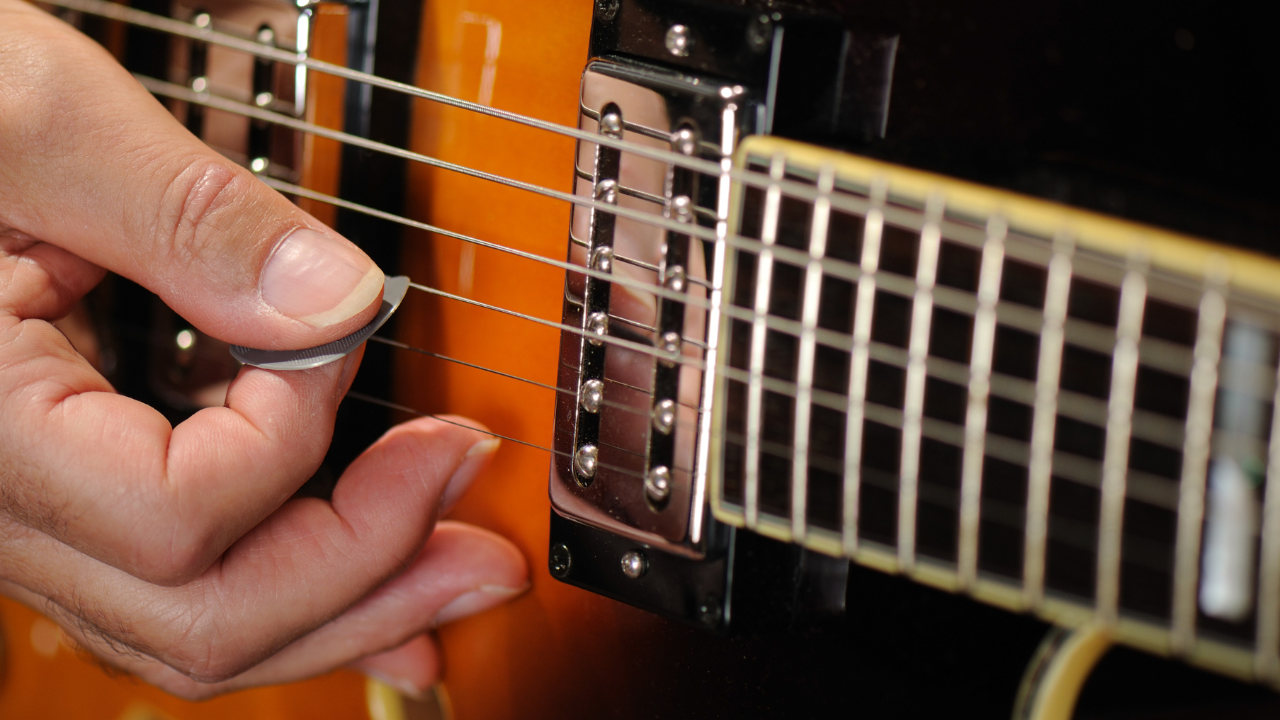
The way you strike a string shapes your tone more than most beginners realize. Most new players spend hours reading gear reviews, comparing amps, and watching pedal demos in the belief that a shiny new piece of equipment will unlock the tone they’re chasing. The truth, as any experienced player will tell you, is that a huge percentage of your tone lives in how you touch the instrument.
Guitar pick attack tone (along with finger pressure, dynamic control, vibrato, and rhythm) shapes the sound coming out of your amp long before the amp does anything to it. In this guide, we’ll walk through why pick attack matters, how to develop it with practical exercises, and how to sound better without spending a dime on new gear.
Table of Contents
- Rob Garland on Why Tone Lives in Your Hands
- Guitar Pick Attack Tone: The 96% Rule
- How to Improve Pick Attack Guitar: The One-Note Test
- Guitar Tone Tips That Work Without Any Pedals
- Dynamic Guitar Playing: Volume, Attack, and Space
- Guitar Tone Without Pedals: What Your Hands Can Do
- A Beginner’s Practice Routine for Better Guitar Tone
Rob Garland on Why Tone Lives in Your Hands

TrueFire educator Rob Garland makes the case for hand-based tone in the video above. His half-joking estimate is that 96.4% of your tone comes from your fingers, and only a small remainder comes from the amp and the instrument. His argument, backed up by decades of teaching and playing, is that the physical connection between your ear, your hands, and the strings is what defines your voice on the guitar.
Guitar Pick Attack Tone: The 96% Rule
The 96% rule (or 96.4%, if you prefer Rob’s exact framing) is a useful mental model for any beginner starting to think about tone. It reframes the tone question away from equipment and toward technique. Yes, gear matters. A great amp and a well-set-up guitar can make the difference between a decent tone and a great one. But the vast majority of what makes a player sound like themselves lives in their hands.
The proof is in the anecdote Rob shares about seeing Eric Johnson at a music-store clinic. Before the store opened, Johnson plugged into a tiny digital Fender practice amp and played a few pentatonic runs. Rob’s reaction: “Oh, there’s Eric Johnson.” No pedalboard. No stack of amps. Just the same hands, the same touch, the same voice. If a legend like Eric Johnson sounds exactly like himself through a practice amp, the lesson for the rest of us is unmistakable: Work on your hands.
How to Improve Pick Attack On Guitar: The One-Note Test
Learning how to improve your pick attack on guitar starts with a deceptively simple exercise Rob calls the one-note test. Play a single note. Then play it again with different variations. Notice how many distinct sounds you can produce with one pitch:
- Harder pick attack. Dig in aggressively. Hear how the note becomes more percussive and cutting.
- Softer pick attack. Let the pick brush the string. Hear how the note becomes warmer and more sustained.
- Using your fingers. Pluck the string with your bare finger or a thumb. Hear how the attack softens and the tone rounds out.
- Adding vibrato. Play the note first, then add controlled vibrato. Rob’s rule: hit the note first, or bend to the note first, and then add the vibrato.
- Bending and releasing. Bend up to the note from a half step below, then release. Hear how the arrival feels different from a straight attack.
- Approaching chromatically. Play a note a half step above or below your target, then move to the target. Hear how the target note sounds richer with the setup.
- Changing dynamics. Play the same note softly, then loudly. Hear how volume alone changes the emotional character.
Spending twenty minutes with a single note like this is more valuable for your tone than an hour of shopping for pedals.
Guitar Tone Tips That Work Without Any Pedals
Guitar tone tips that don’t involve buying new equipment are often the most useful for a beginner. A handful of habits will improve your tone dramatically with the gear you already own:
- Warm up before you play. Cold hands produce cold tone. A few minutes of scales or long tones every session gets your fingers moving and your touch under control.
- Vary your pick attack across a phrase. A phrase that starts soft and builds to a hard peak sounds more interesting than a phrase played at one constant volume. Rob emphasizes dynamics as a defining feature of great tone.
- Play unplugged sometimes. Listen to how your guitar sounds without an amp. Rob mentions doing this to imagine how the amplified version will sound. It’s a powerful ear-training exercise.
- Sing what you play. Even if you’re not a singer, humming or singing along with your notes creates a deeper connection between your ear and your hands.
- Take an honest inventory. If you’re not sure where your tone stands, our free Guitar Tone Quiz is a quick way to see how well you can identify good tone and where you can improve.
Picking Technique Guitar Fundamentals for Beginners
Picking technique guitar fundamentals are the foundation everything else rests on. A few habits every beginner should build:
- Hold the pick lightly but firmly. A death grip produces stiff, brittle tone. A too-loose grip produces flabby, inconsistent tone. Aim for the middle: firm enough to control, loose enough to breathe.
- Angle the pick slightly. Most experienced players don’t hit the string dead-flat. A slight tilt (5 to 15 degrees) produces a smoother attack with less string noise.
- Alternate pick. Down, up, down, up. Most single-note lines flow better with strict alternation. Cross-picking and economy picking are advanced variations to explore later.
- Practice slowly. Speed comes from control, and control comes from slow, deliberate repetition. Practicing fast before you have control produces sloppy, uneven tone.
- Watch your right-hand tension. A relaxed strumming hand produces better tone than a tense one. If your forearm is sore after a practice session, you’re gripping too hard or moving too much.
Dynamic Guitar Playing: Volume, Attack, and Space
Dynamic guitar playing is what separates memorable playing from forgettable playing. Dynamics are more than volume changes. They include the intensity of your pick attack, the space you leave between notes, and the way you build energy across a phrase.
A useful mental model: think of a phrase as a sentence with a beginning, middle, and end. The beginning sets up the idea. The middle develops it. The end resolves it. Each part can have its own dynamic character. A phrase that starts soft, builds to a peak in the middle, and settles at the end reads to a listener as a complete thought. A phrase played at one constant volume tends to blur into the background.
Rob demonstrates this by taking a simple five-note phrase in A minor and playing it many different ways: straight, with expression, with bend-and-release-plus-slide, with chromatic passing notes, with bluesy dynamics, as a chordal variation, with aggressive pick attack for blues-rock energy, with tremolo picking, and with clean fingerstyle for a country feel. The takeaway is worth remembering: a single phrase contains dozens of tonal possibilities. Explore them.
A Beginner’s Practice Routine for Better Guitar Tone
A focused daily routine will improve your tone faster than any gear upgrade. Here’s a 30-minute session designed to build hand-based tone:
- 5 minutes: warm-up. Play a simple scale slowly with full attention to your pick attack and hand tension.
- 10 minutes: one-note test. Pick a single note and produce as many distinct tones from it as you can. Vary attack, dynamics, vibrato, articulation.
- 10 minutes: phrase makeover. Take a short phrase and play it fifteen different ways using the techniques above. Record yourself if possible.
- 5 minutes: unplugged listening. Play a favorite chord progression acoustically. Focus on the sound your fingers are creating without amplification.
For a structured deeper dive, our free Guitar Tone Workout is a focused program designed to build tone-shaping skills systematically in just 10 minutes per day.
Take Your Guitar Pick Attack Tone to the Next Level
Pick attack technique is one of the highest-leverage skills any beginner can develop for next-level tone. Every hour you spend refining how you touch the instrument pays off in every song you play for the rest of your musical life. The best part is that you don’t need any new gear to start the work. The most transformative practice you can do is right there in your hands, waiting for your attention.
Try TrueFire All Access for FREE with a 14-day trial. Get unlimited access to thousands of lessons from world-class instructors, interactive learning tools, and structured paths designed to build the tone, technique, and expression that make a great player sound great.