


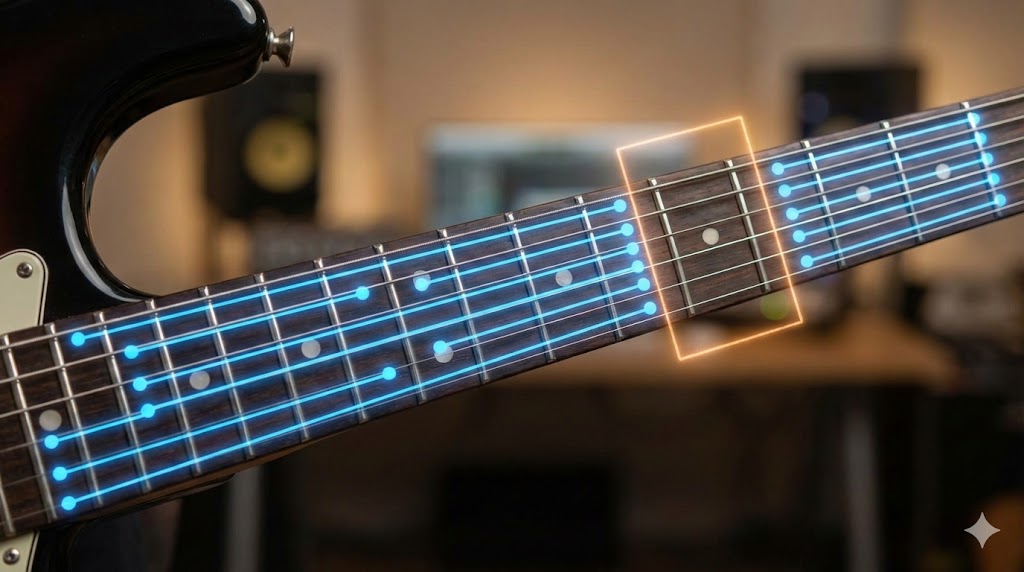
Stop Thinking Vertically: A Guide to Horizontal Playing
Here’s the truth most guitarists don’t want to hear: if you’ve been playing for years but still feel trapped in the same five frets, your guitar fretboard navigation is holding you back. You’ve memorized your boxes. You can rip through a pentatonic pattern in your sleep. But the moment you try to move beyond that comfortable zone, everything falls apart.
Sound familiar? You’re not alone. Most players learn scales vertically—up and down the neck in fixed positions—because that’s how most method books teach them. But here’s the problem: real music doesn’t stay in one place. Melodies travel. Solos breathe. And the players you admire? They’re thinking horizontally.
In this guide, we’re going to break down the mental shift from vertical to horizontal playing, show you practical techniques for connecting pentatonic boxes, and give you exercises that build genuine neck fluency. By the end, you’ll see the fretboard not as a series of isolated positions, but as one interconnected playground.
Table of Contents
- Understanding Vertical vs. Horizontal Playing
- The Horizontal Mindset: Why It Matters
- Connecting Pentatonic Boxes Across the Neck
- Sliding Scales Guitar: Techniques for Smooth Transitions
- Practical Exercises for Guitar Fretboard Navigation
- Common Mistakes to Avoid
- Your Next Steps
Understanding Vertical vs. Horizontal Playing
Before we dig in, let’s clarify what we mean by horizontal vs vertical playing.
Vertical playing means moving up and down the strings within a single position or “box.” When you learned your first pentatonic scale, you probably learned it this way—plant your hand in one spot and play through the pattern from the low E to the high E string, then back down. It’s efficient. It builds foundational technique. And it’s absolutely essential.
But it’s also limiting.
Horizontal playing means moving along the length of the neck—across multiple positions—while staying on one or two strings. Think of it as traveling sideways instead of up and down. This approach opens up melodic possibilities that vertical playing simply can’t access.
The best players seamlessly blend both approaches. They might start a phrase vertically, slide into a new position, run horizontally across three frets, then drop back into another box. That fluid movement? That’s what separates intermediate players from advanced ones. If you’re just getting started with understanding the neck, our guide on how to learn the fretboard on the guitar provides an excellent foundation.
The Horizontal Mindset: Why It Matters
Here’s a concept that might reshape how you think about guitar scale patterns: every scale exists as a single line across each string.
Take the A minor pentatonic scale. Vertically, you might know all five box positions. But horizontally, on just the G string, the entire scale lives at frets 2, 5, 7, 9, 12, 14, 17, 19, and so on. That’s the same scale—just viewed from a different angle.
Why does this matter?
Melodic Flow
Horizontal lines create smoother, more vocal-like phrases. When you play across the neck instead of jumping strings, your melodies sing. Listen to players like David Gilmour or B.B. King—their solos often travel laterally, bending and sliding along single strings for maximum emotional impact.
Tonal Variety
The same note played in different positions sounds different. An A on the 5th fret of the E string has a different character than the A on the 10th fret of the B string. Horizontal playing lets you choose your tone deliberately.
Escape Routes
When you’re improvising and want to move to a new register, horizontal awareness gives you options. Instead of staying stuck in one box until you awkwardly jump to another, you can slide smoothly into new territory.
Connecting Pentatonic Boxes Across the Neck
Let’s get practical. The key to connecting pentatonic boxes is finding the overlap points—the notes that exist in multiple positions—and using them as bridges.
The Overlap Principle
Adjacent pentatonic boxes always share notes. In A minor pentatonic, Box 1 (starting at the 5th fret) and Box 2 (starting at the 8th fret) overlap at frets 7 and 8. These shared notes are your gateways.
Here’s how to use them:
- Play through Box 1 ascending
- When you reach a shared note (like the C at the 8th fret of the E string), use it as a pivot
- Continue into Box 2 without stopping
- Reverse the process coming back down
Practice this slowly. The goal isn’t speed—it’s seamlessness. You want the transition to be invisible to listeners. For a comprehensive breakdown of all five positions and how they connect, check out Unlock the Fretboard: 5 Pentatonic Scale Shapes.
The “Two-String Highway”
Another powerful approach: pick any two adjacent strings and map out the pentatonic notes across the entire neck. For example, on the B and E strings in A minor pentatonic:
- Frets 5, 8 (B string) → Frets 5, 8 (E string)
- Frets 10, 12 (B string) → Frets 10, 12 (E string)
- And so on up the neck
Practice running up and down this “highway.” You’ll start seeing the neck as connected territory rather than isolated islands.
Sliding Scales Guitar: Techniques for Smooth Transitions
Slides are the secret weapon of sliding scales guitar technique. They’re not just ornaments—they’re functional tools for moving between positions without breaking your musical flow.
The Position Shift Slide
This is your bread-and-butter move. Instead of lifting your finger to jump to a new position, slide into it.
Exercise: Play the 5th fret on the G string with your index finger. Now slide that same finger up to the 7th fret, arriving smoothly. That simple action just moved you from Box 1 to Box 2 of A minor pentatonic.
The key is to maintain consistent pressure during the slide. Too light and the note dies. Too heavy and you’ll hear every fret bump along the way.
The Connector Slide
This technique uses slides to link phrases across different positions. Play a short lick in one position, slide on the last note to a new position, then continue with a new phrase.
Example in A minor pentatonic:
- Start in Box 1: Play 5-8 on the G string, 5-7 on the B string
- Slide the 7 up to 10 on the B string
- Continue in Box 4: Play 10-12 on the B string, 10-12 on the high E
That slide at step 2 is your connector. It’s the bridge between two worlds.
Double-Stop Slides
For a fuller sound, try sliding two notes simultaneously. This works especially well in blues and rock contexts. Slide a minor third interval (like frets 5 and 8 on the B and E strings) up two frets for instant attitude.
Practical Exercises for Guitar Fretboard Navigation
Time to woodshed. Here are three exercises designed to build your guitar fretboard navigation skills.
Exercise 1: The Single-String Scale
Pick one string. Play the A minor pentatonic scale from the lowest available note to the highest, using only that string. Do this for all six strings.
Focus on: Smooth position shifts, consistent tone, knowing where every note lives.
Exercise 2: The Box Connector
Play ascending through Box 1, slide into Box 2 at the first opportunity, continue ascending through Box 2, slide into Box 3, and so on—all the way up the neck. Then reverse.
Focus on: Making transitions invisible. A listener shouldn’t hear where one box ends and another begins.
Exercise 3: The Diagonal Run
Start at the 5th fret of the low E string. Play two notes, move up one string AND up the neck by one position. Continue this diagonal pattern until you reach the high E string.
Focus on: Coordinating vertical and horizontal movement simultaneously.
For structured practice with video instruction and interactive tools, Jeff McErlain’s On Location: Pentatonic Deep Dive offers masterclass-level guidance on expanding beyond basic box shapes.
Common Mistakes to Avoid
As you develop horizontal playing skills, watch out for these common traps:
Abandoning Vertical Playing Entirely
Horizontal playing supplements vertical technique—it doesn’t replace it. The goal is fluency in both directions. Some phrases work better vertically. Some work better horizontally. Masters use both.
Sliding Too Much
Slides are powerful, but overusing them makes your playing sound sloppy and undefined. Use them purposefully, not constantly. Every slide should serve the music.
Ignoring the Sound
It’s easy to get so focused on positions and patterns that you forget to listen. Always ask yourself: does this sound good? Technical facility means nothing if the music suffers.
Rushing the Process
Neck fluency takes time. You’re rewiring years of vertical-only thinking. Be patient. Practice slowly. Speed comes naturally once the movements are internalized.
Your Next Steps for Complete Guitar Fretboard Navigation
You now have the conceptual framework and practical tools to break free from box-pattern thinking. But understanding isn’t the same as internalizing. That requires consistent, focused practice—ideally with guidance that keeps you accountable and progressing.
Here’s your action plan:
- This week: Practice the single-string scale exercise for 10 minutes daily. Map the pentatonic scale on every string.
- Next week: Add the box connector exercise. Focus on seamless transitions between adjacent positions.
- Ongoing: Apply these concepts to your improvisation. Next time you solo, consciously challenge yourself to travel horizontally at least once per chorus.
If you’re serious about unlocking complete guitar fretboard navigation, structured learning accelerates everything. The TrueFire Guitar Bootcamp provides a comprehensive curriculum designed to build exactly these skills—taking you from box-bound to fretboard-free.
Ready to see the whole neck? Try TrueFire All Access for FREE with a 14-day trial and get unlimited access to courses from world-class instructors who’ve mastered the art of horizontal playing. Dig in, break it down, and unlock your skills.
The fretboard isn’t a prison. It’s a map. And now you know how to read it in every direction.