



You’ve practiced your scales until your fingers are sore, and you’ve memorized every chord in the book, but something still feels “off.” When you play along with your favorite tracks, you feel like you’re chasing a moving target.
If this sounds familiar, don’t get discouraged! You don’t have a bad ear. You just need to focus on improving your guitar timing. In the world of music, rhythm is the heartbeat. Without it, even the most complex shredding sounds like noise. Today, we’re going to step into the woodshed and break down the exact steps you need to take to lock in with the beat and play with professional authority.
Table of Contents
Developing Your Internal Clock
Before we pick up the pick, we have to talk about the internal clock. Most beginner guitarists rely solely on their eyes or a tapping foot to keep time. While those help, true mastery comes when you feel the pulse in your core. Improving guitar timing starts with active listening.
Think of rhythm as a physical sensation. When you listen to a drummer like Steve Gadd or a rhythm master like TrueFire’s own Carl Burnett, you aren’t just hearing notes. You’re hearing a deliberate placement of sound in time. To unlock your skills, you must move beyond simply “guessing” where the beat is and start knowing exactly where it lives.
Essential Metronome Exercises for Guitarists
The metronome is often viewed as a torture device, but it is actually your best friend. To stop being a slave to the click, you have to learn to dance with it. Here are three metronome exercises for guitarists that will transform your playing:
1. The “Ghost” Note Drill
Set your metronome to 60 BPM. Instead of playing a note on every click, play a simple G major chord on beats 1 and 3. On beats 2 and 4, just “ghost” the strum by moving your hand down as if you’re hitting the strings, but don’t make contact. This forces your body to maintain the rhythmic motion even when there is silence.
2. The “Off-Beat” Challenge
This is where we really dig in. Set the metronome to click only on the “and” of the beat (the upbeat). If you’re counting “1 and 2 and 3 and 4 and,” you only play when the click happens on the “and.” This builds a sense of independence and prevents you from leaning too hard on the downbeat.
3. The Vanishing Click
Start with a standard 4/4 click. Once you feel comfortable, try muting every other measure. Can you stay perfectly in time during the measure of silence? If you emerge on the other side and you’re still aligned with the click, your internal clock is strengthening.
Overcoming Rushing and Dragging
In the recording studio, learning to overcome rushing and dragging is the difference between getting the gig and being sent home.
- Rushing: This usually happens due to nerves or technical difficulty. When a passage gets hard, our adrenaline spikes, and we push ahead of the beat.
- Dragging: This often happens when we aren’t anticipating the next beat or when our physical movements (like a long reach for a chord) take longer than the time allowed.
To fix this, you need to break it down. Slow your tempo way down to 40 or 50 BPM. Use interactive learning tools like TrueFire’s slow-mo and looping features to analyze exactly where your timing wavers. For a deep dive into these mechanics, check out our Complete Guide to Building Real Groove and Confidence.
The Power of Backing Track Practice
While the metronome is great for precision, backing track practice provides the musical context. Playing with a metronome is like running on a treadmill. Playing with a backing track, however, is like running a trail. There are hills, curves, and textures.
When you use TrueFire’s Top 50 Multitrack Audio Jams, you’re playing with world-class musicians with the power to mute, solo or adjust the volume of any instrument track. This teaches you how to listen to the snare drum for the backbeat and the bass guitar for the “one.” This real-world application is the fastest way to improve your guitar timing because it forces you to react to other instruments.
Understanding Subdivisions and the “Pocket”
To play with great timing, you must understand the math of the measure. A beat isn’t just a point in time; it’s a container. In its simplest form, you can visualize it like this:

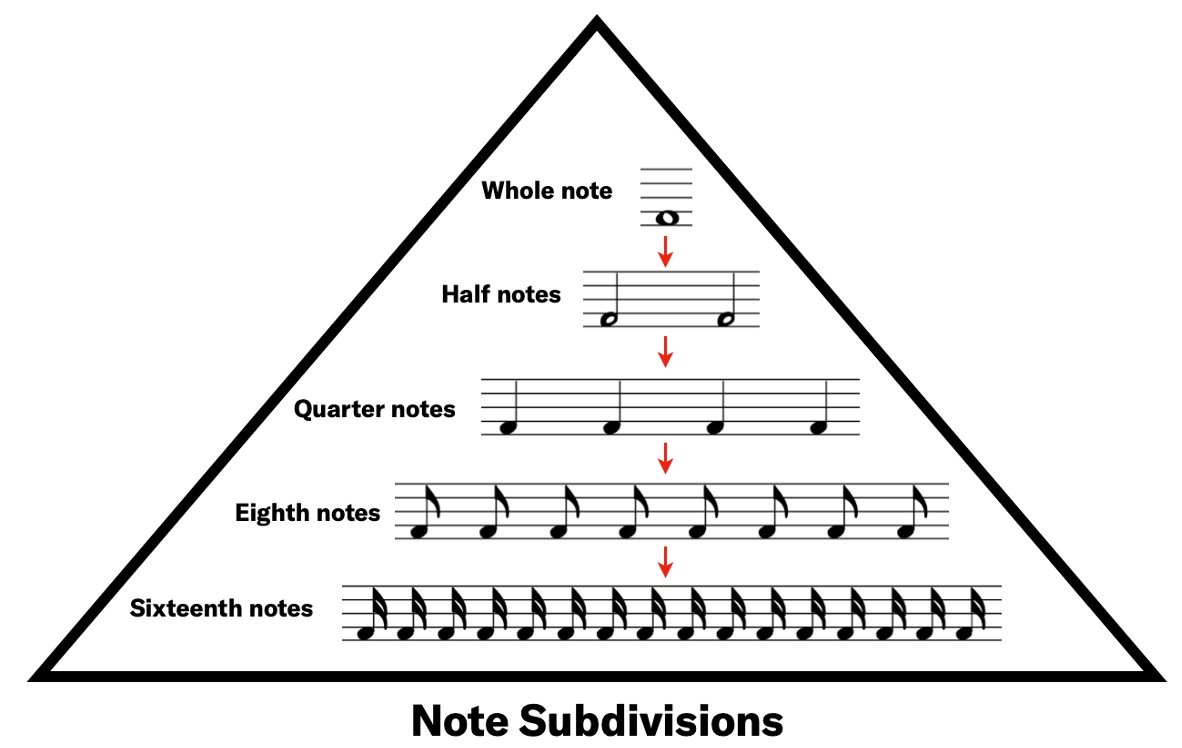
Image: YamahaSynth.com
However, “the pocket” is about more than just hitting the click—it’s about how you inhabit the space between those notes to create intrigue.
Finding the R&B Groove with Callum Bair

TrueFire educator Callum Bair explains that even a “super simple” progression, like a 1-2-3-4 in A Major, can be transformed by how you approach the timing of your embellishments. In his approach to R&B and Gospel-influenced guitar, the pocket is defined by “flurries” and “trills” that happen on each chord.
When you’re trying to unlock your skills in this style, Callum suggests looking at “upper structure” voicings. Instead of just strumming a block chord, you might use your pinky to hammer on a 6th interval or a 9th. This creates a melodic “traveling” feel. As Callum notes, the magic happens when you aren’t just repeating yourself, but instead are constantly creating personality within the groove.
Practical Application: The “Traveling” Technique
To dig in to this concept, try these steps in your next woodshed session:
- Simplify the Foundation: Start with a basic triad (like an A Major at the 5th fret).
- Add Rhythmic Intrigue: Don’t just hit the chord on beat one. Use a multi-string hammer-on to slide into the voicing.
- Listen and Respond: Callum emphasizes that great pocket playing is about listening to the other musicians (whether it’s the keys or the singer) and “playing it back to them.”
By focusing on these small details (the little slides, the intentional inversions, and the melodic fills) you move from just improving guitar timing to actually making the music breathe. It’s about being comfortable “traveling” your guitar while staying simple at the core.
Conclusion: Your Journey to Rhythmic Mastery
Improving guitar timing isn’t something that happens overnight, but it is the most rewarding investment you can make in your musical journey. By moving from the metronome to backing track practice, and consciously overcoming rushing and dragging, you’ll find that your playing becomes more relaxed, more professional, and infinitely more fun.
Remember, don’t just play the notes. Play the time. Now, head back to the woodshed, fire up a track, and let’s get to work!
Ready to lock in your rhythm? Try TrueFire All Access for FREE with a 14-day trial.