


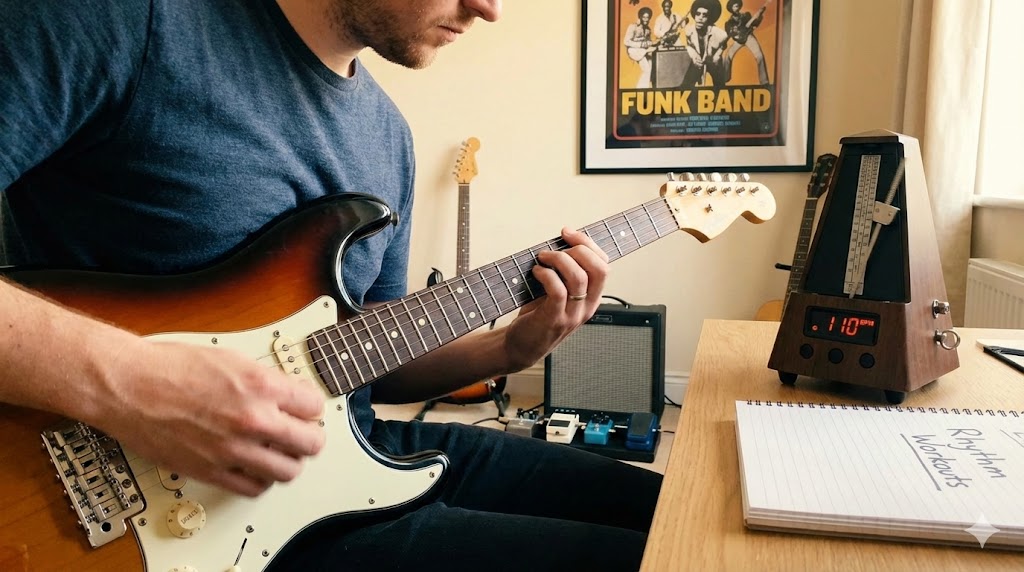
7 Rhythm Guitar Exercises Every Intermediate Player Needs to Woodshed
Here’s a truth most intermediate guitarists need to hear: your rhythm playing is the backbone of everything you do on the fretboard. You can shred pentatonic runs all day, but if your time wobbles and your comping sounds like strumming through mud, you’re leaving serious musicality on the table. The good news? Rhythm guitar exercises for intermediate players don’t have to feel like homework. When you woodshed the right material-syncopation drills, funk grooves, triad inversions, percussive techniques-your entire playing levels up.
This guide breaks down seven focused rhythm workouts designed for players who’ve moved past open-chord strumming and are ready to dig in to the techniques that separate gigging musicians from bedroom players. Grab your guitar, set up your metronome, and let’s get to work.
Table of Contents
- 1. 16th-Note Strumming Patterns: Build Your Rhythmic Engine
- 2. Guitar Syncopation Exercises: Play Off the Beat with Confidence
- 3. Funk Guitar Rhythm: Master the Mute-and-Attack
- 4. Percussive Guitar Techniques: Add Texture and Groove
- 5. Triad Inversions on Guitar: Unlock the Entire Fretboard
- 6. Shell Chords: Rhythm Economy for Blues and Jazz
- 7. Metronome Practice for Guitar: Tighten Up Your Time
- Common Mistakes Intermediate Rhythm Players Make
- What’s Next: From Rhythm to Soloing
1. 16th-Note Strumming Patterns: Build Your Rhythmic Engine
If eighth-note strumming is the bicycle of rhythm guitar, 16th-note strumming patterns are the engine that powers funk, R&B, pop, rock, and country. Every beat divides into four equal 16th notes: down-up-down-up. Your strumming hand should move continuously in this pattern whether or not it’s striking the strings. That constant motion is your internal clock.
Exercise: The Selective Contact Drill
Start with a basic A7 chord at 70 BPM. Strum the full 16th-note subdivision for four bars, then begin removing specific strokes while keeping your hand moving at the same speed. Try these patterns over a I-IV-V blues progression:
- Pattern A: Accent beats 1 and 3, ghost beats 2 and 4 (country shuffle feel)
- Pattern B: Accent the “e” and “a” of beats 2 and 4 (funk upbeat feel)
- Pattern C: Accent only beat 1 and the “and” of beat 2 (syncopated rock feel)
The key is that your strumming arm never stops. As the late Ross Bolton-an MI instructor, Al Jarreau collaborator, and one of the most respected funk guitar educators-taught, the picking hand is the timekeeper. It rarely stops. To go deep on this concept, master the ABCs of Funk Guitar with Bolton’s foundational lesson on TrueFire’s blog.
2. Guitar Syncopation Exercises: Play Off the Beat with Confidence
Syncopation is where intermediate players hit a wall. Playing on the downbeats is comfortable. Playing between them-anticipating the “one,” landing on the “and” of beat four-requires a completely different relationship with time.
Exercise: The Anticipation Drill
Take a two-chord vamp-Am7 to D9. Normally, you’d change chords on beat 1. Instead, shift the chord change to the “and” of beat 4 in the previous bar. This anticipation is one of the most common syncopation devices in popular music. Practice at 80 BPM until it feels natural and groovy rather than rushed.
Exercise: Displaced Accents
Over a static E9 chord using a 16th-note strumming pattern, accent only the upstrokes for an entire 12-bar form. This forces your ear to internalize off-beat positions. Once this becomes comfortable, you can place accents anywhere in the bar with intention. Record yourself and listen back-your ears will catch timing inconsistencies that your hands can’t feel in the moment.
3. Funk Guitar Rhythm: Master the Mute-and-Attack
Funk guitar rhythm is arguably the most demanding discipline for the rhythm hand. It’s where 16th-note strumming, syncopation, and muting converge into a single, tight groove. The defining characteristic is the interplay between notes that ring and notes that are choked.
Exercise: The Scratch Groove
Fret an E9 chord (think Hendrix’s “E7#9” shape at the 7th fret) at 85 BPM. Strum continuous 16th notes, but lightly release fretting-hand pressure on specific subdivisions so the strings produce a percussive “chk” instead of a pitched chord. Start by scratching beats 2 and 4 completely (chord rings on 1 and 3), then get more complex: ring only the “e” of beat 1 and the “a” of beat 3, scratching everything else.
Your wrist has to stay loose and fluid-a stiff wrist kills funk immediately. Think of your strumming arm as a pendulum that swings freely while your fretting hand decides what rings and what gets choked. Learn grooves from Jeff McErlain, one of TrueFire’s most prolific rhythm guitar educators, who emphasizes that great rhythm playing starts with listening and awareness of the musical space around you.
4. Percussive Guitar Techniques: Add Texture and Groove
Percussive guitar techniques turn your instrument into a one-person rhythm section. These approaches are essential for acoustic players but equally powerful on electric, especially in trio settings where you need to fill more sonic space.
Exercise: The Palm-Mute Groove
Rest the heel of your picking hand lightly on the strings near the bridge. Strike a power chord progression (E5–A5–B5) using only downstrokes in an eighth-note pattern. The palm mute creates a tight, chunky “thud” that mimics a kick drum. Alternate between palm-muted notes and open-ringing notes to create dynamic contrast within a single bar.
Exercise: The Slap-Strum Combo
Between chord strums, slap the strings with the thumb side of your picking hand to produce a snare-like crack. The rhythm becomes: strum (beat 1)-slap (beat 2)-strum (beat 3)-slap (beat 4). Once solid, insert the slap on off-beats while strumming the downbeats for a more complex rhythmic texture. Practice the palm-mute groove at 90 BPM for five minutes daily, then combine both techniques in a single 8-bar phrase.
5. Triad Inversions on Guitar: Unlock the Entire Fretboard
Here’s where intermediate rhythm playing starts to sound advanced. Most players learn barre chords and open chords, then stop exploring. Triad inversions-playing the same three-note chord in different positions and on different string groups-give you the vocabulary to create rhythm fills, voice movement, and melodic comping.
Exercise: The Triad Climb
Every major or minor triad has three inversions: root position, first inversion (third on the bottom), and second inversion (fifth on the bottom). Pick a key-G major. Play the G major triad in root position on strings 2-3-4, then find the first inversion nearby, then the second inversion. Work through all three inversions ascending the neck, then descend. Do this for every string group (1-2-3, 2-3-4, 3-4-5).
Musical Application
Once you have three or four triad shapes under your fingers, comp through a chord progression by moving between inversions instead of jumping between barre chord positions. This creates smooth voice leading-the kind of rhythm playing you hear from Nashville session players and jazz compers. It transforms your parts from “just chords” into melodic, moving lines.
If you feel stuck figuring out what to practice next, follow a personalized Learning Path on TrueFire to get a step-by-step roadmap tailored to your goals and skill level.
6. Shell Chords: Rhythm Economy for Blues and Jazz
Shell chords are stripped-down voicings containing only the root, third, and seventh. They’re a cornerstone of jazz and blues comping because they leave harmonic space for other instruments while clearly outlining the progression.
The Two Essential Shapes
- Root on the 6th string: Play the root, skip a string, then fret the 7th and 3rd on strings 4 and 3. For G7: fret 3 on string 6, fret 3 on string 4 (b7), fret 4 on string 3 (3rd).
- Root on the 5th string: Same concept, different position. For C7: fret 3 on string 5 (root), fret 3 on string 3 (b7), fret 2 on string 2 (3rd).
Exercise: The Blues Comp
Play a 12-bar blues in G using only shell voicings with a swing eighth-note feel at 120 BPM, accenting beats 2 and 4. Notice how the economy frees your right hand for rhythmic nuance and your left hand for chromatic approach tones. Shell chords pair brilliantly with triad inversions-alternate between a shell voicing on lower strings and a triad on upper strings within the same bar.
7. Metronome Practice for Guitar: Tighten Up Your Time
Every exercise in this guide becomes exponentially more effective with strategic metronome practice for guitar development.
Exercise: The Halved Click
Set your metronome to half the tempo of your groove. If you’re practicing a funk pattern at 100 BPM, set the click to 50 BPM and treat each click as beats 2 and 4 only. This forces you to generate beats 1 and 3 internally. It’s uncomfortable at first, and that discomfort means it’s working.
Exercise: The Disappearing Click
Many metronome apps let you mute random bars. Set the click to drop out for one bar out of every four. During the silent bar, maintain the tempo without external support. Gradually increase the silence ratio until you can hold a steady groove for eight bars with no click. The metronome isn’t there to babysit your time-it’s there to reveal where your time breaks down. Keep a practice journal and note your BPM progress weekly.
Common Mistakes Intermediate Rhythm Players Make
- Neglecting the fretting hand’s role in rhythm. Rhythm isn’t just strumming-it’s the interaction between both hands. Muting, releasing, and re-fretting all contribute to the groove.
- Practicing too fast too soon. If you can’t play a pattern cleanly at 60 BPM, you can’t play it at 120. Slow down and lock in the feel first.
- Ignoring dynamics. Playing everything at the same volume sounds robotic. Practice accenting different beats within the same pattern.
- Only practicing alone. Rhythm guitar exists in context. Play along with backing tracks and drum loops to develop ensemble time.
- Avoiding unfamiliar styles. A rock player who woodsheds funk will play rock with more precision. A blues player who studies jazz shell chords will comp with more sophistication. Cross-pollination makes you better across the board.
What’s Next: From Rhythm Guitar Exercises to Real Musicianship
These rhythm guitar exercises for intermediate players are building blocks for everything you do as a guitarist. Strong rhythm chops make your solos more musical, make you a better bandmate, and give you the confidence to sit in on any jam.
Ready to bridge the gap between chord playing and melodic expression? Learn how to transform your rhythm into soloing-a natural next step once your groove is dialed in.
The most effective way to develop these skills is with expert guidance, interactive learning tools, and a structured library. TrueFire gives you slow-motion playback, loopable video lessons, synced tab, and jam tracks from educators who’ve spent decades on bandstands. Get access to over 80,000 video lessons covering every style and skill level.
Try TrueFire All Access for FREE with a 14-day trial. Dig in, woodshed these exercises with world-class instruction, and hear the difference in your playing. Your groove is waiting.