


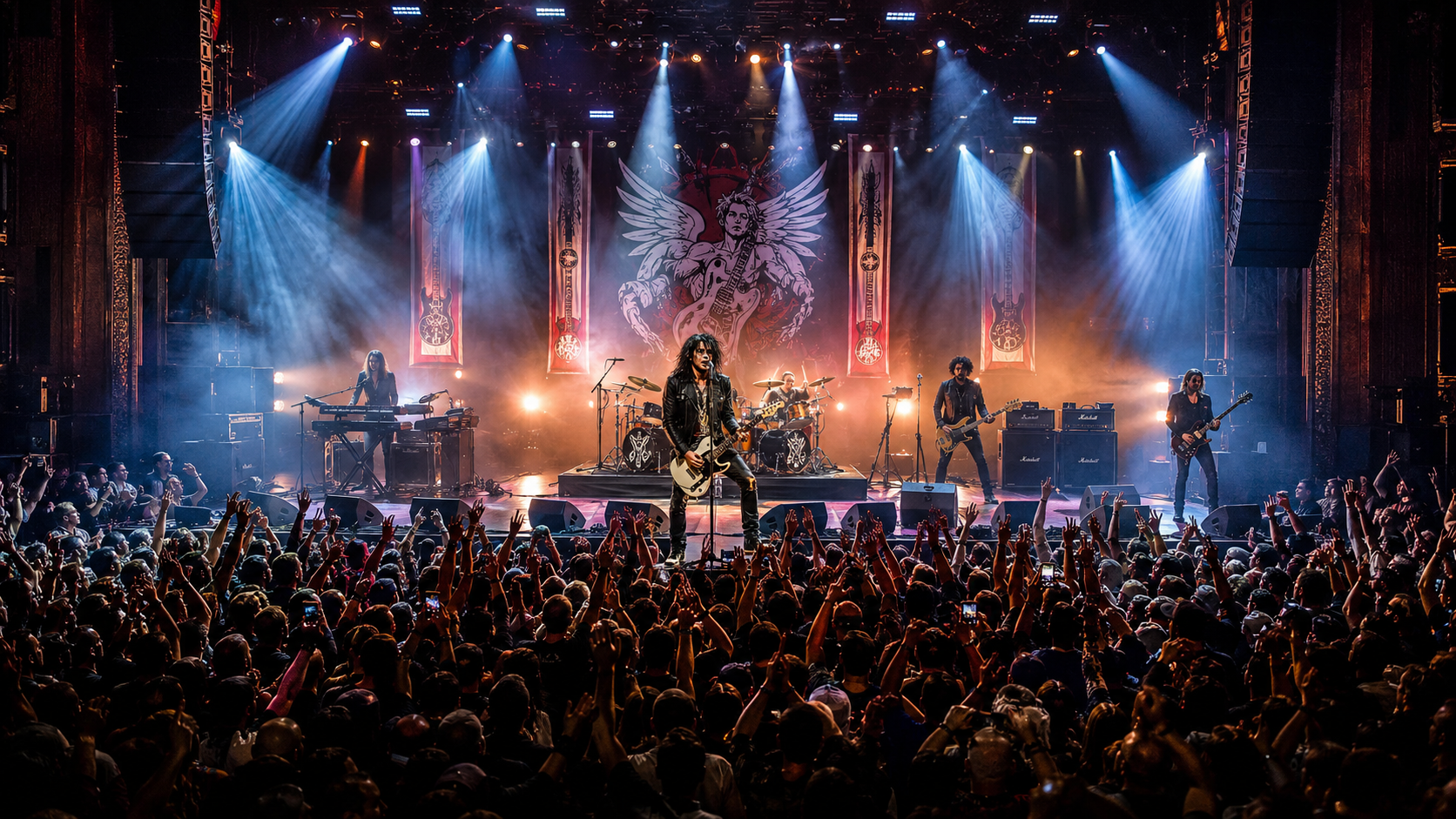
Every rock star guitarist you admire spent years inside someone else’s playing before they found their own voice. That is not a coincidence. Studying a legend’s technique, tone, and gear is one of the oldest and most effective forms of musical education on the planet. It is not imitation. It is apprenticeship, and the difference matters. When you sit with a player long enough to understand why they do what they do, something shifts. Their habits start rewiring your habits. Their instincts start sharpening yours. Eventually, you push through the other side with a stronger, more personal sound than you had before.
This article introduces five rock guitar legends worth that kind of serious study: Steve Vai, Eric Johnson, Andy Timmons, Yngwie Malmsteen, and Marty Friedman. Each one built a completely distinctive voice. Each one solved the core problems of guitar, including tone, technique, phrasing, and expression, in their own way. You will find out what makes each player worth studying, what habits you can absorb from them, and where to go deeper on each one. By the end, you will have a clear path forward.
What It Actually Means to Play Like a Rock Star Guitarist
The phrase “play like a rock star guitarist” gets thrown around loosely. Most people mean something vague, like playing with confidence or sounding impressive. However, the real meaning runs deeper than that. The players covered in this article did not just play well. They each built a completely recognizable identity on the instrument. You could hear two bars of any of them and know exactly who it was.
That level of identity does not come from gear alone, or even from raw technique. It comes from the accumulation of specific, deliberate choices made over years. For example, a particular pick angle, a preferred way of entering a phrase, a specific relationship with dynamics and space. These are learnable things. In fact, they are the things that studying a legend teaches you most efficiently. You are not working in the abstract. You are working from a real, documented example.
The goal of this cluster is to give you that kind of access. Each supporting article goes deep on one player’s technique, tone, and gear. This pillar piece gives you the conceptual frame. Together, they answer a practical question: what can you actually absorb from studying a rock legend. How do you make it your own?


This video is unavailable.
Dig deep with Steve Vai on TrueFire!Start →
Steve Vai and the Art of Theatrical Technique
Steve Vai is one of the most technically ambitious players in rock history. His approach covers an enormous amount of ground, from extreme whammy-bar use and legato runs to unconventional chord voicings and a theatrical command of the stage. However, what makes Vai worth studying is not just the difficulty of what he plays. It is the intentionality behind it. Every technique in his arsenal exists to serve a musical idea, even when that idea is deliberately over the top.
For any rock star guitarist trying to develop range and expressiveness, Vai’s approach to the whammy bar alone is worth a dedicated study session. Most players treat it as an accent. Vai treats it as a primary voice. His custom gear setup reinforces this, because the tools he uses are chosen specifically to enable ideas that would be impossible otherwise.
Vai also approaches practice with an almost philosophical rigor. His documented methods around slow practice, mental visualization, and ear training are as instructive as the techniques themselves. If you want to understand how a player at his level thinks about the instrument, his full technique and gear breakdown is the place to start.
Eric Johnson and the Pursuit of Pure Tone
Eric Johnson occupies a different corner of rock guitar. His obsession is tone. Specifically, the relationship between touch, pick attack, and the way those variables interact with his signal chain to produce a sound that is immediately, unmistakably his. Johnson is the kind of player who can hear the difference between battery brands in his effects pedals. That level of attention is instructive even if you never go that far yourself.
What separates Johnson from most players is that his tonal precision is not a studio artifact. It is a live, in-the-moment skill rooted in picking mechanics and right-hand control. His picking articulation is among the cleanest in rock guitar. As a result, his lines have a clarity and definition that most players only hear on heavily processed recordings.
For any rock star guitarist who wants to sound better without necessarily playing more notes, Johnson is the essential case study. The lesson is that dynamics and touch are techniques, not personality traits. They can be practiced. His approach to clean tone and picking detail breaks down exactly how he gets there.
This video is unavailable.
Dig deep with Eric Johnson on TrueFire!Start →
Andy Timmons and the Power of Melodic Phrasing
Andy Timmons is one of the most underrated players in this conversation. His technical ability is substantial, but it never leads the music. Instead, his melodic sensibility drives every decision. Timmons plays with the instinct of a songwriter, not a shredder. He prioritizes singing lines, expressive bends. A warm lead tone that feels vocal in a way that very few electric guitars achieve.
What makes Timmons particularly useful for study is his accessibility across skill levels. A less experienced player can connect with his phrasing immediately, because the musical logic is clear. Meanwhile, a more advanced player can dig into the subtlety of his note choice, his bend precision, and the way he builds and releases tension across a phrase. Both players will find something meaningful.
His gear setup reinforces his musical priorities. The warmth and sustain in his tone are not accidental. They are the product of specific, deliberate choices that support his phrasing approach. For any rock star guitarist who wants to develop a more vocal, expressive lead style, Timmons’s approach to melody and bending is a practical and rewarding place to invest your practice time.
Yngwie Malmsteen and the Neo-Classical Blueprint
Yngwie Malmsteen changed rock guitar. That is not hyperbole. Before Malmsteen, neo-classical technique was a fringe interest among rock players. After him, it became a full vocabulary with its own pedagogy, its own gear preferences, and a global community of players dedicated to mastering it. His influence on the rock star guitarist archetype is impossible to overstate.
His approach is built on scalar sweep picking, fast legato passages, and a deep integration of classical harmonic structure into a rock context. The scalloped fretboard he uses is a specific tool that allows a particular kind of vibrato and note-bending behavior. Understanding why that choice exists tells you a great deal about how deliberately he has constructed his technique from the ground up.
This video is unavailable.
Dig deep with Yngwie Malmsteen on TrueFire!Start →
Studying Malmsteen is challenging, but the challenge is the point. He forces you to address weaknesses in your picking economy, your synchronization between hands, and your harmonic knowledge. Even players with no interest in neo-classical music come away from that study with cleaner, more precise technique overall. His full breakdown of neo-classical approach and tone gives you a structured way into that world.
This video is unavailable.
Dig deep with Andy Timmons on TrueFire!Start →
Marty Friedman and the Courage to Sound Different
Marty Friedman is the most unconventional player in this group, and that is exactly why he belongs here. His picking angle is unusual enough that it becomes the first thing most players notice. However, his unconventional mechanics are not an accident or a quirk. They are the direct result of chasing specific sounds that conventional technique made harder to achieve.
His melodic choices draw from non-Western musical traditions, particularly from Japanese and East Asian music, in ways that were almost unheard of in rock guitar when he emerged. As a result, his phrasing has an angular, unpredictable quality that no other player of his era matched. He does not just play interesting notes. He sequences them in ways that feel genuinely surprising, even after repeated listening.
This video is unavailable.
Dig deep with Marty Friedman on TrueFire!Start →
Friedman is worth studying specifically because of how clearly his playing reflects a deliberate set of values. He decided what he wanted to sound like and then built the technique to get there, rather than learning technique first and finding a sound later. That sequence matters. For any rock star guitarist who wants to develop a genuinely personal voice, Friedman’s approach to phrasing and unconventional technique makes that process concrete and practical.
Why Each Legend Teaches You Something Different
These five players were not chosen arbitrarily. Together, they cover the full range of what rock guitar excellence can look like. Vai teaches theatrical range and technical intention. Johnson teaches that tone is a craft, not a circumstance. Timmons teaches melodic economy and expressive depth. Malmsteen teaches the structural power of classical harmonic thinking. Friedman teaches that originality is the product of deliberate, even contrarian choices.
No single player covers all of that ground. In fact, each one is, in some ways, a counterpoint to the others. Johnson’s restraint contrasts directly with Vai’s excess. Friedman’s angular melodic instincts contrast with Malmsteen’s classical symmetry. Studying more than one of them does not dilute the lessons. Instead, it triangulates them and gives you a broader map of what is possible.
The practical takeaway is straightforward. You do not have to copy any of these players. However, you do have to understand what choices they made and why. That understanding becomes a resource you carry into your own playing permanently.
The Right Way to Study a Rock Star Guitarist
Most players study legends incorrectly. They learn a famous lick or two, play it at speed, and move on. However, that approach captures the surface without touching the root. The players in this cluster reward a different approach: patient, structural, and curious.
Start by listening deeply before you touch your guitar. Ask what this player sounds like before you ask how they do it. Notice the overall character of their tone. See how they enter and exit phrases. Notice where they leave space and where they accelerate. These observations give you a framework before the technical details arrive.
Then, go slow. Specifically, go slower than you think you need to. The habits these players have built over decades are embedded in micro-details that disappear at speed. A slower tempo reveals the exact weight of a bend, the precise moment a note blooms or fades, the attack angle on a picked phrase. Those details are where the real learning lives. Finally, apply what you absorb across your own musical context, not just in the lick you learned. That transfer is where imitation becomes education.
Continue Learning
Each supporting article in this cluster goes deep on one player’s technique, tone, and gear. Work through them in whatever order suits your curiosity, or follow this path for a logical progression from theatrical range to raw originality.
- Everything you need to know about Vai’s technique and gear
- How Johnson builds his iconic clean tone through touch and picking mechanics
- Timmons’s approach to melodic phrasing and expressive bends
- A structured guide to Malmsteen’s neo-classical technique and setup
- Friedman’s unconventional picking angle and distinctive phrasing approach
Final Thought
The fastest way to develop your own voice on guitar is to spend serious time inside someone else’s. Every rock star guitarist who eventually sounded like no one else got there by first understanding exactly how someone specific did what they did. Pick the player from this list whose sound moves you most. Follow the link, go deep on the supporting profile, and start building habits that will shape your playing for years. TrueFire’s courses make that process concrete, guided, and immediately applicable. The next move is yours.
Cultivate your inner rock star on TrueFire!Start →
About the Education Team
Four music-industry veterans with decades of combined experience in music education, curation, and production at TrueFire and ArtistWorks. The TrueFire Studios Education Team plans and edits this content and works with our master-musician faculty to keep it accurate and genuinely useful.