


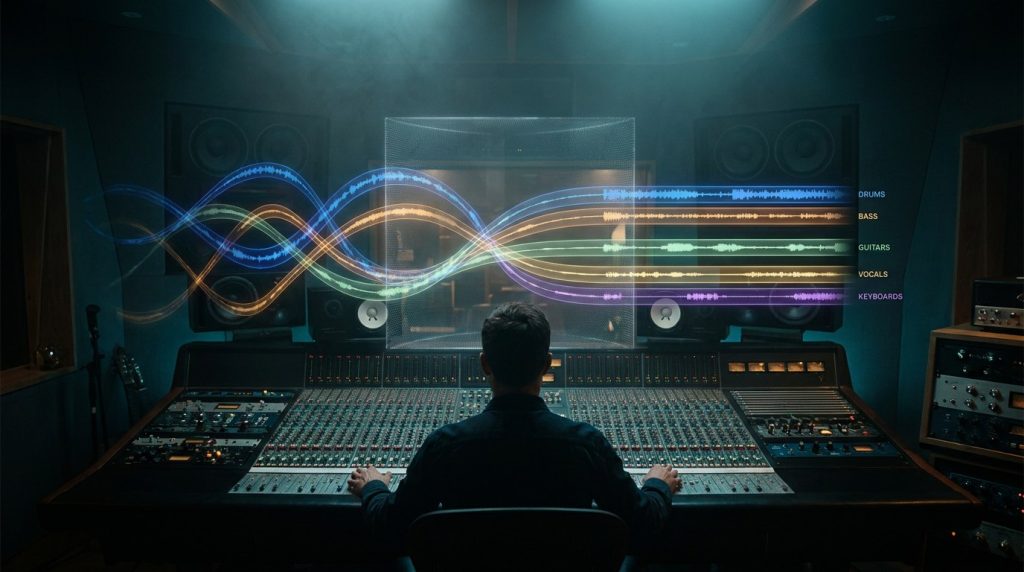
AI music production tools now help with tasks from separating a mix into parts to mixing and mastering. Musicians report benefits from these tools. They also raise questions about skills and income. This guide sorts the record into the good, the bad and the ugly. For the wider picture, see our overview of music and AI.
What AI Music Production Tools Do
AI music production tools mostly work on audio a musician already has. In other words, they help finish, fix or reshape recordings rather than write new songs.
Stem Separation
Stem separation splits a finished stereo mix into separate parts, such as vocals, drums, bass and other instruments. Without it, pulling one part out cleanly usually requires the original multitrack recordings.
Free versions have been available for years. For example, streaming service Deezer released its Spleeter tool on GitHub in 2019 “for anyone to use,” FACT Magazine reported. Spleeter came “with pretrained models for 2, 4 and 5 stems separation,” according to Deezer. Meta’s researchers also published a free tool called Demucs, according to its GitHub page. That project has since been archived, the same page shows.
Mixing and Mastering Assistants
Mastering is the last step before release. It sets a track’s overall loudness and tone so it sounds consistent on different speakers. AI mastering services do this automatically. For instance, LANDR says it spent a decade “mastering more than 25 million tracks,” according to DJ Mag in 2023.
Other tools work as assistants inside a producer’s software. For example, in a 2018 review, Sound On Sound explained that iZotope’s Master Assistant needs to hear “approximately 30 seconds of, ideally, the loudest part of your mix.”
Cleanup and Repair
Cleanup tools remove noise, hum or room sound from recordings. Producers in a 2026 Sonarworks survey grouped these jobs together. “Audio cleanup, noise reduction, stem separation, and session organization were commonly cited as areas where AI feels useful and non-threatening,” Sonarworks reported.
The Good: Tools That Rescue and Save Time
One documented use of AI music production is restoring old recordings.
The Last Beatles Song
One case is “Now and Then,” a Beatles song built from an old John Lennon cassette demo. Paul McCartney credited technology from director Peter Jackson’s team. “He was able to extricate John’s voice from a ropey little bit of cassette,” McCartney said, according to Al Jazeera.
McCartney also described how the process worked. “They tell the machine ‘That’s a voice, this is a guitar, lose the guitar’,” he said, according to the same Al Jazeera report. Later, he stressed what the tool did not do. McCartney wrote in a June 2023 social media post, as quoted by FOX 13: “To be clear, nothing has been artificially or synthetically created. It’s all real and we all play on it.”
Meanwhile, producer Giles Martin stressed that the voice itself was real. “AI is not creating John’s voice. John’s voice existed on that cassette, and we made the song around him,” Martin told MusicRadar.
The song won the Grammy for Best Rock Performance in February 2025. Loudwire called it “the first of its kind AI-assisted song to ever win a Grammy award.” Before the ceremony, Linda Bloss-Baum, a lecturer at American University, discussed the nomination. “There’s a lot of bad that can come to artists from AI, but this is an example of something really good,” she told AFP.
One Survey: Stem Separation Tops AI Music Production Uses
Separating a song into parts is the most common AI use in one musician survey. Research by Water & Music for Moises found that 71% of AI-using musicians used stem separation. By comparison, 24% used full song generation. However, about 80% of respondents came from Moises’ own users, and Moises sells stem separation, according to the report.
The same report also asked about income. According to Moises, 26% of respondents who make money from music said AI has increased their income. Fewer than 4% reported a decrease, and 56% reported no change.
A Mastering Engineer’s View
Mastering engineer Mike Thorne sees automatic mastering as a way in for more musicians. “I think it’s probably a good thing because it opens mastering up to more people,” Thorne told Production Expert in 2022.
The Bad: Sameness and Skills
The Same Tools, the Same Sound
Some producers worry that shared tools lead to a shared sound. “Respondents widely highlight concerns that AI could accelerate musical sameness—flooding the market with palatable but generic-sounding content,” Sonarworks reported from its survey with Sound On Sound.
Similarly, music-tech writer Adam Crute made this point in 2021. “Consequently, if the processor does its job properly, anybody using the same plug-in or processor will end up with very similar sounding parts and mixes,” Crute wrote in MusicTech. He also warned that leaning on such tools means “you will never learn to explore what sonic perfection actually is.”
Not every engineer agrees that automatic mastering counts as mastering. “It’s not really mastering, though, is it? Because it’s not doing that quality check,” mastering engineer Katie Tavini told Production Expert in 2022.
Skills and Jobs
Engineers have raised concerns about skills, too. In 2023, Johny Edouard, an engineer at Eastmain Studio in Rochester, New York, said AI means “somebody can just press a button and do something that I spent a lot of time like honing my skills,” according to Spectrum News 1.
Likewise, musicians in the Water & Music survey shared similar worries. According to Moises, 58% of AI users said they worry about authenticity, and 55% cited copyright and licensing concerns.
The Ugly: Creators’ Income at Risk
What the Studies Project
Several industry studies estimate how much income AI music production and generation could take from creators. All are projections, and all come from organizations that represent creators.
First, Goldmedia studied the issue for GEMA and Sacem. It estimated that 27% of authors’ and creators’ revenue is at risk in the medium term. That would mean a cumulative loss of 2.7 billion euros for Sacem and GEMA members by 2028. “An increasingly predatory competition is to be expected for creators, especially in areas where AI is particularly likely to replace existing human-made music,” the study’s authors wrote, according to Music Business Worldwide.
Next, Goldmedia ran a similar study for APRA AMCOS, which represents creators in Australia and New Zealand. It projected that “by 2028, 23% of music creators’ revenues will be at risk due to generative AI.” The study says that figure applies if no action is taken. The study surveyed more than 4,200 members. Of them, 82% were concerned that AI could stop them making a living from their work.
Later, a CISAC study estimated that music creators will see 24% of their revenues at risk of loss by 2028. It also projected that AI-generated music could account for about 60% of music libraries’ revenues by 2028, according to CISAC. Music libraries supply production music for film, TV and ads.
Warnings From Creators’ Groups
CISAC President Björn Ulvaeus, co-founder of ABBA, described both sides of the issue. “For creators of all kinds, from songwriters to film directors, screenwriters to film composers, AI has the power to unlock new and exciting opportunities – but we have to accept that, if badly regulated, generative AI also has the power to cause great damage to human creators, to their careers and livelihoods,” Ulvaeus said, according to CISAC.
The UK Musicians’ Union says the effect on work has already started. “It is already happening and gobbling up opportunities for our members to make a living,” Naomi Pohl, its general secretary, said in a September 2024 speech, according to CMU.
Practical Checks for AI Music Production Tools
Here are a few practical habits for anyone trying AI music production tools.
- Keep your originals. Save unprocessed stems and mixes, so you can undo any AI step later.
- Compare against a reference. Listen to an AI master next to a finished track you know well, at the same volume.
- Read the terms. Check whether an online service may use your uploaded audio to train its systems.
- Note what each tool did. The U.S. Copyright Office asks applicants to disclose AI-generated material. Our guide to AI music copyright covers those rules.
- Get a second opinion on big releases. For example, compare an automatic master with a human engineer’s version.
Where AI Music Production Stands
AI music production tools helped finish a Grammy-winning Beatles song, and stem separation led AI use in one musician survey. At the same time, producers, engineers and rights groups have raised concerns about sameness, skills and income. For how AI helps and misleads students, see our guide to learning guitar with AI.
Practice smart and play hard with TrueFire!Start →
Continue Learning
Explore the rest of this series:
- Music and AI: The Good, the Bad and the Ugly
- AI Music Generators: The Good, the Bad and the Ugly
- AI Voice Cloning in Music: The Good, the Bad and the Ugly
- Learning Guitar With AI: The Good, the Bad and the Ugly
- AI Music Copyright: The Good, the Bad and the Ugly
About the Education Team
Four music-industry veterans with decades of combined experience in music education, curation, and production at TrueFire and ArtistWorks. The TrueFire Studios Education Team plans and edits this content and works with our master-musician faculty to keep it accurate and genuinely useful.