

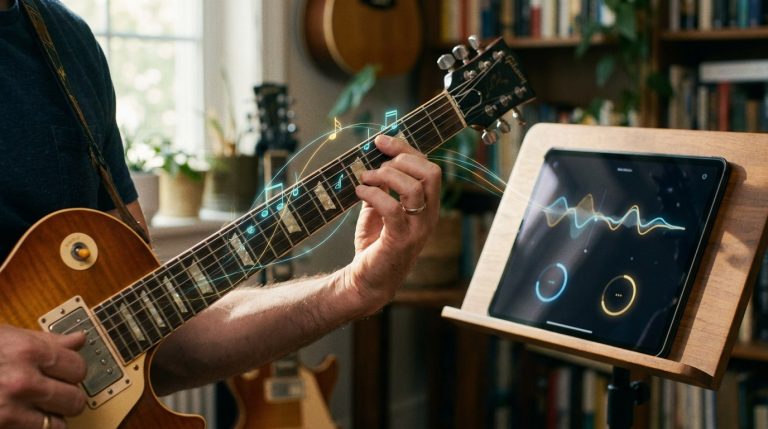
Learning guitar with AI now means more than asking a chatbot for chords. Apps can split a song into parts, slow it down and check whether you played a scale correctly. This guide sorts what teachers, reviewers and researchers report into the good, the bad and the ugly. For the wider picture, see our overview of music and AI.
How Tools for Learning Guitar With AI Work
Most tools for learning guitar with AI rely on a few core abilities. Knowing them helps you judge what an app can do.
Listening and Feedback
First, many apps listen through your phone or computer microphone. They compare what you play with what the lesson expects. Then they show which notes landed and which ones missed.
Splitting and Slowing Songs
Second, stem separation splits a recording into parts, such as vocals, drums, bass and guitar. As a result, you can mute the original guitar and play along with the band. Many apps can also slow a song down without changing its pitch.
Writing Out Chords and Tabs
Third, recognition tools estimate the chords or notes in a recording and write them out. Meanwhile, chatbots answer theory questions in plain text. However, both produce estimates, not checked transcriptions.
The Good: Practice Help on Demand
Learning Guitar With AI Apps
One draw of learning guitar with AI is practice help on demand. For example, Moises separates songs into parts for play-along practice. In June 2026, the company said its platform “serves more than 75 million users worldwide,” according to its newsroom. That’s up from 70 million in its 2025 year in review.
Ultimate Guitar, a major tab site, added an AI feature in 2024. Its owner, Muse Group, called Practice Mode “a new machine-learning toolset to transform how millions of guitarists learn to play their favorite songs at home.” The same release said the app “has been downloaded over 53 million times and is home to 1.8 million tabs.”
Muse Group’s CEO later described what the feature does. “One I’m really excited about is Ultimate Guitar’s AI-powered Practice Mode. It listens to a player’s performance and gives personalised feedback – showing which notes were played correctly, which were missed, and offering guidance on pitch and rhythm,” founder and CEO Eugeny Naidenov told the Cyprus Mail in 2025.
Fender is involved, too. In June 2026, Moises announced a partnership with Fender. “We believe AI should hand players more ways to create, not do the creating for them,” Max Gutnik, chief product officer of Fender Electronics, said in the announcement.
What Teachers Say
One guitar teacher sees promise. “AI will break down barriers and democratise music education, making it more inclusive and diverse,” Justin Sandercoe, founder of JustinGuitar, wrote in Guitar World in 2023.
Martin Keary, VP of Product at Muse Group, described the kind of homework AI can check. “If you think about it, what a lot of a guitar teacher gives you as homework, it’s scales, it’s playing chords, all those things the AI can help you get better at by telling you if you’re doing it right,” Keary told TechRadar in 2024.
AI is also showing up in teacher training. In a 2026 survey of 370 music student teachers in China, 107 said they “frequently use AI tools to facilitate their lesson preparation and study.” The study, in Frontiers in Psychology, asked about AI tools in general, not guitar apps.
The Bad: Wrong Notes and Missing Feedback
AI Transcriptions Still Miss
Reviewers have tested how accurate tools for learning guitar with AI are. Transcription tools still make mistakes. In July 2026, MusicRadar reviewer Ethan Hein tested Klang.io, an AI transcription tool. “As has been the case with other AI-powered transcription services that we’ve tested, Klang.io doesn’t come close to the accuracy and reliability of a skilled human transcriber,” Hein wrote in MusicRadar.
Chatbots can also get chords wrong. In a 2024 research paper, GPT-4o’s accuracy on chord questions fell to about 15% in the hardest tests. That was when it wasn’t told which chord types to expect. The paper, posted on arXiv, had not been peer-reviewed, and newer models may perform differently.
A separate 2024 study tested chatbots on musicology, the academic study of music. Its authors concluded: “However, LLMs are not yet at the required level for the field and do not meet the minimum quality, ethical and likely legal standards currently being discussed.” That paper is also on arXiv.
One Study: Teachers Couldn’t Spot AI Lesson Plans
In a 2024 study, 56 music teachers rated eight lesson plans, some written by people and some by AI. According to the International Journal of Music Education, “assessors were unable to accurately label if a lesson plan was created by a human or generated by AI (55% accurate overall).” However, they did rate the human-made plans higher as a group.
What Educators Say About the Teacher’s Role
Music education groups and researchers have addressed the teacher’s role. The National Association for Music Education (NAfME) has published principles on AI. “AI should be used as a tool to enhance, not replace, educators’ ability to inspire a love of music in students,” NAfME’s AI principles state.
Music education lecturer Jacob Holster of Penn State made a similar point. Writing in Music Educators Journal in 2024, he said chatbot text “often seems intelligent but can be inaccurate or incomplete.” He added: “Despite the appearance of intelligence, these tools cannot replace the understanding and expertise of a human music teacher.”
Keary also pointed to physical technique. “But so much of playing guitar is physical, it’s fixing your hand position, it’s fixing your posture as you play. You’ll always need a teacher for that,” Keary told TechRadar.
The Ugly: AI Fakes Aimed at Guitarists and Fans
Scams Using Guitarists’ Faces
AI fakes have started to target guitarists and their fans. In June 2025, Joe Bonamassa warned fans about fake AI-generated ads. “AI generated, designed to mislead and scam people. Please be aware,” Bonamassa wrote, as reported by Guitar Player.
Guitarist and content creator Tanya Yakimova says fake AI videos of her were used to target her fans. “Some people were using these fake videos to build trust with my fans and then attempt to scam them out of money,” Yakimova told Guitar World in June 2026.
The same Guitar World report heard from other players. “It’s literally our livelihood being stolen, and platforms need to start treating it that way,” guitarist Sophie Lloyd told Guitar World. In addition, 19-year-old Brazilian guitarist Mari Zaghete pointed to money as the driver. “If AI-modified content were prevented from being monetized, there would be a major decline in this type of material,” Zaghete said.
Copycat Channels
Gear reviewer Rhett Shull found an AI-generated guitar channel that appeared to be built using his content, according to Guitar.com. The channel appeared to borrow his old studio setup, thumbnails and video style. It drew more than 600,000 views and over 5,000 subscribers.
How to Check AI-Made Guitar Lessons
Here are simple checks that apply to almost any tool for learning guitar with AI.
- Play along with the original recording. If a tab or chord chart doesn’t match what you hear, check it before you practice it.
- Compare with a second source. For example, check an AI-made tab against an official songbook or a trusted transcription.
- Treat chatbot answers as a starting point. Then confirm theory answers in a book, a course or with a teacher.
- Get feedback on your hands. Apps can hear wrong notes. However, Keary says hand position and posture still need a teacher.
- Check who made a video or ad. Before buying a course or following a channel, look for the artist’s official website or verified accounts.
Where Learning Guitar With AI Stands
Tools for learning guitar with AI now split songs and listen to you play, their makers say. However, reviewers and researchers still find errors, and Keary and NAfME both point to the teacher’s role. Meanwhile, players and fans have raised concerns about AI fakes of real guitarists. For who owns AI music and who gets paid, see our guide to AI music copyright.
Practice smart and play hard with TrueFire!Start →
Continue Learning
Explore the rest of this series:
- Music and AI: The Good, the Bad and the Ugly
- AI Music Generators: The Good, the Bad and the Ugly
- AI Voice Cloning in Music: The Good, the Bad and the Ugly
- AI Music Production Tools: The Good, the Bad and the Ugly
- AI Music Copyright: The Good, the Bad and the Ugly
About the Education Team
Four music-industry veterans with decades of combined experience in music education, curation, and production at TrueFire and ArtistWorks. The TrueFire Studios Education Team plans and edits this content and works with our master-musician faculty to keep it accurate and genuinely useful.