



The Autumn Leaves chords are often the first jazz changes a guitarist learns, and for good reason. The whole tune is built from two simple moves, repeated in a logical order. With three-note shell chords, you can play every bar without a single barre. This guide walks you through the form, the shapes and a practice plan.
A Short History of Autumn Leaves
Autumn Leaves began as a French song, “Les Feuilles mortes,” composed by Joseph Kosma in 1945 with lyrics by the poet Jacques Prévert. It appeared in the 1946 film Les Portes de la nuit. Later, Johnny Mercer wrote the English lyrics.
In the 1950s, jazz musicians adopted it. Cannonball Adderley’s 1958 recording on Somethin’ Else, featuring Miles Davis, is a classic, and Bill Evans recorded a famous version in 1959. Today it’s one of the most recorded jazz standards of all, with more than a thousand recordings.
Why Autumn Leaves Is a Great First Standard
There are good reasons teachers so often start here. For one thing, the tune is built from just two chord moves, so there’s very little to memorize. In addition, it covers both a major and a minor ii-V-I, the two most important patterns in jazz.
It’s also a jam session favorite. So once you know the Autumn Leaves chords, you’ll be able to join in almost anywhere.
How the Autumn Leaves Chords Are Built
Autumn Leaves is 32 bars long. First comes an 8-bar A section, played twice. Then come two more 8-bar sections that reuse the same chords in a new order.
The tune moves between two keys that share the same notes: B-flat major and G minor. And it gets there with just two chord moves.
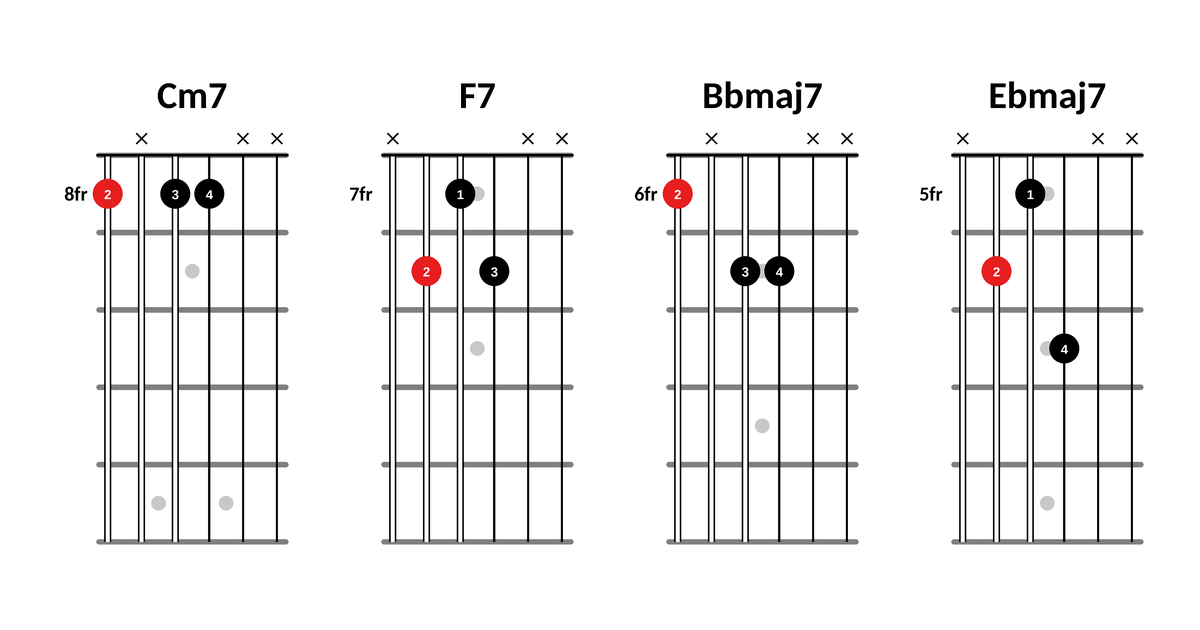
The Two ii-V-Is in the Autumn Leaves Chords
The first move is a major ii-V-I to B-flat: Cm7, F7, Bbmaj7. The second is a minor ii-V-i to G minor: Am7b5, D7, Gm6.
Ebmaj7 sits between them as a bridge from one key to the other. Once you see those two moves, the whole tune makes sense. For more on both patterns, see our guide to jazz chord progressions.
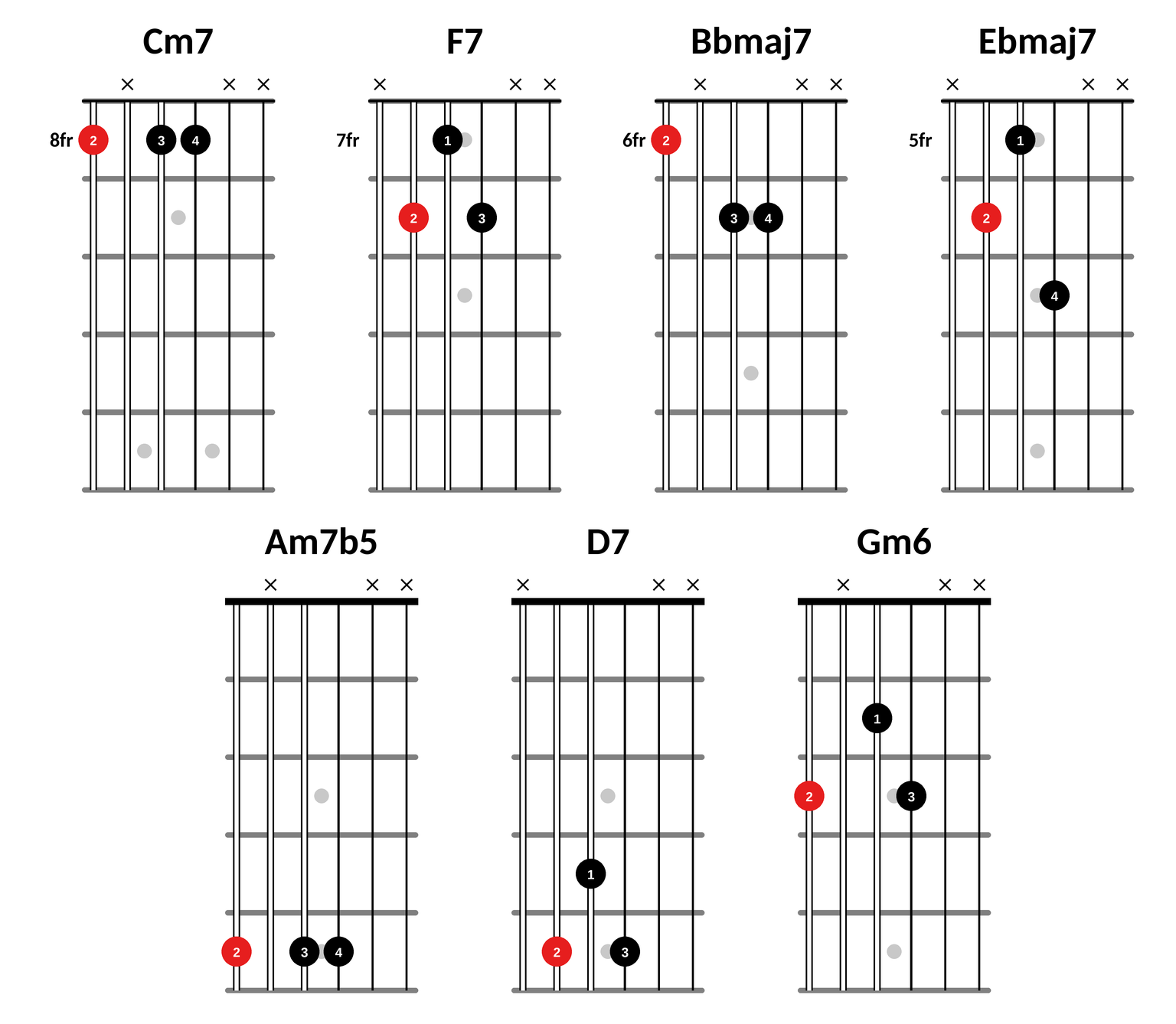
The Autumn Leaves Chords as Shell Voicings
Each shape is written from the low E string (left) to the high E string (right). A number is the fret, and “x” means don’t play that string. Here are the chords of the A section.
- Cm7: 8 x 8 8 x x.
- F7: x 8 7 8 x x.
- Bbmaj7: 6 x 7 7 x x.
- Ebmaj7: x 6 5 7 x x.
- Am7b5: 5 x 5 5 x x. This is the minor 7 shell, because the shell leaves out the 5th, the only note that changes.
- D7: x 5 4 5 x x.
- Gm6: 3 x 2 3 x x.
Why the A Section Walks Down the Neck
Look at the frets in that list. Every chord or two, the shape drops a fret or two, from the 8th fret down to the 2nd. Meanwhile, the root jumps between the 6th and 5th strings, so your hand barely moves.
That’s the real power of shell chords. Instead of jumping around the neck, you glide from one chord to the next.
The Full Autumn Leaves Chord Chart
Here’s the whole tune in G minor, one chord per bar unless two are shown.
- Bars 1-16 (the 8-bar A section, played twice): Cm7, F7, Bbmaj7, Ebmaj7, Am7b5, D7, Gm6, Gm6.
- Bars 17-24: Am7b5, D7, Gm6, Gm6, Cm7, F7, Bbmaj7, Ebmaj7.
- Bars 25-32: Am7b5, D7, Gm7 and Gb7, Fm7 and E7, Ebmaj7, Am7b5 and D7, Gm6, Gm6.
Charts vary a little in the last eight bars. For instance, some show Gm7 and C7, then Fm7 and Bb7, in bars 27 and 28. Others, including iReal Pro, skip the Ebmaj7 and go from E7 straight to Am7b5, D7, Gm6. In either case, go with the chart you’re reading, since the shells work the same way.
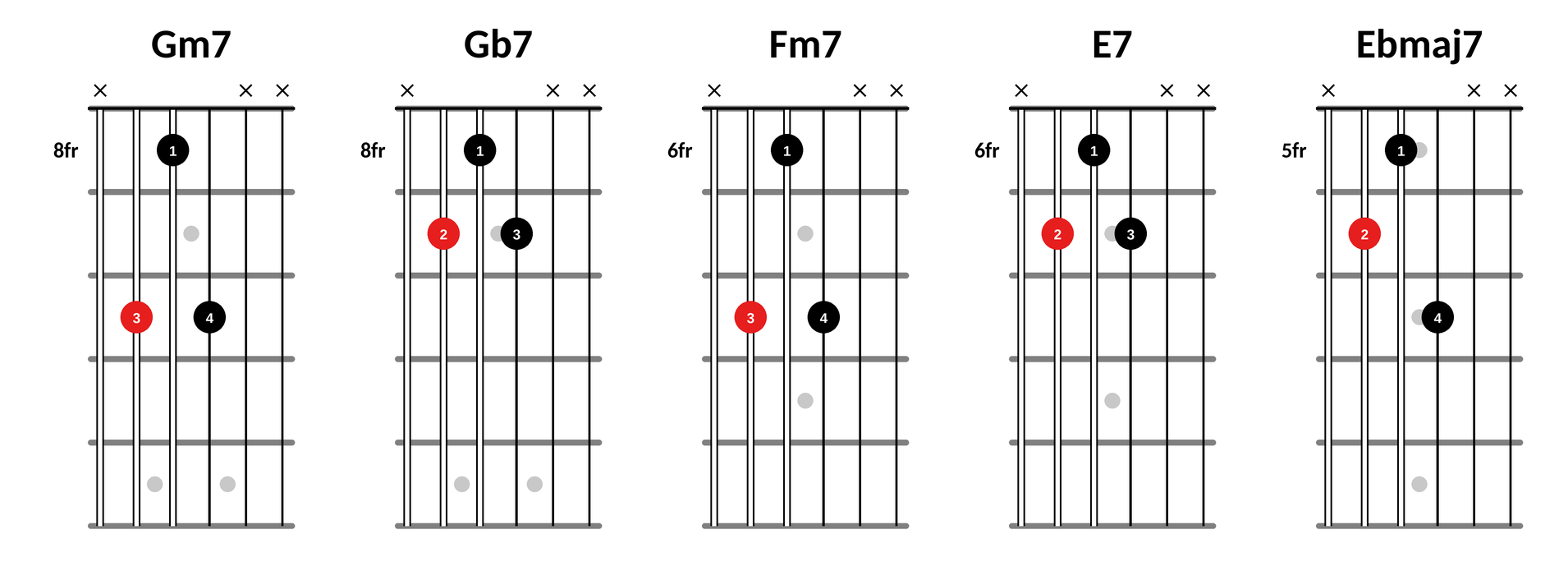
The New Chords in the Last Section
Bars 27 and 28 bring four new chords: Gm7, Gb7, Fm7 and E7. Each one is a half step below the last, so play them all with the root on the 5th string.
- Gm7: x 10 8 10 x x.
- Gb7: x 9 8 9 x x.
- Fm7: x 8 6 8 x x.
- E7: x 7 6 7 x x.
Then slide down one more fret to Ebmaj7 (x 6 5 7 x x). In other words, the whole run is one long slide down the A string.
Comping the Autumn Leaves Chords With a Band
When you play with a band or a recording, the feel matters as much as the shapes. Strum four light, short strokes per bar, one on each beat. The bass player covers the low notes, so keep your shells soft and let them stop short.
As you get comfortable, try playing the next chord half a beat early, just before the bar line. Musicians call this an anticipation, or a push. It gives the Autumn Leaves chords a little forward push without changing a single shape.
How to Practice the Autumn Leaves Chords
- Learn the two moves first. Play Cm7, F7, Bbmaj7 until it’s smooth. Then play Am7b5, D7, Gm6.
- Play the A section slowly. Give each chord four even strums, and notice how it walks down the neck.
- Add the last section. Practice the slide from Gm7 to Ebmaj7 on its own before you add it to the tune.
- Play along with a recording. Start with the Cannonball Adderley version, then try others.
- Comp like a swing guitarist. Use four light, short strums per bar.
Keep Going With Autumn Leaves
Once these Autumn Leaves chords feel natural, our lesson on comping Autumn Leaves and Body and Soul shows how to add rhythm and color.
For all ten shapes, see our guide to shell voicings. Then pick your next tune from our list of 253 jazz standards.
Learn and Play 25 Jazz Standards on TrueFire!Start →
Continue Learning
Explore the rest of this series:
- Jazz Standards on Guitar: 253 Tunes You Can Play With 10 Shell Chords
- Shell Voicings for Jazz Guitar: The 10 Shapes Behind Hundreds of Standards
- Jazz Chord Progressions: The 6 Patterns Behind Most Standards
- The G6 Chord: Three Easy Ways to Play the Sweet Sound of Swing
- All of Me Chords for Jazz Guitar: Play the 1931 Standard With Shell Voicings
About the Education Team
Four music-industry veterans with decades of combined experience in music education, curation, and production at TrueFire and ArtistWorks. The TrueFire Studios Education Team plans and edits this content and works with our master-musician faculty to keep it accurate and genuinely useful.