

The G6 chord is a G major chord with one extra note, and that note gives it a sweet, old-time sound. You’ll hear it all over swing-era jazz, and it’s surprisingly easy to play. In fact, the open version needs only two fingers. This guide shows three ways to play it and how to use it in real jazz standards.
What Is a G6 Chord?
A plain G major chord is built from G, B and D. A G6 chord keeps all three and adds E, the sixth note of the G major scale. So G6 is G, B, D and E.
The added E sits on top of the chord without fighting it. As a result, the G6 chord sounds bright, settled and a little nostalgic, rather than tense.
G6 vs. Gmaj7 vs. G7
These three chords differ by just one note. G6 adds E, Gmaj7 adds F#, and G7 adds F. That one note changes the mood completely.
G6 sounds sweet and old-fashioned. Gmaj7 sounds dreamy and more modern. G7, by contrast, sounds bluesy and restless, because it wants to move to the next chord.
Why G6 and Em7 Are Twins
Here’s a surprising fact: G6 and Em7 contain exactly the same four notes, G, B, D and E. What makes them sound different is the lowest note. With G in the bass, you hear G6. With E in the bass, you hear Em7.
How to Play the G6 Chord: Three Ways
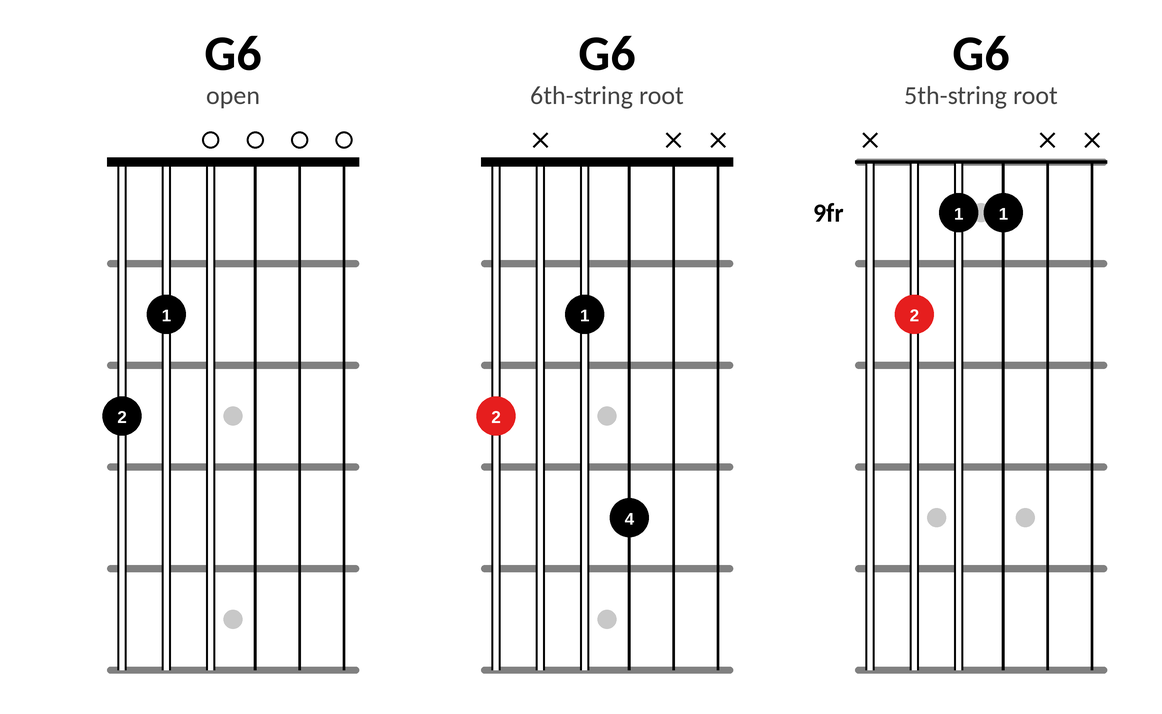
The strings below are listed from the thickest (low E) to the thinnest (high E). In the shape codes, a number is the fret, and “x” means don’t play that string.
1. The Open G6 Chord
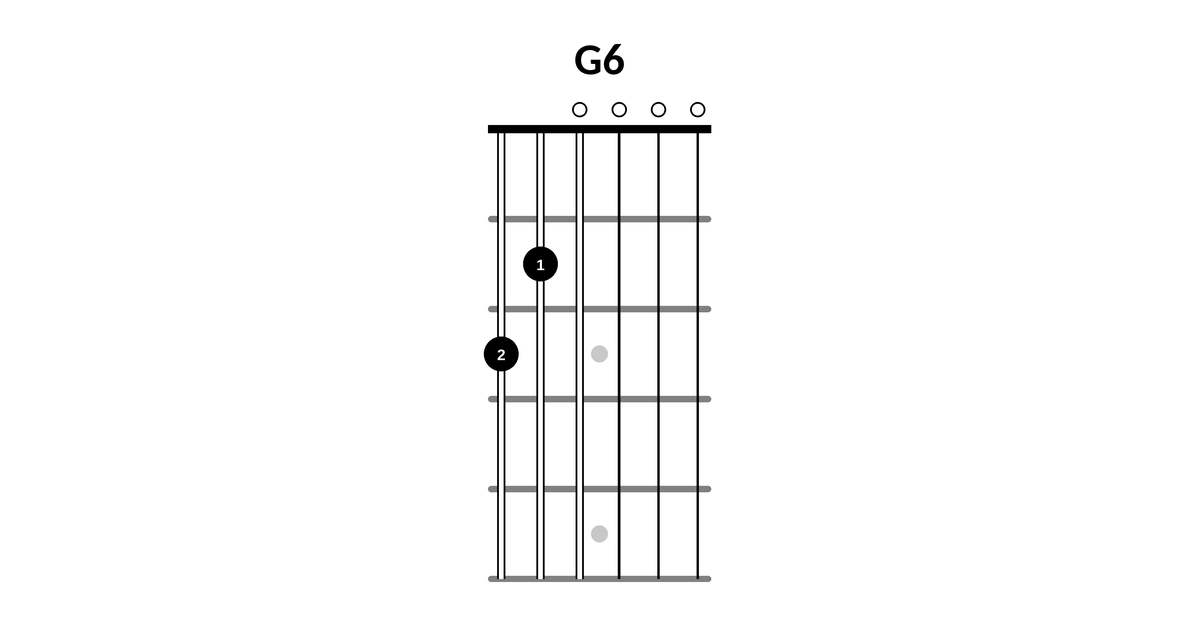
The open shape code is 3 2 0 0 0 0. It’s an open G chord without the high E string fretted.
- Low E string: 3rd fret, middle finger.
- A string: 2nd fret, index finger.
- D, G, B and high E strings: open.
Strum all six strings. The open high E string is the 6th, so let it ring.
If you play your open G chord with your ring finger on the high E string, switching to G6 is easy. Simply lift that finger and let the string ring open. G6 also makes a satisfying last chord. For instance, The Beatles’ She Loves You famously ends on a G6 sound, with Paul, George and John singing G, E and D.
2. The G6 Shell, Root on the 6th String
The shape code is 3 x 2 4 x x. Put your middle finger on the 3rd fret of the low E string, your index on the 2nd fret of the D string, and your pinky on the 4th fret of the G string. Mute the other strings with the undersides of your fingers.
This three-note shell is how jazz guitarists usually play the G6 chord with a band.
3. The G6 Shell, Root on the 5th String
The shape code is x 10 9 9 x x. Put your middle finger on the 10th fret of the A string, then lay your index finger flat across the 9th fret of the D and G strings.
It’s the same chord higher up the neck. So use whichever shape is closer to the chords around it.
Why Swing Tunes Love the G6 Chord
In the swing era of the 1930s and 1940s, players often voiced major chords as 6 chords. Major 7 chords became more common later, in more modern jazz. That’s why older tunes so often sound “right” with a 6.
For example, Moonglow and Django Reinhardt’s Nuages are both played in G, and both are full of G6. Minor 6 chords have their own history, too. They’re a trademark of Django Reinhardt’s Minor Swing onward.
Ending a Tune on a 6 Chord
Many swing tunes end on a 6 chord, because it sounds finished without sounding plain. So next time a tune in G ends on a plain G, try G6 for the last chord.
One Note From Gmaj7 to G6
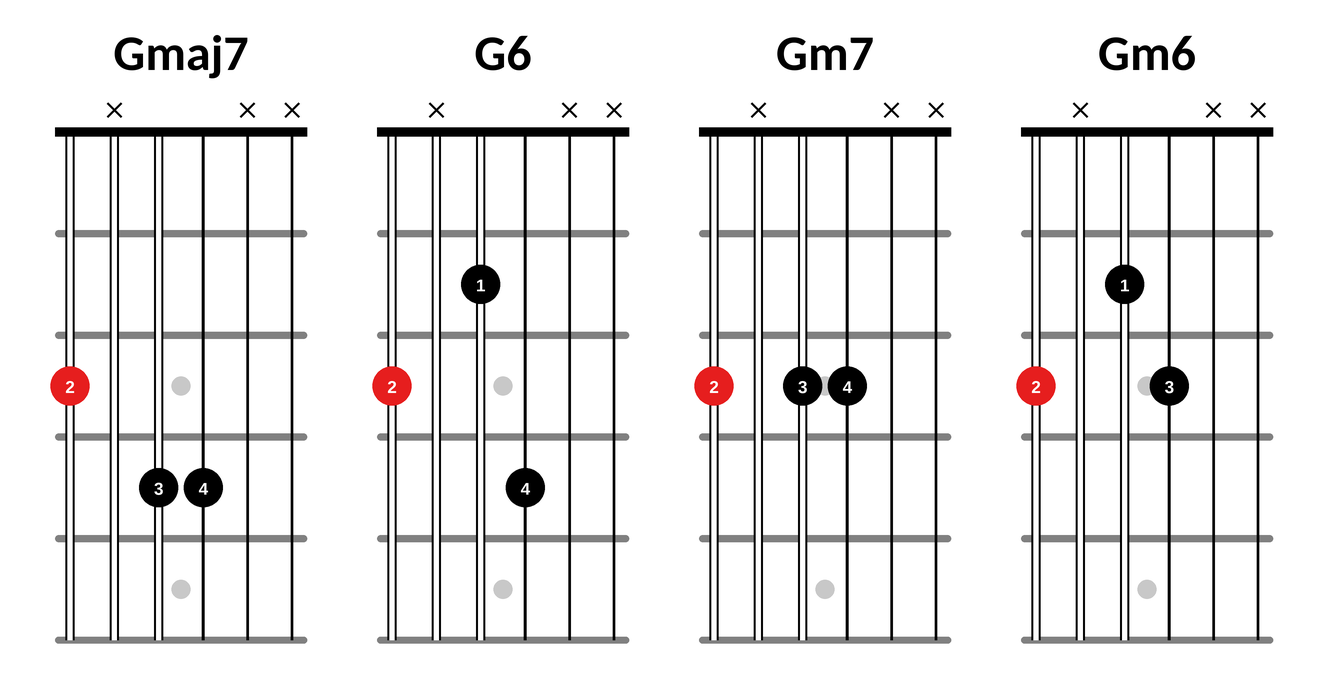
On the 6th string, the major 7 and major 6 shells are just one note apart. Play Gmaj7 (3 x 4 4 x x), then move the D-string note down two frets to get G6 (3 x 2 4 x x).
The minor chords work the same way. Play Gm7 (3 x 3 3 x x), then move the D-string note down one fret to get Gm6 (3 x 2 3 x x). Switch back and forth, and listen to how the 6 chords sound warmer.
Practice the G6 Chord in a Progression
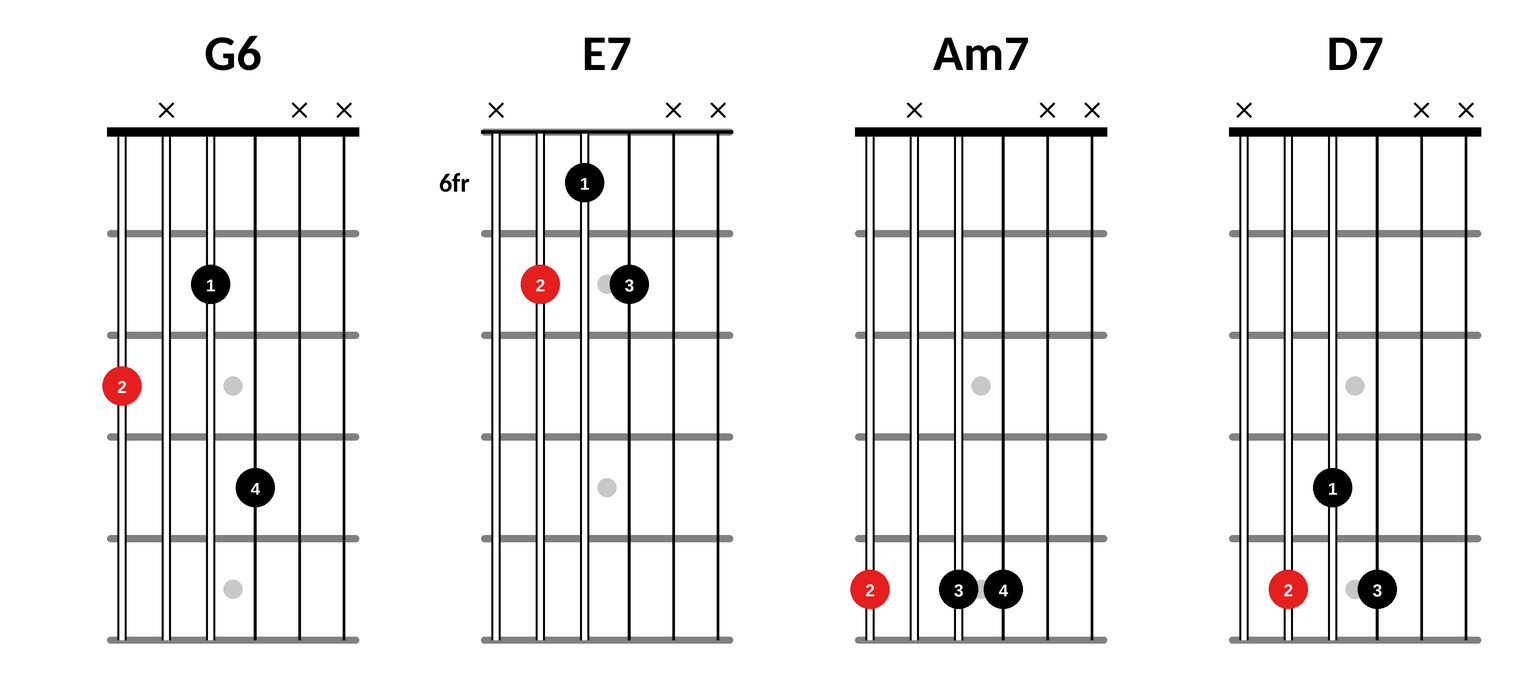
The classic way to hear G6 in action is a turnaround in G. Play each chord for two beats, then repeat.
- G6 (3 x 2 4 x x).
- E7 (x 7 6 7 x x).
- Am7 (5 x 5 5 x x).
- D7 (x 5 4 5 x x).
This is the I-VI-ii-V, one of the most common jazz chord progressions. Our guide to jazz chord progressions shows five more.
Common G6 Chord Mistakes
- Muting the high E string on the open shape. That string is the 6th, so it must ring. Arch your fingers so they don’t touch it.
- Letting extra strings ring on the shells. Lay your fingers slightly flat to mute the strings marked “x.”
- Using Gmaj7 when the melody holds a G. The F# in the chord rubs against the G in the melody, so play G6 there instead.
- Forgetting the minor version. Gm6 is just as useful, especially in minor swing tunes.
Keep Going With 6 Chords
For all ten shell shapes, including the major 6 and minor 6, see our guide to shell voicings. Then hear lots of 6 chords in a real tune with the All of Me chords.
To understand how chords like G6 are built, read our guide to chord construction, from triads to 7ths. And browse our list of 253 jazz standards for more tunes to try them in.
Learn and Play 25 Jazz Standards on TrueFire!Start →
Continue Learning
Explore the rest of this series:
- Jazz Standards on Guitar: 253 Tunes You Can Play With 10 Shell Chords
- Shell Voicings for Jazz Guitar: The 10 Shapes Behind Hundreds of Standards
- Jazz Chord Progressions: The 6 Patterns Behind Most Standards
- Autumn Leaves Chords: Play the Classic Jazz Standard With Shell Voicings
- All of Me Chords for Jazz Guitar: Play the 1931 Standard With Shell Voicings
About the Education Team
Four music-industry veterans with decades of combined experience in music education, curation, and production at TrueFire and ArtistWorks. The TrueFire Studios Education Team plans and edits this content and works with our master-musician faculty to keep it accurate and genuinely useful.