

Circle of fifths chord relationships appear throughout the music guitarists play. The diagram can help you recognize neighboring keys and familiar patterns such as dominant-to-tonic motion. Those relationships are useful starting points, while chord quality, voice leading, rhythm, and melody determine how the progression actually sounds.
This article breaks down why that neighboring relationship works and how tension and resolution factor in. How you can start using the circle deliberately to build progressions that sound finished rather than accidental. For the foundation of how the circle itself is arranged, check out the full guide to the circle of fifths for guitar before diving in here.
Why Random Chord Choices Feel Aimless
Most guitarists start by learning shapes. Then they start stringing shapes together. Sometimes it works. Often it doesn’t, and the reason is hard to name.
The problem is that chord choice without a framework is essentially guessing. You might land on something that sounds good by accident, but you can’t repeat the logic. You don’t know why it worked, so you can’t build on it.
Circle of fifths chord progressions solve this directly. Instead of picking chords at random, you choose from positions that are harmonically related by design. The circle isn’t a magic trick. It’s a map of how closely related chords actually are.
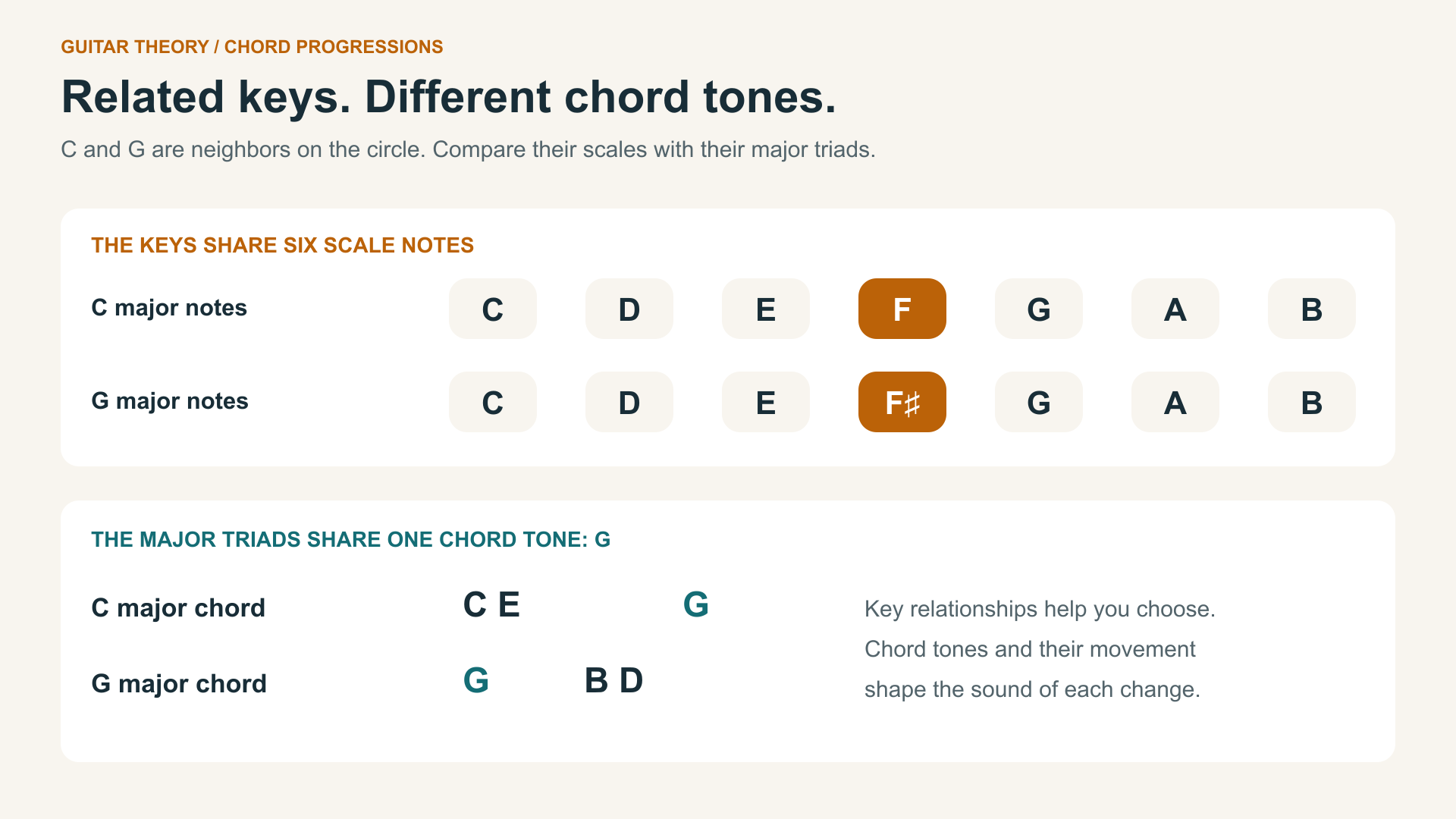
Neighboring major keys share six scale notes, but their tonic major triads share only one chord tone. C major and G major, for example, share six scale notes, while the C and G chords share only G. How smooth a chord change sounds depends on its voicing, the movement of individual notes, and its musical context. Circle distance alone does not tell you how many notes any two chords share.

The Neighbor Principle: What “Adjacent” Actually Means
On the standard circle used in this series, a clockwise step moves to a root a perfect fifth higher, such as C to G. A counterclockwise step moves to a root a perfect fifth lower, or a perfect fourth higher, such as G to C. That counterclockwise relationship underlies familiar dominant-to-tonic resolutions.
Shared tones can help connect chords, but so can small movements between different notes. In G7-C, for example, B can rise to C and F can fall to E. Those half-step movements help explain the sense of arrival.
The circle is a useful guide to circle of fifths chord progressions. The chord quality and its role in the key still matter: a major, minor, or dominant seventh chord on the same root can create a different effect. Use the diagram to suggest a path, then listen to the actual chords.
How Tension and Resolution Work on the Circle
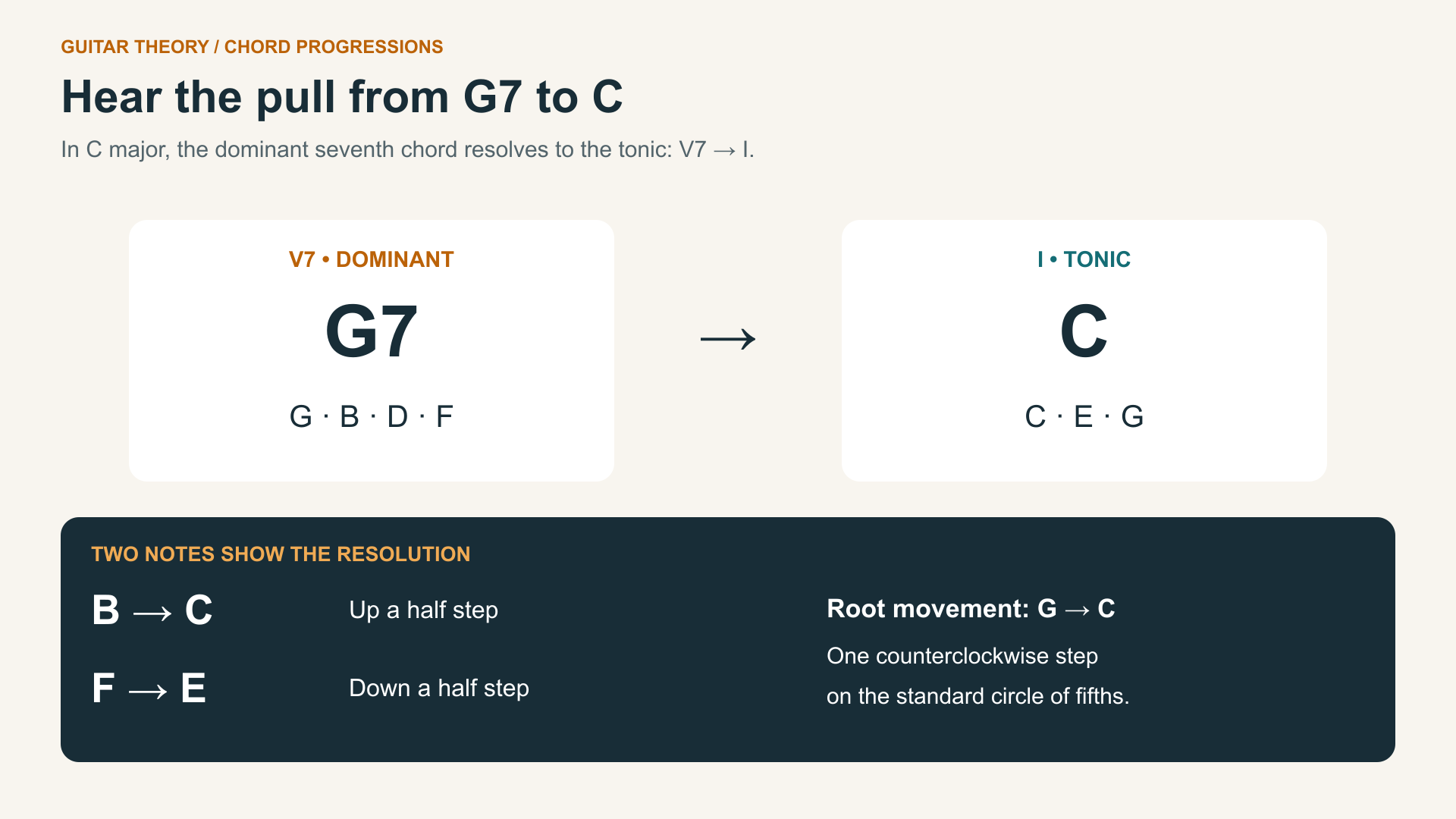
Harmonic tension is the sense that a chord wants to move; resolution is the arrival that answers that expectation. A common example in C major is G7 resolving to C, or V7-I.
G7 contains G, B, D, and F. B can rise a half step to C, while F can fall a half step to E. Together with the dominant-to-tonic root relationship, these movements help create a strong resolution.
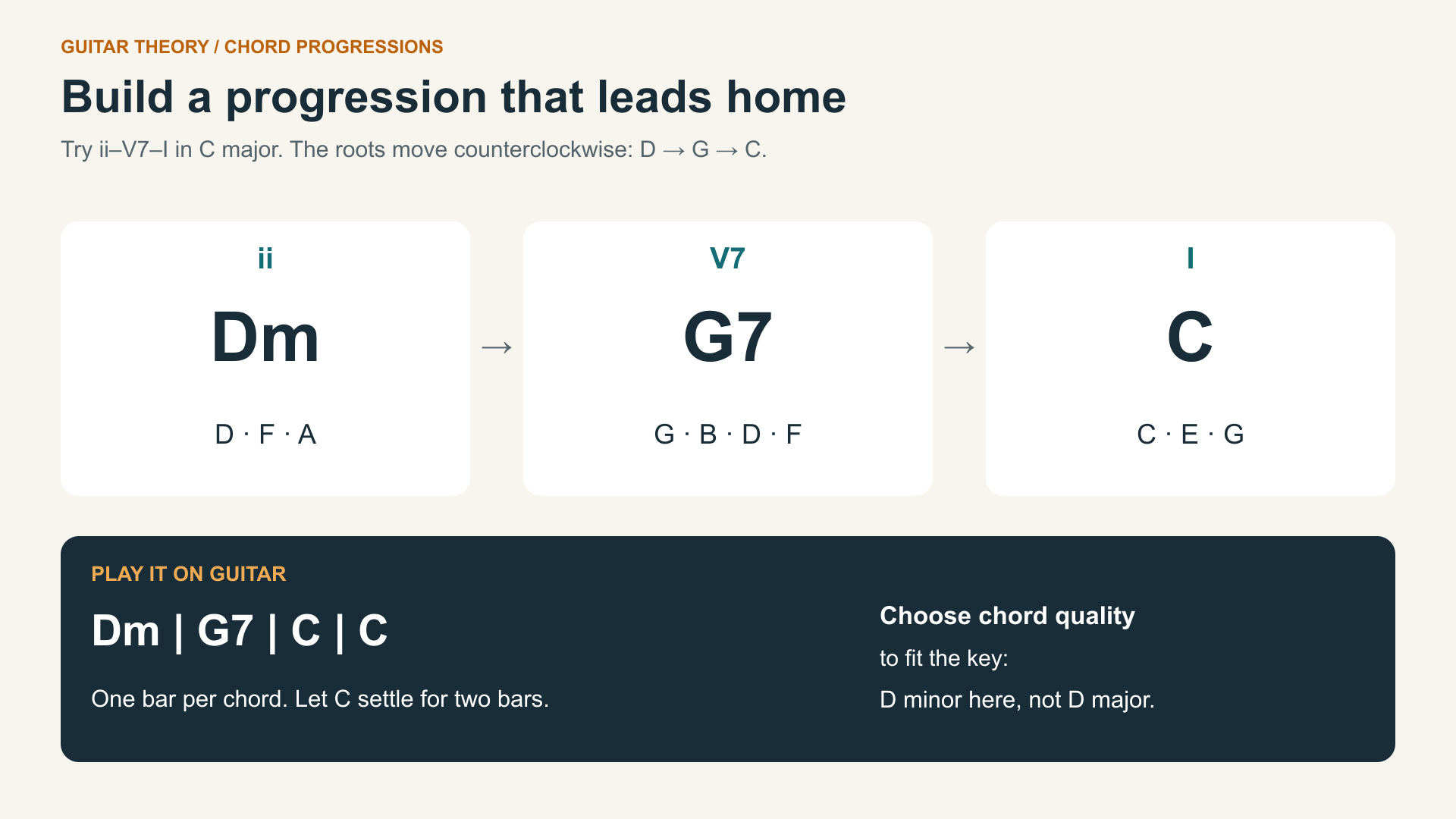
On this circle, G to C is one counterclockwise step, not clockwise. A longer example is Dm-G7-C: its roots follow D-G-C counterclockwise, while the chord qualities create ii-V7-I in C major.
You can delay the final C to create suspense or land on it for a clearer ending. Direction alone does not guarantee resolution; the melody, voicing, rhythm, and established key all contribute.
Building Circle of Fifths Chord Progressions: The Practical Method
Start by choosing a home key and a destination chord. In C major, try the root sequence D-G-C. Use Dm, G7, and C to create ii-V7-I. Play one bar of Dm, one bar of G7, and two bars of C.
These roots occupy consecutive counterclockwise positions, but the chord qualities come from their roles in C major. Using D major instead would introduce F♯ and change the harmony. That can be a deliberate choice, but it is not the same diatonic progression.
Now reverse the order and compare the sound. Notice how the melody, bass movement, and placement of the tonic influence the result. Neither direction has a fixed emotional meaning in every musical context.
For contrast, try changing a voicing, extending a chord, delaying the tonic, or introducing a deliberately chosen borrowed chord. Judge the result by its sound and role in the progression, rather than assuming that a distant circle position must create more tension.
When Staying Close Becomes a Trap
A familiar progression can become predictable if its rhythm, voicing, melody, and harmonic pacing never change. That is not a limitation of adjacent roots alone. The same chord sequence can support many different musical results.
Try varying the rhythm, holding a common tone, changing the bass note, or delaying the final resolution before adding a new chord. If you choose a more distant root, listen to how its notes connect with the surrounding harmony; distance on the circle is not a direct measure of dissonance or surprise.
The aim is to make intentional choices you can hear and repeat. To explore how the same progression works at a different pitch level, see the guide to knowing how to transpose a song using the circle.
The goal isn’t to stay safe. The goal is to make intentional choices. The circle gives you the vocabulary to describe what you’re doing and to repeat it when it works.
From Theory Map to Musical Instinct to Circle of Fifths Chord Progressions
After practicing a few progressions, you can start recognizing dominant-to-tonic motion by ear. Listen for G7-C, then try D7-G or A7-D. Their roots move one counterclockwise step on this circle. Also notice which notes stay in place and which move by a small interval between your chosen voicings.
That’s the shift you’re after: from reading the map to navigating by feel.
If you want to understand how the circle connects to key signatures and why certain chords belong in certain keys, the key signatures guide in this cluster covers exactly that. For understanding how closely related minor keys fit into the same framework, the piece on relative minor keys is the natural next step. And if you’re still getting oriented with how the circle itself is laid out, the plain-English guide to reading the circle will fill in any gaps.
Building progressions from the circle isn’t about following rules. It’s about understanding why certain chords feel like they belong together. Then using that understanding to make deliberate creative choices. The pillar guide to the circle of fifths for guitar pulls all of these ideas together in one place when you’re ready to see the full picture.
Practice smart and play hard at TrueFire!Start →
About the Education Team
Four music-industry veterans with decades of combined experience in music education, curation, and production at TrueFire and ArtistWorks. The TrueFire Studios Education Team plans and edits this content and works with our master-musician faculty to keep it accurate and genuinely useful.