

Most guitarists stall on theory for one simple reason: nobody ever hands them a map. You pick up fragments, a scale here, a chord name there, but nothing connects. The circle of fifths is that connection. It is a single diagram that organizes major and minor key relationships and helps you understand key signatures, chord families, and transposition. Once you understand what you are looking at, it stops being a decoration on a music teacher’s wall. It becomes a tool you actually reach for.
This article gives you the full picture. First, we will look at what the circle of fifths actually is and why it is arranged the way it is. Then we will walk through the five skills in this series: reading the diagram, identifying key signatures, understanding relative minors, building chord progressions, and transposing with confidence. Each skill has a dedicated deep-dive article linked from this one. The goal here is orientation, not overwhelm. By the time you finish reading, you will know exactly what the circle does, why it matters for
What the Circle of Fifths Actually Is
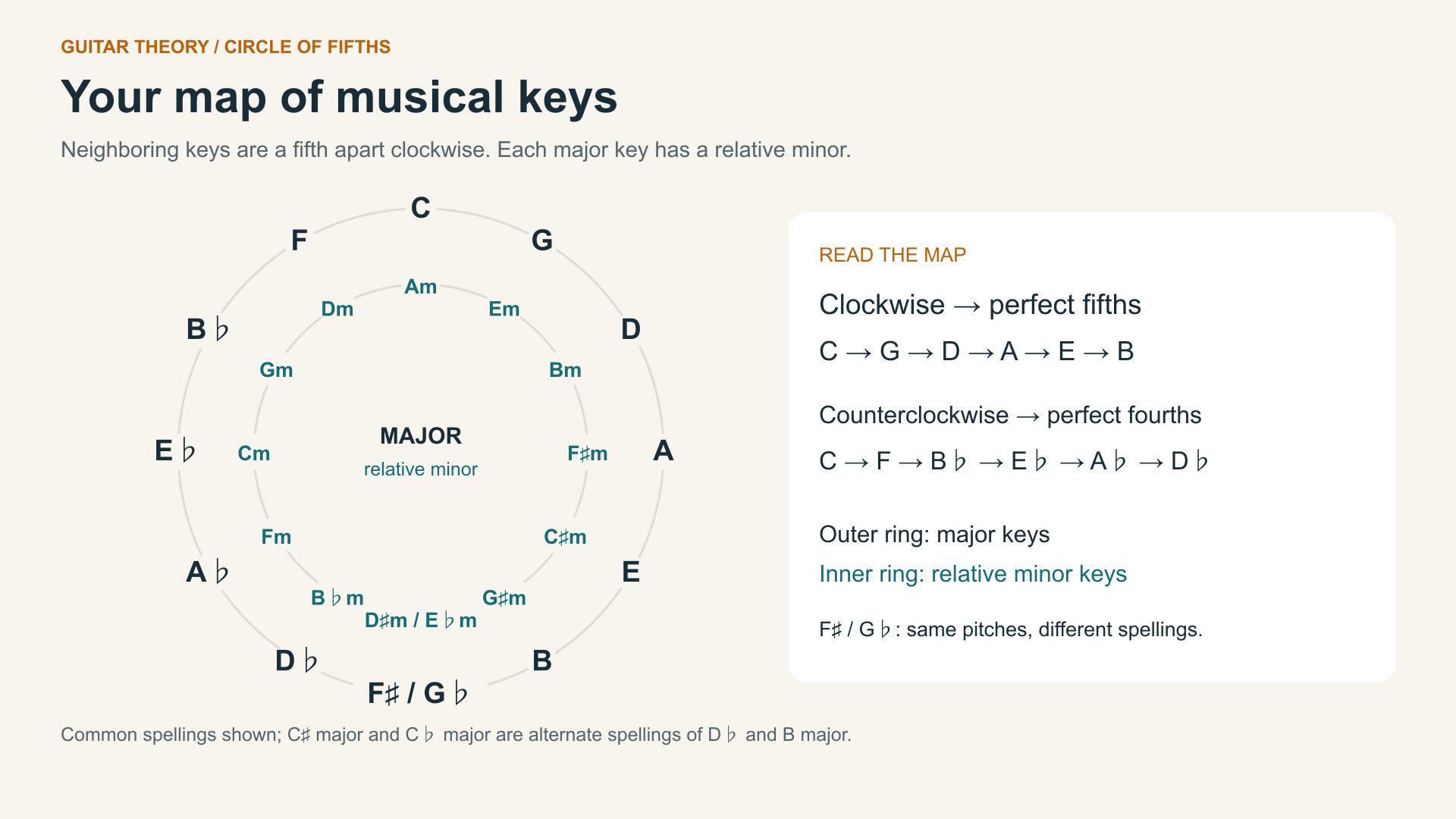
The circle of fifths is a visual map. It arranges twelve pitch-class positions around a clock face. Each position can show a major key and its relative minor, and some positions have two useful spellings, such as F♯ and G♭. Move one step clockwise, and you land on the key a perfect fifth higher. Move one step counterclockwise and you land on the key a perfect fourth higher. That pattern repeats around the circle until you arrive back where you started.
The arrangement is not random. Keys that sit next to each other on the circle share almost all the same notes. Because of that, chords from neighboring keys blend naturally. That physical proximity on the diagram represents real harmonic closeness in sound. So the circle is not just a memory aid. It reflects how music works.
For guitarists specifically, the circle of fifths is useful in a way it sometimes is not for piano players. On a piano, the key layout makes some patterns visually obvious. On a
Reading the Circle of Fifths: Start Here Before Anything Else
Before the circle can do anything for you, you need to know what you are actually looking at. The outer ring, the inner ring, the positions at the top and bottom, the distribution of sharps and flats: all of that has a logic. The logic is simple once someone walks you through it.
Most guitarists glance at the circle, feel vaguely intimidated, and set it aside. That is a mistake worth correcting early. The circle of fifths rewards about twenty minutes of focused attention. After that, the structure clicks and stays with you. Understanding the layout is not a prerequisite you power through. It is where the practical payoff begins.
If you want a step-by-step breakdown of how the diagram is built and what each part means for your playing, start with the plain-English walkthrough built for guitarists. That article handles the mechanics so this one can stay focused on the bigger picture.
Key Signatures Made Easy With the Circle
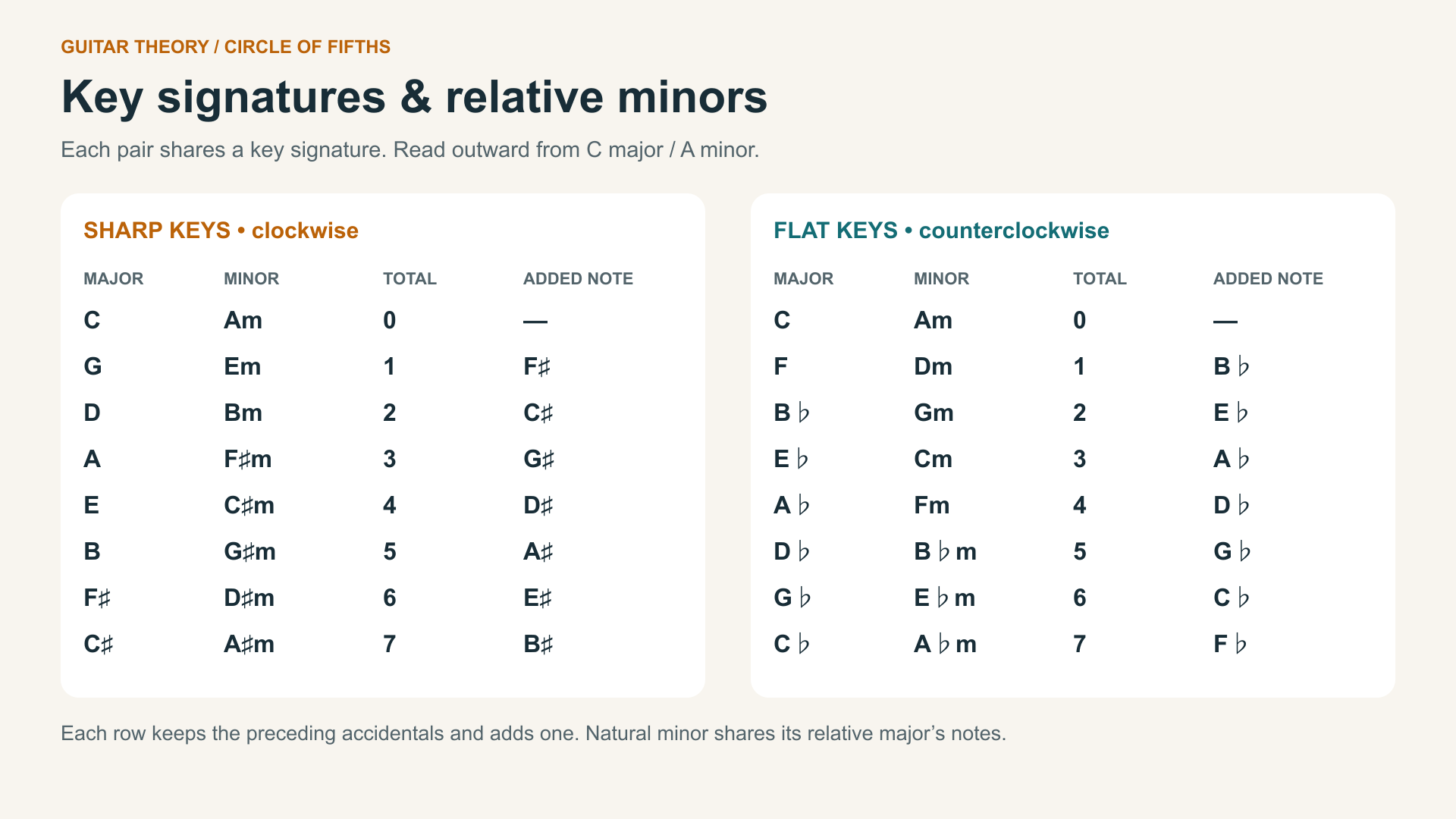
One of the most immediate practical uses of the circle of fifths is reading key signatures without guessing. Every key carries a specific number of sharps or flats. Instead of memorizing those numbers as a disconnected list, the circle tells you instantly.
Start at C major, which has no sharps or flats. Along the sharp-key spelling chain, each clockwise step adds one sharp: G has one, D has two, and A has three. Along the flat-key spelling chain, each counterclockwise step adds one flat: F has one, B♭ has two, and E♭ has three. On a chart that switches between sharp and flat spellings near the bottom, follow the appropriate spelling chain rather than continuing the same count around the entire circle.
A key’s position on the circle tells you exactly how many alterations it contains. That is not a trick. That is a structural feature of the diagram. It means you can ditch the flashcards.
For
Relative Minor Keys and the Circle’s Inner Ring
> Every major key has a relative minor that shares its key signature. The major scale and its relative natural minor contain the same notes, but they have different tonal centers: different notes and chords feel like home. C major and A natural minor, for example, both use C, D, E, F, G, A, and B.
On a circle with an inner minor ring, each relative minor sits inside its major partner. This gives you a useful starting point for scales and chords, but minor-key music is not limited to natural minor. In A minor, an E or E7 chord commonly introduces G♯, strengthening the pull toward A.
For guitarists, the shared notes mean familiar scale patterns can serve both contexts. Establishing the new key depends on the melody, bass, chord progression, and emphasis; simply beginning a scale on another note is not enough.
If you want to go deeper on how to use this in real musical situations, the relative minor explainer covers the concept from the ground up.
Building Chord Progressions With the Circle of Fifths
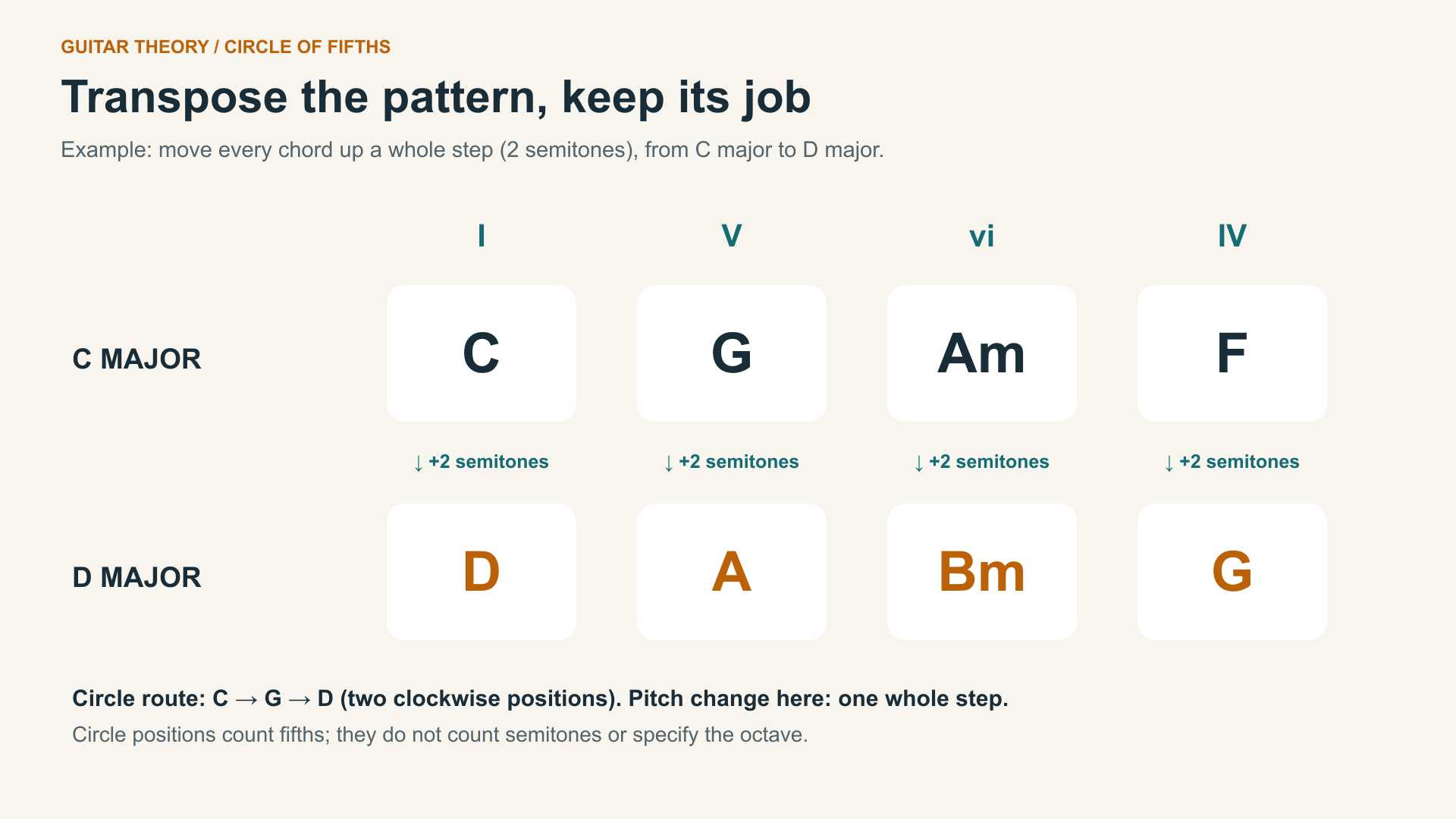
> The circle can help you find a useful family of chords. In a major key, the tonic chords of the two neighboring major keys supply IV and V. C major sits between F major and G major, so F, C, and G give you the IV, I, and V chords in C major.
>
> These three chords belong to C major; playing them does not require changing keys. This does not mean every chord from F major or G major is also diatonic to C major. The circle suggests useful relationships, while chord quality, voice leading, rhythm, and melody determine how a progression sounds.
The circle shows you the same relationships composers and arrangers have leaned on for centuries.
For guitarists who write their own material, this is genuinely useful. You do not need to understand all of the underlying theory to start applying it. The circle tells you where the good combinations live. Your ear then confirms what the diagram suggests. For a full breakdown of how to build progressions this way, the chord progressions guide explains exactly how neighboring chords work and why.
Transposing Songs Using the Circle of Fifths
Transposing is one of those tasks that stops a lot of guitarists cold. A singer needs the song a step higher. The chord shapes in the original key are awkward on the neck. In either situation, the circle of fifths shows you exactly where to move.
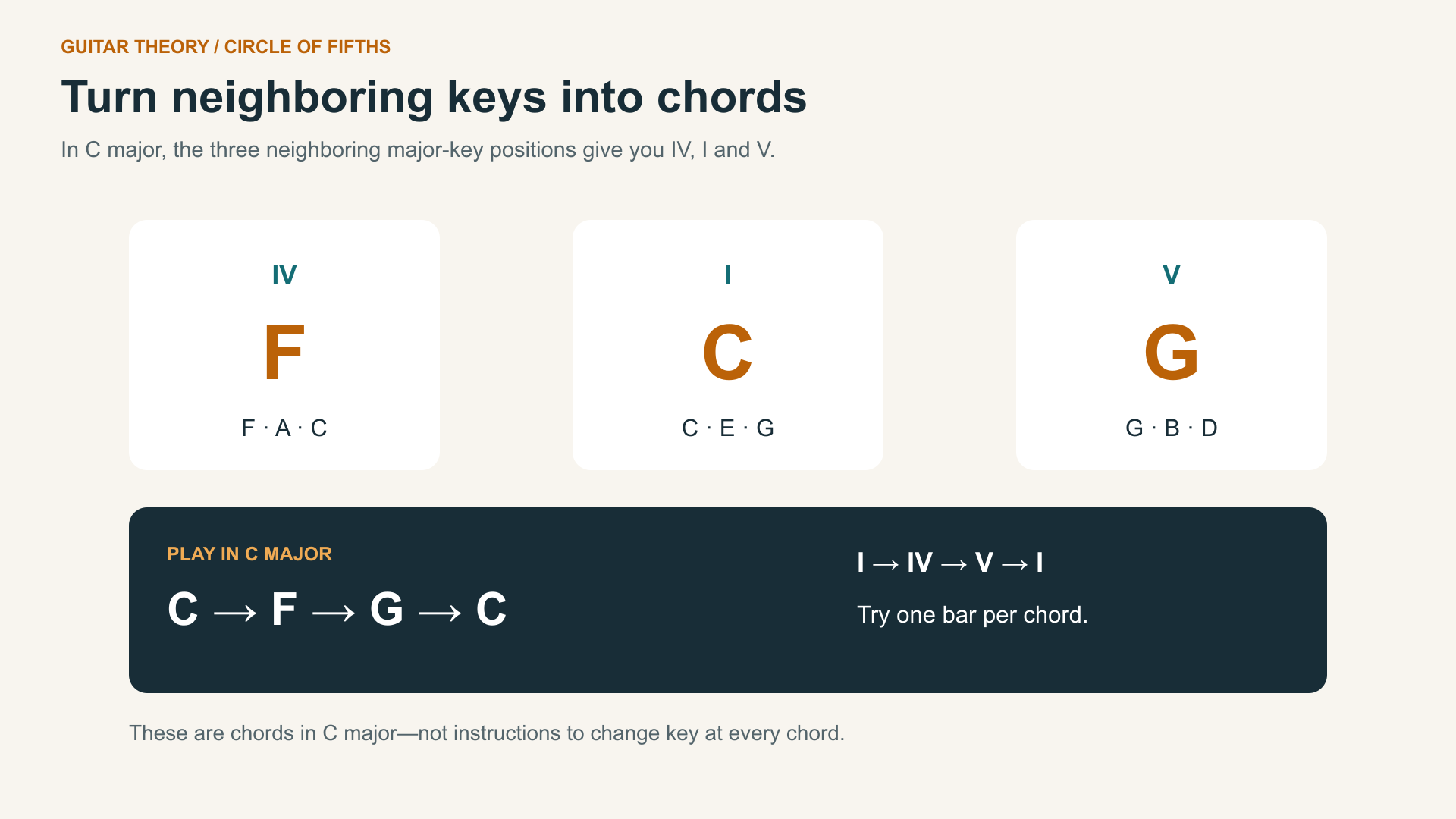
The circle maps relationships between keys, but its steps count fifths rather than semitones. To move a song from C major to D major by a whole step, raise every note and chord root by two semitones while preserving each chord’s quality. On the circle, C to D is two clockwise positions through G. The circle does not specify the octave, so direction around the diagram alone does not tell you whether your actual performance moves higher or lower.
Transposing also becomes less stressful when you understand what you are actually doing. The circle of fifths makes the logic visible. Instead of converting chords one at a time by rote, you are moving a pattern to a new position on the map. For a practical, step-by-step approach to doing this without confusion, the transposing guide walks through the process in plain terms.
The Circle of Fifths as a Daily Practice Tool
The circle of fifths is not only useful for pre-show preparation or theory study. It is also a useful frame for daily practice. If you tend to practice the same scales and shapes in the same familiar spots on the neck, the circle can deliberately push you out of that groove.
For example, you can move a pattern or a chord shape through positions on the circle as a practice routine. Instead of repeating something comfortable, you are systematically visiting every key in a logical order. That approach builds fluency across the whole neck. Over time, this kind of circle-based practice changes how you hear the
The circle also supports ear training. Practice hearing the interval between successive roots, then listen to how a chord progression resolves in each key. In equal temperament, every perfect fifth has the same interval size. Differences you hear may come from register, voicing, open strings, or musical context rather than from a unique interval at each position.
Continue Learning
The circle of fifths makes the most sense as a cluster of related skills, not a single concept to memorize all at once. Work through these in order and each one will reinforce the next:
- How the diagram is built and what each part means for your playing
- Using the circle to read key signatures without guessing
- Understanding relative minor keys through the inner ring
- Building chord progressions from neighboring positions on the circle
- Transposing songs to a new key without the confusion
Final Thought
The circle of fifths has been around long enough that it is easy to dismiss as something for classical students or music school. Do not make that mistake. It is one of the most compressed, practical reference tools in music. It answers questions guitarists face at every level, from what chords fit together to where to move a song for a singer. Learn these five skills one at a time and the circle stops being abstract. It becomes something you reach for, the same way you reach for a tuner or a capo. The videos in this series handle the mechanics. Your job right now is to get oriented, see how the pieces connect, and then go play.
Practice smart and play hard at TrueFire!Start →
About the Education Team
Four music-industry veterans with decades of combined experience in music education, curation, and production at TrueFire and ArtistWorks. The TrueFire Studios Education Team plans and edits this content and works with our master-musician faculty to keep it accurate and genuinely useful.