


VG
DADGAD chords are the entry point to one of the most distinctive harmonic worlds in guitar. If you’ve ever heard Davey Graham, Pierre Bensusan, or even Led Zeppelin and thought “how does that sound so open and unresolved?”, the answer is almost always this tuning. It creates a suspended, floating quality that standard tuning simply cannot replicate. This article covers why DADGAD chords work the way they do, how their vocabulary is organized, and what it costs you harmonically. For the broader context on why alternate tunings matter at all, check out the complete guide to open tunings every guitarist should explore. Then come back here and dig in.
What DADGAD Chords Sound Like Before You Play a Shape
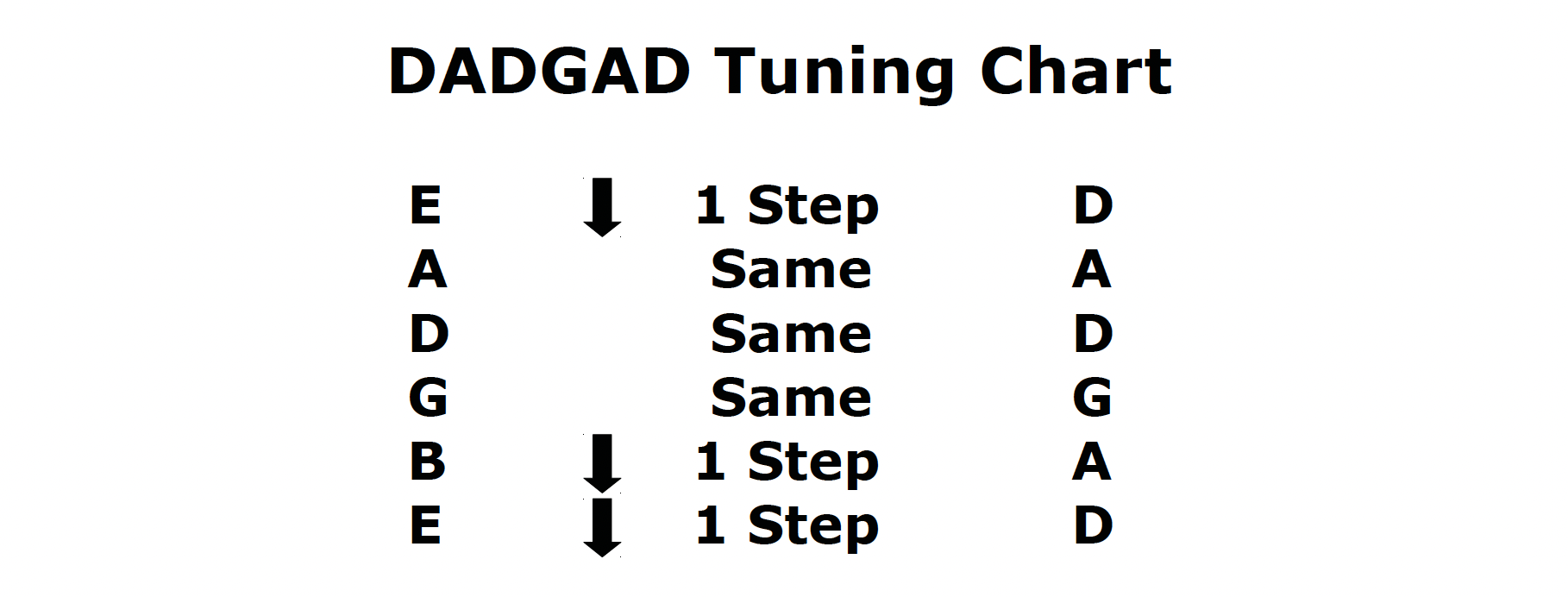
Strum your open strings after tuning to DADGAD. That sound is neither major nor minor. It’s suspended. Harmonically unresolved. The open chord rings like a question with no obvious answer. That quality carries through every chord you build on top of it.
This is not a bug. In fact, it’s the entire reason Celtic players and fingerstyle writers have gravitated toward DADGAD for decades. The tuning doesn’t resolve neatly. Instead, it invites melodic and harmonic motion that feels like it’s always searching. For players who write music with an evocative, droning atmosphere, that openness is the point.
Because the open strings produce a suspended chord, even simple two-finger shapes carry more harmonic weight than they would in standard tuning. The resonance of the open strings does a lot of the work for you.


This video is unavailable.
Get video-sync tab and notation for this lesson on TrueFire!Start →
Why DADGAD Chords Require a Fresh Start
Here’s the honest tradeoff: your familiar chord shapes are mostly gone. The visual patterns you’ve built in standard tuning don’t transfer cleanly. A shape you’ve always used for a major chord now produces something entirely different. As a result, players new to DADGAD often feel like beginners again, even after years of experience.
That disorientation is temporary, but it’s real. The good news is that DADGAD’s harmonic logic is consistent once you understand it. The tuning is built around a modal framework. Its diatonic chords reflect that character throughout. Instead of forcing standard shapes onto the neck, you learn new shapes that lean into what the tuning naturally does.
For comparison, if you’ve worked through open chords in a major-rooted tuning like Open D, you already know how much a tuning can reorganize the fretboard. DADGAD takes that reorganization further. Its root chord is ambiguous rather than clearly major or minor.
The Modal Character That Defines DADGAD Chords
DADGAD is most closely associated with the Dorian and Mixolydian modes, as well as the natural minor scale. Celtic music leans heavily on these sounds. That’s one reason the tuning became so central to that tradition. The modal character means that chord progressions built inside DADGAD don’t always behave the way you’d expect from a standard major-key framework.
The relationship between chords in DADGAD often feels more open-ended than in a typical major-key progression. There’s less pull toward a definitive resolution. Instead, you get movement between chords that each carry some of that suspended quality from the open strings.
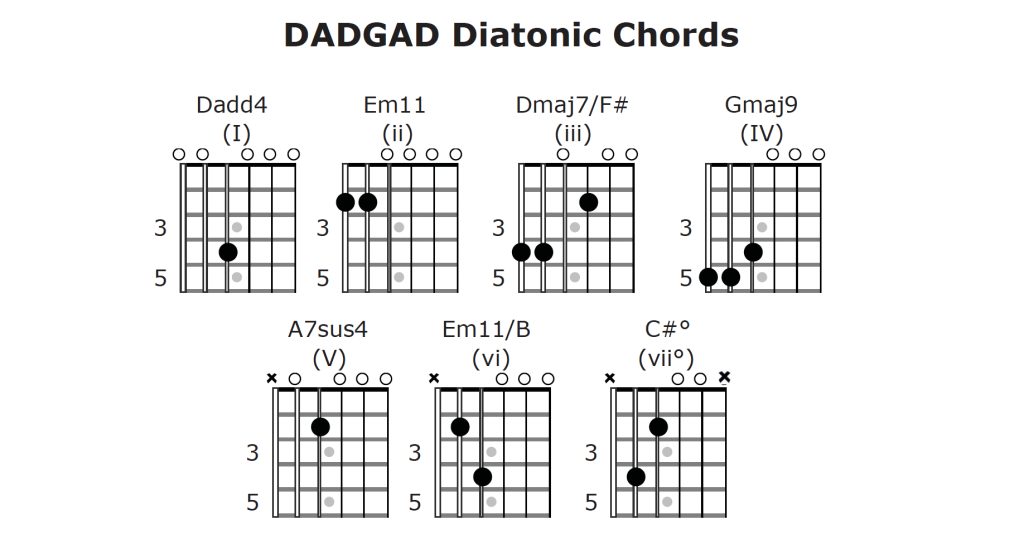
This also means that understanding the diatonic chord map for DADGAD is genuinely useful. When you know where each chord tone lands on the neck, you can navigate the harmonic space intentionally. Vicki Genfan’s video walks through these shapes directly. You can see and hear exactly where each chord falls.
Hearing a Familiar Progression Through DADGAD Chords
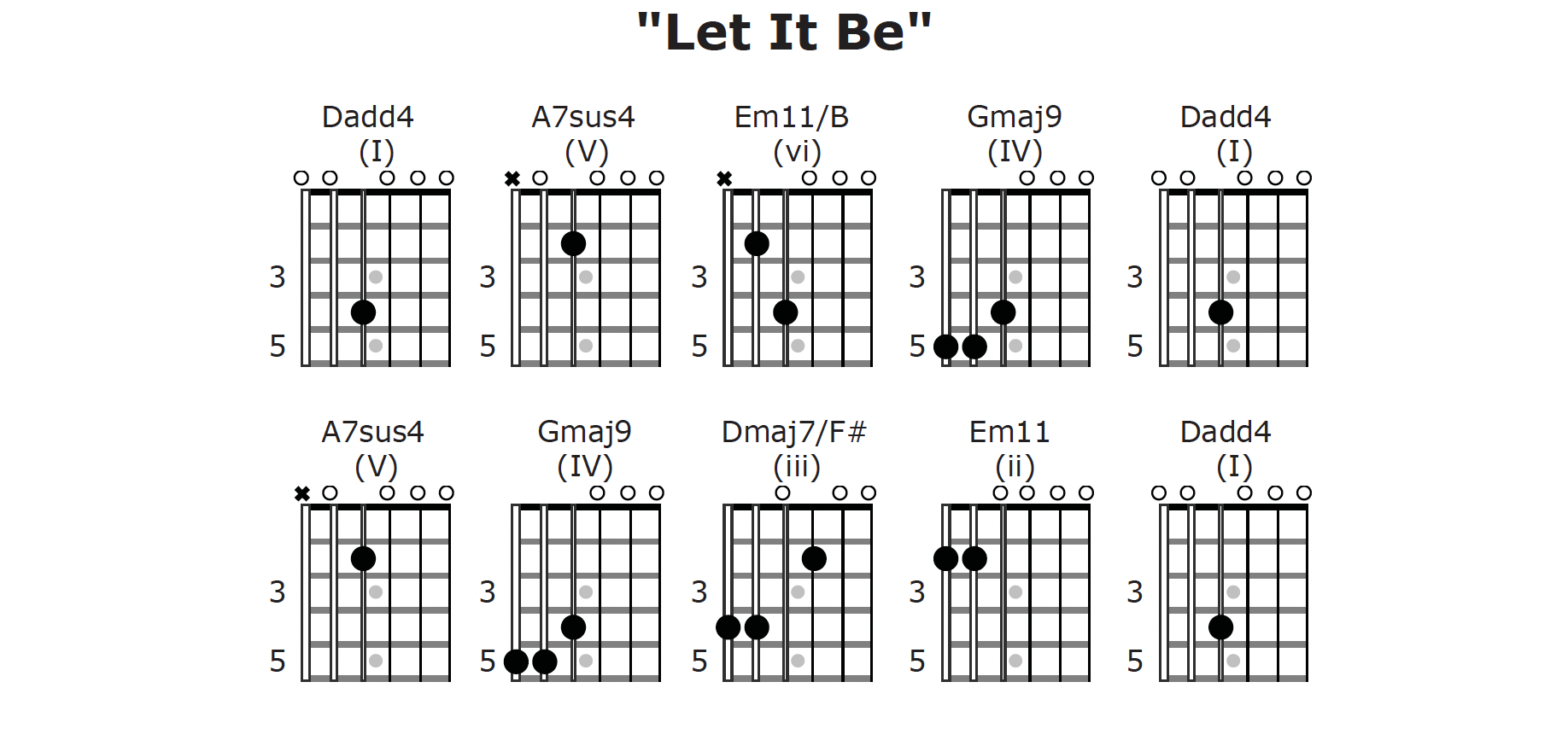
One of the clearest ways to understand what DADGAD does is to hear a familiar progression transformed inside it. Vicki uses “Let It Be” as a reference point, and it’s a smart choice. You already know how that progression sounds in standard tuning. Hearing it reshaped by DADGAD’s modal character gives you an immediate reference for what the tuning actually changes.
The chords still function as a progression, but they carry extra resonance and a different emotional weight. The suspended quality of the open strings bleeds into each shape. As a result, even a well-known sequence sounds more open and more unresolved than it does in standard tuning.
That’s a genuinely useful exercise. Play through the progression first. Then compare what you hear to Vicki’s video performance of the same shapes. The difference between knowing a chord’s name and hearing it ring inside this tuning is significant.
Common Mistakes Players Make With DADGAD Chords
The most common mistake is trying to play standard-tuning logic in a modal tuning. Players reach for familiar shapes and get frustrated when the harmony sounds wrong. In contrast, players who accept the tuning’s suspended character from the start make faster progress.
A second mistake is overcomplicating the shapes too early. DADGAD’s open strings carry a lot of harmonic content on their own. Simpler voicings that let open strings ring almost always sound better than busy ones. Specifically, two-finger shapes will outperform a crowded barre chord that mutes all that resonance.
A third mistake is ignoring the drone. DADGAD is built for droning. The lowest open string and the highest open string share the same pitch class. That creates a natural pedal tone running through everything you play. Use it. Let it ring. That drone is one of the things that makes DADGAD chords sound like themselves.
If you’re drawn to other tunings that use sustained open-string resonance as a compositional tool, the articles on Open Emin11 for cinematic sounds and Open Csus2 for ambient fingerstyle cover that territory from different angles.
Building Your DADGAD Chord Vocabulary Over Time
Start with the diatonic chord chart that Vicki works through in the video. Learn each shape, then play it with as many open strings ringing as possible. Notice how each chord sounds in context rather than in isolation. After that, try the “Let It Be” progression to hear the shapes moving together.
From there, write something short. Eight bars is enough. Use the drone, let the open strings breathe, and resist the urge to fill every space. DADGAD rewards stillness as much as movement. The modal atmosphere comes precisely from what you don’t play as much as from what you do.
DADGAD chords become more intuitive the more time you spend inside the tuning. Its harmonic world starts to feel logical on its own terms rather than foreign. For a broader map of where DADGAD sits among all the options, return to the overview of open tunings worth learning. Also worth exploring is the open tuning world of Open G, which handles ambiguity differently but rewards the same willingness to rebuild your chord vocabulary from the ground up.
Dig deep with Vicki Genfan in her Top-Ranked TrueFire library!Start →
Continue Learning
Explore the rest of this series:
- 11 Open Tunings for Guitar Every Player Should Know (And Why They’re Worth the Switch)
- Open D Guitar Chords: How to Tune, Play Diatonic Chords, and Sound Great Fast
- Open G Guitar Chords: How to Navigate the Tuning Behind Blues and Classic Rock
- Open Emin11 Guitar Tuning: How to Get a Dark, Cinematic Sound From Open Strings
- Open Csus2 Guitar Tuning: How to Use a Suspended Open Tuning for Ambient and Fingerstyle Playing
- 6 Unusual Open Guitar Tunings Worth Exploring (With Diatonic Chords and Etude Performances)
About the Education Team
Four music-industry veterans with decades of combined experience in music education, curation, and production at TrueFire and ArtistWorks. The TrueFire Studios Education Team plans and edits this content and works with our master-musician faculty to keep it accurate and genuinely useful.
Featured Contributor
VG
Vicki’s mastery of guitar borders on pure alchemy. Audiences are mesmerized by the waves of sound Vicki creates with just two hands, her voice, 29 alternate tunings, and and the percussive technique she calls slap-tap.