


VG
Unusual guitar tunings have a way of doing something that standard tuning rarely manages: they make the instrument feel genuinely new. If you have already spent time with open tunings like open D or open G, you know the basic payoff. The full picture of what open tunings offer covers the broad landscape. But this article is for players who are ready to go further. These six tunings sit past the well-traveled territory. They voice extended, suspended, and minor chords from the open strings, and each one opens a distinct harmonic world that standard tuning simply cannot produce without significant effort.
Why Unusual Guitar Tunings Go Further Than the Basics
The popular open tunings work because the open strings voice a single, recognizable chord. You strum without fretting anything, and you hear a complete sound. These six unusual guitar tunings operate on exactly the same principle. The difference is what that chord is.
Instead of a plain major chord, you get a chord with added color: a suspended fourth, a minor seventh, an eleventh, an added ninth. That extra harmonic information is baked into the tuning itself. As a result, even simple fingerpicking patterns carry more weight. The instrument does more of the work before you play a single fretted note.

This video is unavailable.
Get video-sync tab and notation for this lesson on TrueFire!Start →
The Six Tunings and What Each One Offers
These tunings fall loosely into three families: extended add voicings, minor voicings, and suspended voicings. Understanding which family a tuning belongs to helps you predict how it will behave before you pick it up.
Extended add voicings. The C6add9 and C11add9 tunings layer color on top of a major foundation. The open strings voice chords with added tones that fill out the harmonic spectrum. C6add9 carries a bright, sophisticated shimmer. C11add9 pushes further into jazz-inflected territory. Both reward fingerstyle approaches because the added tones ring independently across strings.
Minor voicings. Cmin11 and Dmin7 bring a darker, moodier palette. Minor open tunings are rarer than their major counterparts, so they tend to feel more distinctive immediately. Cmin11 in particular has a cinematic quality. Dmin7 sits in a more intimate, introspective register. For context, the approach to the open Emin11 tuning covered in a darker cinematic context shares some of that same atmospheric logic.
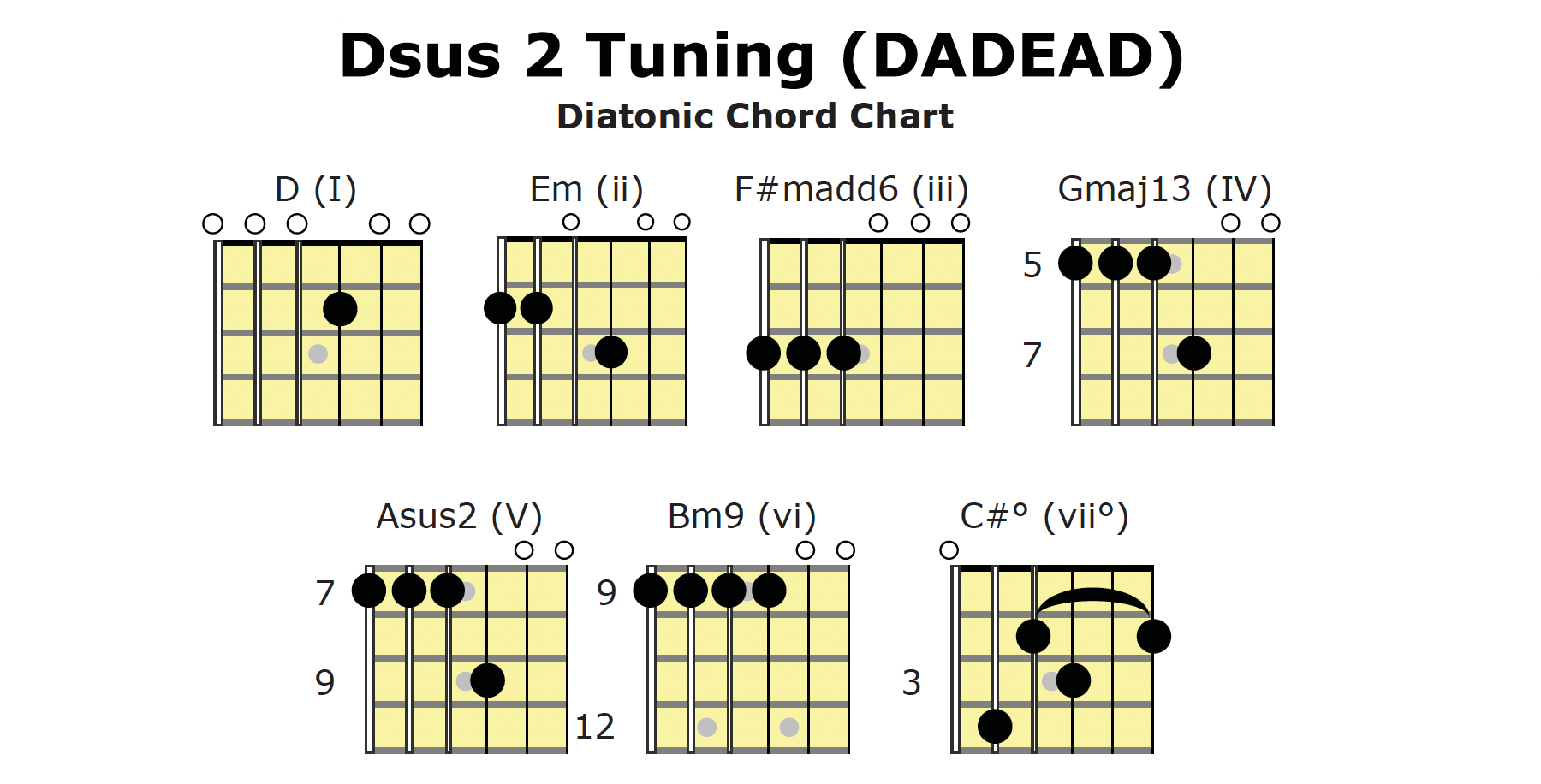
Suspended voicings. D7sus4 and Dsus2 both carry that characteristic sense of unresolved openness. Suspended chords do not commit to major or minor, so they feel suspended between emotional states. Dsus2, in particular, shares conceptual ground with the suspended open Csus2 tuning explored for ambient and fingerstyle playing, though the specific voicings produce different results.
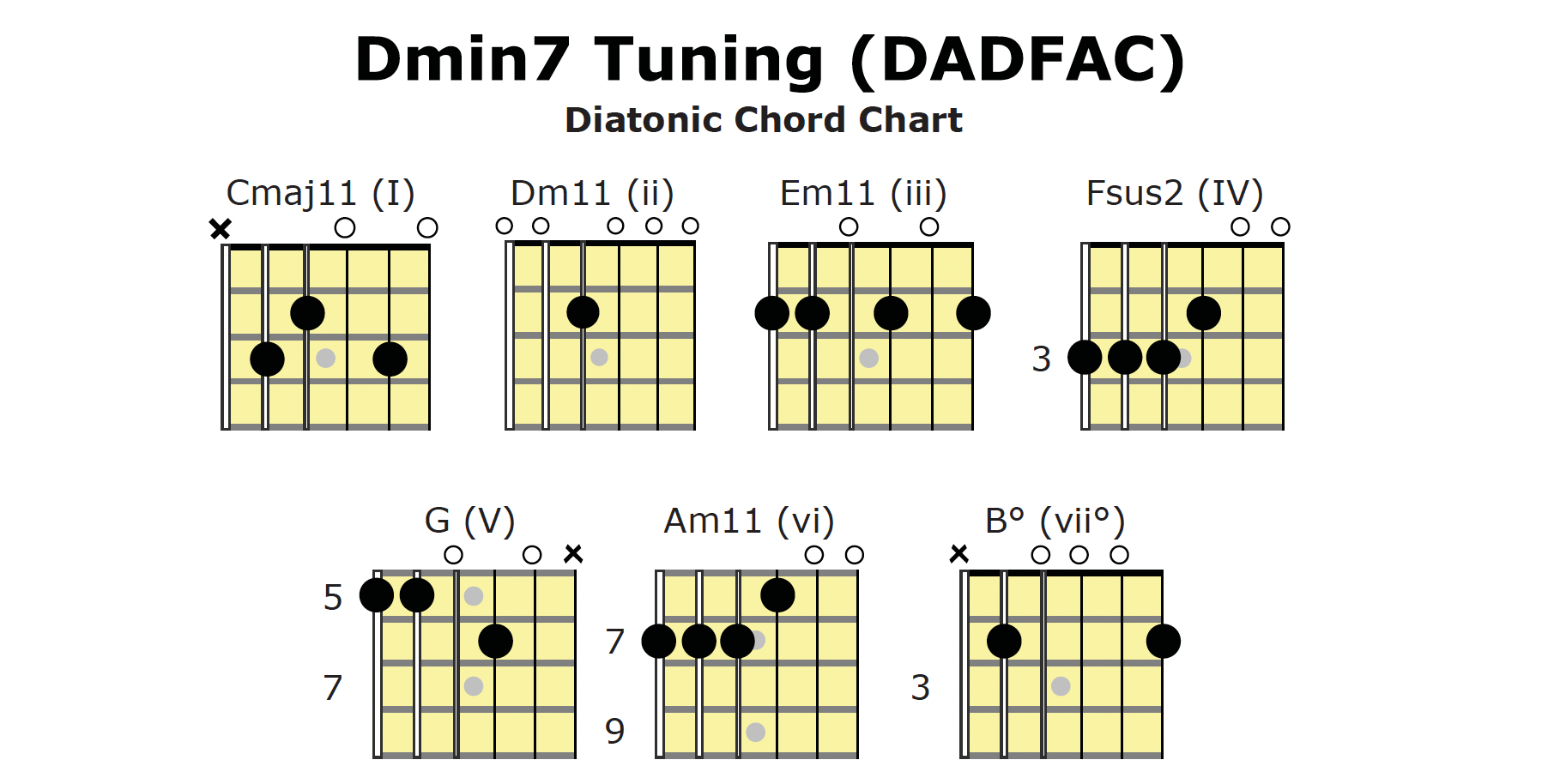
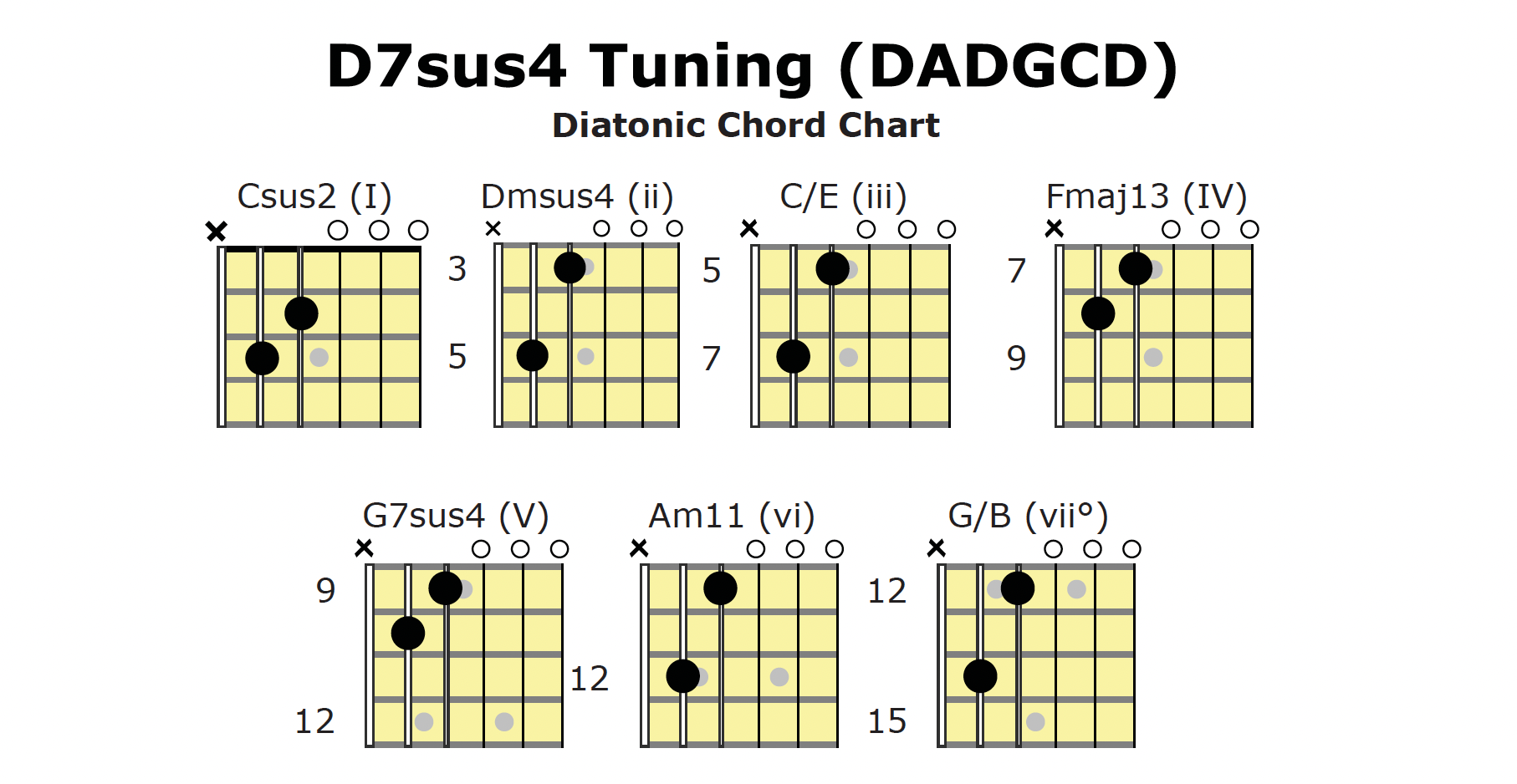
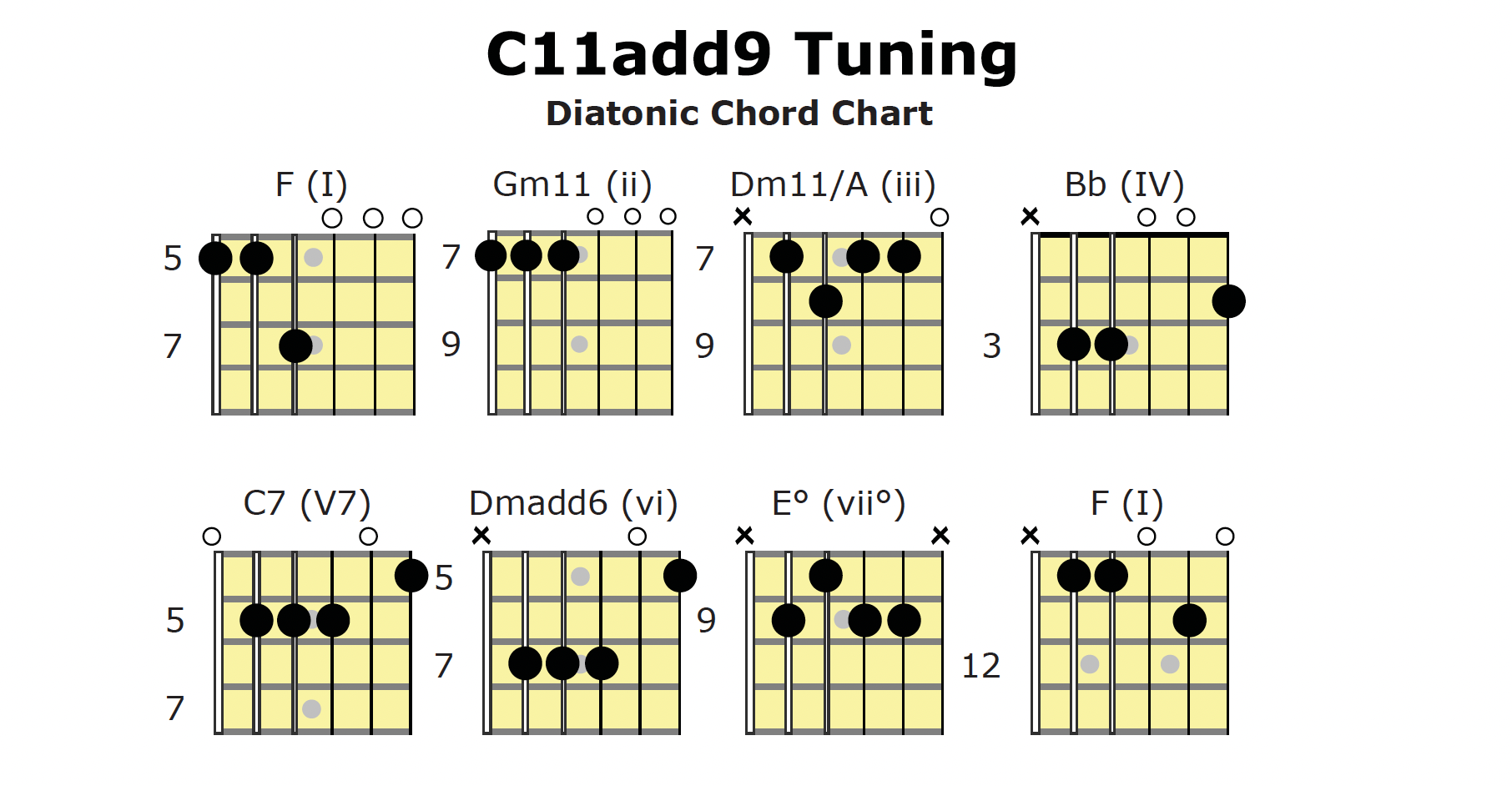
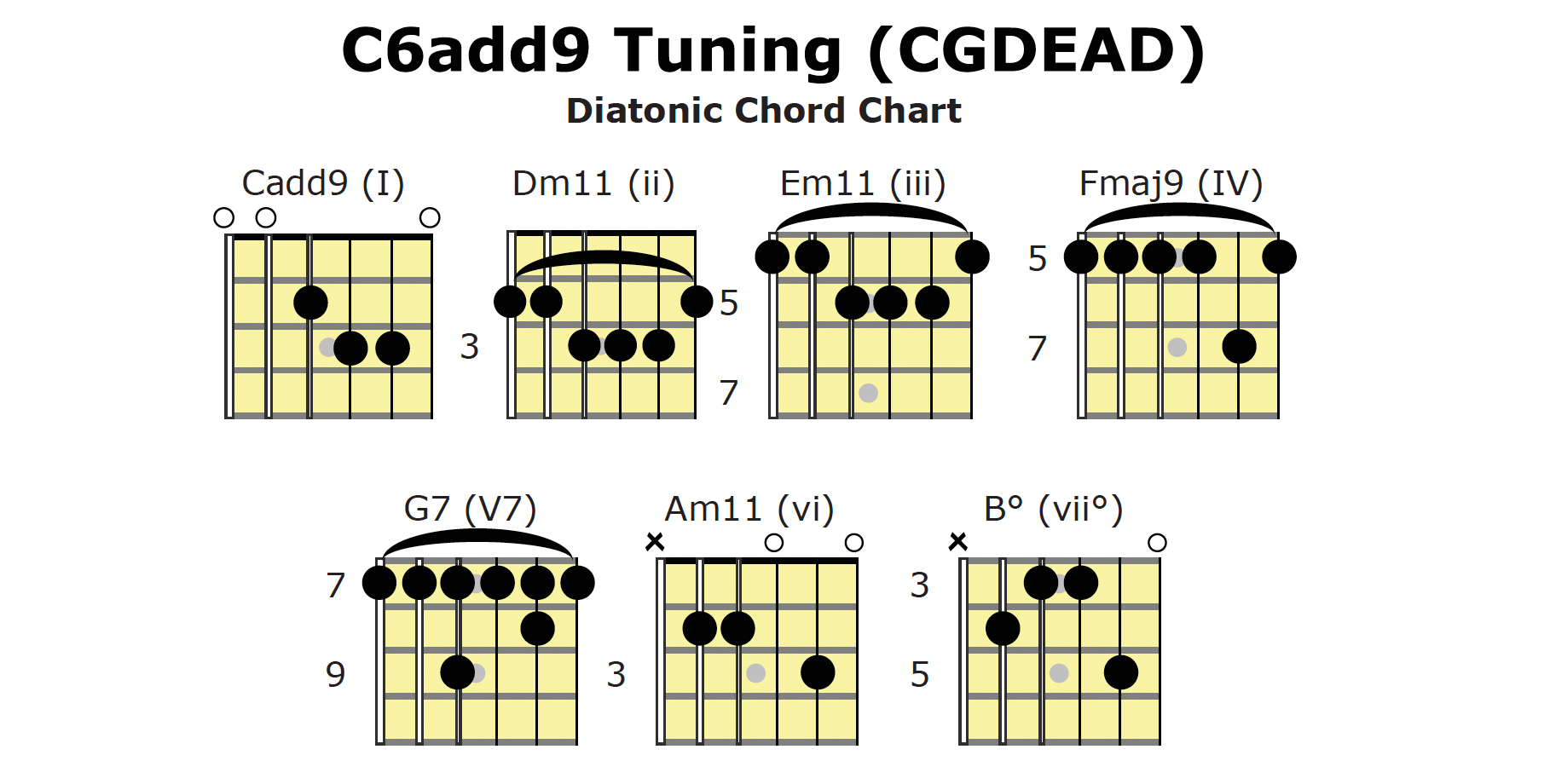
Diatonic Chord Maps: Your Starting Point in Each Tuning
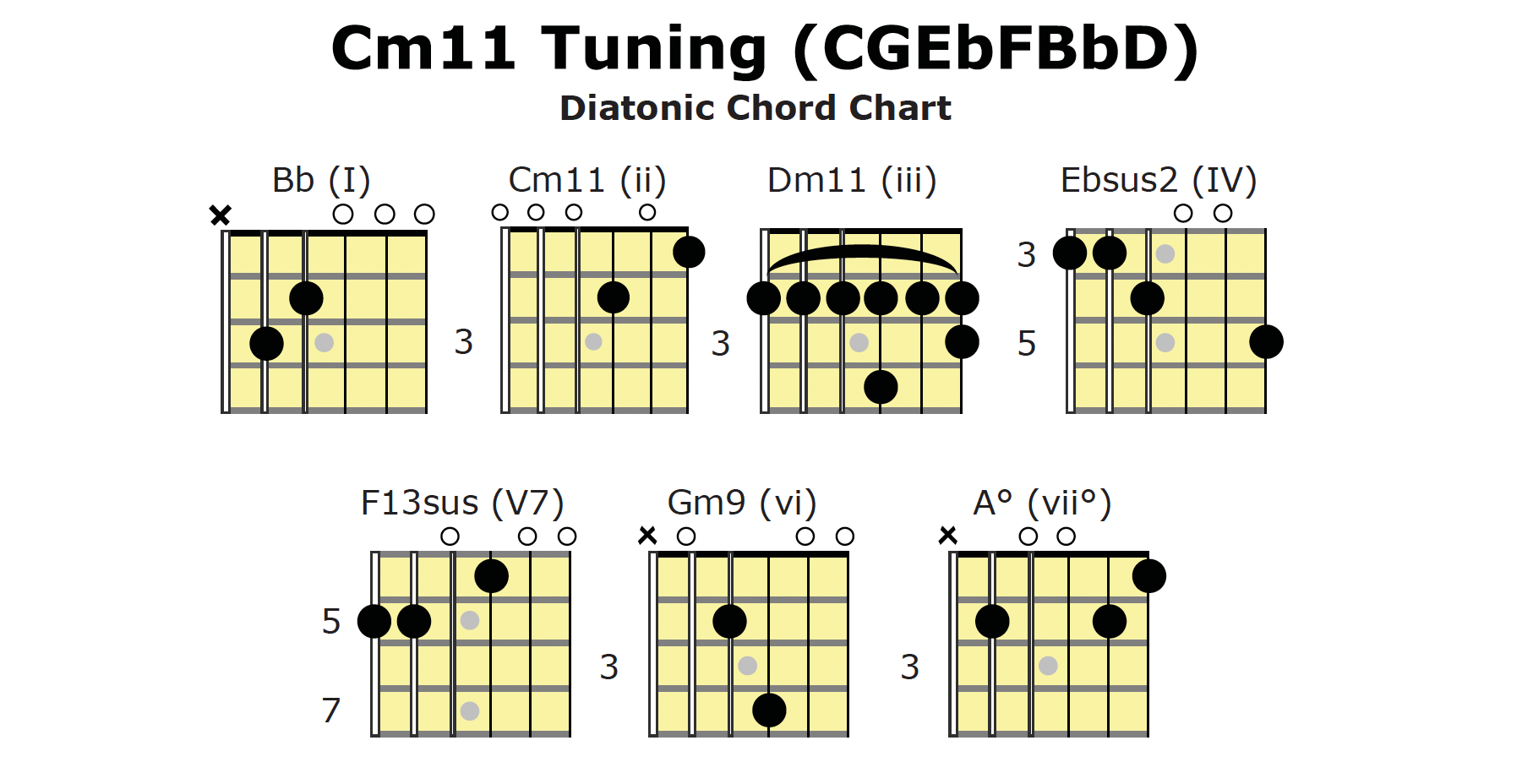
Every one of these unusual guitar tunings comes with a diatonic chord guide. That matters because unusual tunings can feel disorienting at first. You know the open chord sounds good. But where do you go from there?
A diatonic chord map tells you which chord shapes fall naturally within the tuning’s harmonic context. In other words, it gives you the key chords before you have worked out anything on your own. You can begin writing and experimenting immediately, rather than spending your first hour trying to locate a basic chord shape.
Think of the map as a vocabulary list. You do not need to use every word. But having the list in front of you means you can form complete sentences right away. Once you are comfortable with those primary chords, you will start hearing other possibilities and adding to your own vocabulary from there.
Vicki Genfan’s Etude Performances in Context
Educator Vicki Genfan demonstrates two of these unusual guitar tunings in etude performances included with this lesson. An etude is not just a technical exercise. In this context, it is a short, complete musical piece that shows the tuning working in a real musical setting.
That distinction is important. Theory and chord diagrams tell you what is possible. A performance shows you what it actually sounds like when someone commits to a tuning and plays through it musically. Vicki’s etudes do exactly that. They demonstrate the creative ceiling of each tuning, not just its theoretical floor.
Watching those performances, notice how the open strings interact with fretted notes. Notice how the tuning’s built-in chord color shapes the phrasing. You will hear decisions being made that only make sense because of the tuning itself. Those are the kinds of decisions you will start making naturally once you spend real time inside one of these unusual guitar tunings.
How to Actually Work Through These Tunings
The most common mistake players make with unusual guitar tunings is tuning up, playing around for a few minutes, and then moving on before anything clicks. The tuning has not failed you. You simply have not been inside it long enough.
Pick one tuning from the six and commit to a single session with it. First, tune up carefully and let your ear adjust to the new open chord. Then, work through the diatonic chord map one chord at a time. Play each shape slowly and listen to how it resonates against the open strings.
After that, try a simple repeating pattern using only two or three of those chords. Do not aim for a finished song. Instead, aim for a moment where the tuning starts telling you something. That moment, when the instrument starts suggesting ideas rather than waiting for instructions, is when unusual guitar tunings become genuinely useful creative tools.
For reference, the DADGAD tuning’s approach to modal exploration shows a similar philosophy at work: time inside the tuning produces insight that chord diagrams alone never will. And if you want to understand how the more foundational open tunings compare in feel and behavior, the open D tuning walkthrough and the open G tuning guide give you solid reference points.
This video is unavailable.
Get video-sync tab and notation for this lesson on TrueFire!Start →
The Further You Stray, the More Original You Sound
These six unusual guitar tunings are an invitation to go further than most players bother to go. Each one is a distinct harmonic world. The chords you find inside them do not sound like chords you have heard before. Most guitarists have never tuned to these voicings. That unfamiliarity is the point.
The full open tunings overview frames this well: every open tuning is a trade. You give up familiar shapes and get a new set of natural sounds in return. These six tunings make that trade in a particular direction, toward richer, less common harmonic territory. The further you go in that direction, the more original your music tends to sound.
Choose one tuning. Tune up. Work the chord map. Then let the instrument lead.
Dig deep with Vicki Genfan in her Top-Ranked TrueFire library!Start →
Continue Learning
Explore the rest of this series:
- 11 Open Tunings for Guitar Every Player Should Know (And Why They’re Worth the Switch)
- Open D Guitar Chords: How to Tune, Play Diatonic Chords, and Sound Great Fast
- Open G Guitar Chords: How to Navigate the Tuning Behind Blues and Classic Rock
- DADGAD Guitar Chords: How to Use the Modal Tuning Favored by Celtic and Fingerstyle Players
- Open Emin11 Guitar Tuning: How to Get a Dark, Cinematic Sound From Open Strings
- Open Csus2 Guitar Tuning: How to Use a Suspended Open Tuning for Ambient and Fingerstyle Playing
About the Education Team
Four music-industry veterans with decades of combined experience in music education, curation, and production at TrueFire and ArtistWorks. The TrueFire Studios Education Team plans and edits this content and works with our master-musician faculty to keep it accurate and genuinely useful.
Featured Contributor
VG
Vicki’s mastery of guitar borders on pure alchemy. Audiences are mesmerized by the waves of sound Vicki creates with just two hands, her voice, 29 alternate tunings, and and the percussive technique she calls slap-tap.