


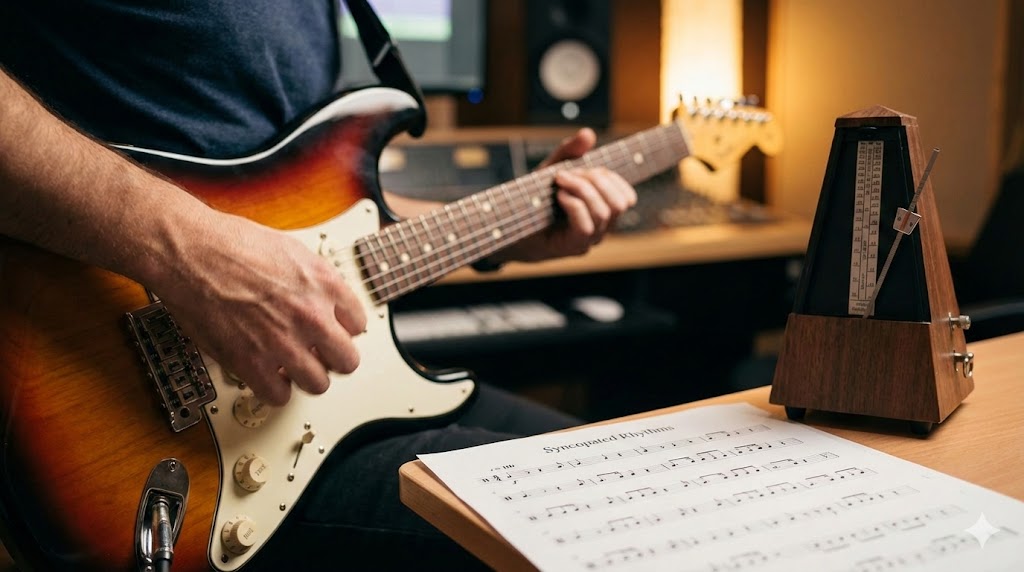
Master Guitar Syncopation and Transform Your Rhythm Playing
Table of Contents
- What Is Guitar Syncopation, and Why Does It Matter?
- How Syncopation Works: The Rhythmic Mechanics
- Offbeat Strumming: Your Gateway to Groove Guitar
- Syncopated Strumming Patterns to Woodshed
- Funk Guitar Rhythm: Where Syncopation Lives and Breathes
- Rhythm Guitar Accents: The Dynamic Layer
- Common Mistakes (and How to Fix Them)
- Your 30-Day Syncopation Practice Plan
- Next Steps: Unlock Your Skills
You know the feeling. You’re strumming along, hitting every chord cleanly, nailing the changes, and yet something’s missing. The part sounds flat. Mechanical. The missing ingredient? Guitar syncopation, the rhythmic technique that transforms lifeless strumming into the kind of groove that makes people move. It’s the difference between playing rhythm guitar and owning it.
Syncopation is everywhere in the music you love, the stuttering funk of Nile Rodgers, the reggae-infused pop of The Police, the swampy pocket of New Orleans R&B. Once you understand how it works, and once you internalize it in your hands, your strumming patterns will never sound the same. Let’s break it down.
What Is Guitar Syncopation, and Why Does It Matter?
At its simplest, syncopation means placing rhythmic emphasis where your listener doesn’t expect it. In standard 4/4 time, the “strong” beats are 1 and 3. Most beginner strumming patterns hammer those beats dutifully. But intermediate and advanced players know the real magic lives between and around those predictable downbeats.
When you accent the “and” of beat 2 instead of beat 3, or let a rest land where a strum “should” be, you create rhythmic tension, and that tension gives music its forward motion, its pull, its groove. Without syncopation, rhythm guitar is wallpaper. With it, rhythm guitar becomes the engine of the song.
A Quick Theory Refresher
Think of a measure of 4/4 time divided into eighth notes: 1-and-2-and-3-and-4-and. The numbered beats are downbeats; the “ands” are upbeats (offbeats). Syncopation occurs when you shift your emphasis to those offbeats, or when you deliberately omit a note on a strong beat, creating anticipation. For sixteenth-note subdivisions, the grid gets finer: 1-e-and-a, 2-e-and-a. Funk and R&B guitar live in those sixteenth-note spaces, and that’s where your groove guitar vocabulary really expands.
How Syncopation Works: The Rhythmic Mechanics
There are three primary ways guitarists create syncopation. Understanding each gives you a toolkit to mix and match across any genre.
1. Accented Offbeats
The most common form. You strum on the offbeat (the “and”) with more force or tonal clarity than surrounding notes. Your strumming hand keeps its constant down-up motion, but you selectively dig in on the upstrokes. The result leans forward, pulling the listener’s ear toward the next beat.
2. Tied Notes and Anticipations
An anticipation happens when you play a chord change slightly before the expected downbeat, typically on the “and” of the beat before. Instead of changing from G to C on beat 1, you hit the C on the “and of 4.” That early arrival creates powerful momentum. If your chord changes ever felt late when playing along with records, anticipations are likely why.
3. Rests as Rhythmic Events
Sometimes the most powerful note is the one you don’t play. Muting the strings on a downbeat so your strum produces a percussive “chk” instead of a chord turns silence into rhythm. This is central to funk guitar rhythm. To explore how muting builds multi-layered grooves, TrueFire educator Rick Stickney is one of the best at breaking down those layered approaches.
Offbeat Strumming: Your Gateway to Groove Guitar
Before tackling complex syncopated figures, get comfortable with the foundational skill: offbeat strumming. This means training your hand to emphasize upstrokes while maintaining a steady down-up motion.
Exercise 1: The Upstroke Isolation Drill
Set your metronome to 70 BPM. Play an open Am or Em chord. Strum continuous eighth notes, but only let your upstrokes make contact with the strings. Downstrokes pass through the air, maintaining motion without sound. Count aloud, accenting every “AND.” Woodshed this five minutes daily, increasing by 5 BPM each session until comfortable at 120 BPM.
Exercise 2: Accent Shifting
Now play all eight eighth notes, shifting your accent to different positions. Accent beat 2 and the “and” of 4. Then try the “and” of 1 and the “and” of 3. Each variation produces a completely different feel from the same motion, one of the most efficient ways to build a massive strumming vocabulary. For more on accent placement, check out Vicki Genfan’s strumming patterns lessons.
Syncopated Strumming Patterns to Woodshed
Let’s put theory into practice with patterns you can start using today.
Pattern 1: The Pop-Rock Anticipation
Rhythm: 1 . (and) 2 . and . 4 (and)
Strum on beat 1, the “and” of 2, beat 4, and tie the “and” of 4 into beat 1 of the next measure. This is the workhorse syncopated pattern behind countless pop and rock songs. The tied note is the anticipation: your chord change arrives a half-beat early, giving the progression propulsion. Practice over a simple I-IV-V-I at 90 BPM, changing chords on the “and of 4.”
Pattern 2: The Reggae Skank
Rhythm: . and . and . and . and
Strum only on the upbeats. No downbeats at all. Use short, clipped chords with immediate muting. Your fretting hand lifts slightly to kill sustain. This produces that iconic choppy, percussive feel. It’s pure offbeat strumming in its most concentrated form and an outstanding exercise for building independence between your strumming hand’s motion and accent placement.
Pattern 3: The Sixteenth-Note Funk Chop
Rhythm: 1-e-and-a 2-e-and-a 3-e-and-a 4-e-and-a
This lives in sixteenth-note territory. Your hand moves in constant sixteenth-note down-up-down-up motion, but you mute everything except the accented notes. The ghost strums between accents are just as important. They create the fabric of the groove. This is the kind of funk guitar rhythm that players like Jimmy Nolen perfected, and it remains the foundation of modern funk, R&B, and neo-soul rhythm guitar.
Funk Guitar Rhythm: Where Guitar Syncopation Lives and Breathes
If there’s one genre where syncopation isn’t just a technique but the entire point, it’s funk. Funk guitar rhythm is built on the interplay between clean chord stabs, muted ghost notes, and strategically placed accents within a sixteenth-note grid. The great funk guitarists, Jimmy Nolen with James Brown, Al McKay with Earth, Wind & Fire, Nile Rodgers with Chic, were masters of making complex syncopated patterns feel effortless.
The key concept is “the grid.” Your strumming hand never stops moving in sixteenth notes, a constant engine at fixed speed. What changes is which notes you let ring and which you mute. You’re not “placing” individual notes; you’re sculpting rhythm by subtracting from a continuous flow. It’s a fundamentally different way of thinking about strumming, and it unlocks an enormous range of rhythmic possibilities.
The Ghost Note Connection
Ghost notes, quiet, muted strums between accented notes, give funk its characteristic tightness. They’re the connective tissue of the groove. Practice by playing all sixteen sixteenth notes as muted ghost strums, then gradually “opening up” specific notes to let the chord ring. You’re carving rhythm from percussion.
TrueFire instructor Rick Stickney, whose Filthy Funk Rhythm course is a masterclass in this approach, teaches “Three Degrees of Funk”, building grooves from a simple foundation and adding complexity one layer at a time. For more on syncopated groove styles, Shane Theriot’s Mojo Rhythmsare another essential resource, rooted in his work with the Neville Brothers and Hall & Oates.
Rhythm Guitar Accents: The Dynamic Layer
Syncopation tells you when to emphasize. Accents tell you how much. Together they create rhythm guitar parts that breathe and move dynamically.
Types of Accents for Rhythm Guitar
There are several ways to accent a note on guitar, each producing a different character. A velocity accent means strumming harder for more volume. A tonal accent involves changing the quality, strumming closer to the bridge for a brighter, more cutting sound. A harmonic accent means voicing a different chord tone or extension on the accented beat. And a rhythmic accent can be created by holding a note slightly longer than its neighbors. The best rhythm guitarists blend all four types instinctively.
Accent Exercise: Dynamic Contouring
Play steady eighth notes over a four-bar progression. First pass: accent beats 2 and 4. Second pass: accent the “and” of every beat. Third pass: create your own pattern. Record all three, then listen back. Notice how dramatically the feel changes with identical notes and chords.
Common Mistakes (and How to Fix Them)
Stopping your strumming hand to place syncopated notes. The number one mistake. Your hand should maintain constant motion. The pendulum never stops. Syncopation comes from selectively making contact, not changing your hand’s speed. If you catch yourself pausing, slow way down and focus on continuous motion first.
Losing the pulse. Syncopation only works against a steady beat. If your internal clock wavers, syncopated patterns sound random. Always practice with a metronome or drum loop. TrueFire’s interactive learning tools let you loop and slow down sections, invaluable for drilling syncopated passages.
Over-syncopating. Not every beat needs to be displaced. The power of syncopation comes from contrast between expected and unexpected. If everything is syncopated, nothing is. Think of syncopation as seasoning: essential, but ruinous in excess.
Neglecting dynamics. Playing every note at the same volume flattens the groove, even with perfect rhythmic placement. Dig in on your accents and lighten up on ghost notes. Dynamic contrast is what makes syncopated patterns feel alive.
Your 30-Day Syncopation Practice Plan
Week 1: Upstroke Isolation Drill, 10 min/day. Start at 60 BPM, add 5 BPM daily. Add the reggae skank pattern. Week 2: Accent Shifting at 80 BPM with four combinations per session. Apply the Pop-Rock Anticipation to songs you know. Week 3: Sixteenth-Note Funk Chop at 65 BPM, focus on ghost-note consistency. A TrueFire All Access membership gives you full courses and backing tracks to make this work musical. Week 4:Create your own syncopated patterns combining offbeats, anticipations, and ghost notes. Record yourself and evaluate.
Next Steps: Unlock Your Skills
Guitar syncopation isn’t an advanced trick reserved for session pros. It’s a fundamental rhythmic skill that every serious player needs. The exercises and patterns in this guide give you a concrete starting point, but the real learning happens when you dig in with focused, consistent practice. Work with a metronome. Record yourself. Steal rhythmic ideas from records you love and reverse-engineer how they work.
The educators at TrueFire have built courses designed to accelerate this process, from Rick Stickney’s layered funk grooves to Vicki Genfan’s strumming vocabulary to Shane Theriot’s New Orleans mojo rhythms. The interactive learning tools, looping, slow-motion playback, synced tab, and backing tracks, let you woodshed syncopated passages until they’re locked in.
Try TrueFire All Access for FREE with a 14-day trial and start building the kind of rhythm guitar chops that make other musicians want to play with you. Your groove is waiting.