


Knowing how to transpose is one of those skills that separates guitarists who can work in any situation from those who are stuck in one key. A vocalist needs the song higher. A jam session is running in a different key than your chart. You want to move a riff somewhere more comfortable on the neck. These problems come up constantly. Most players either guess their way through or avoid the situation entirely.
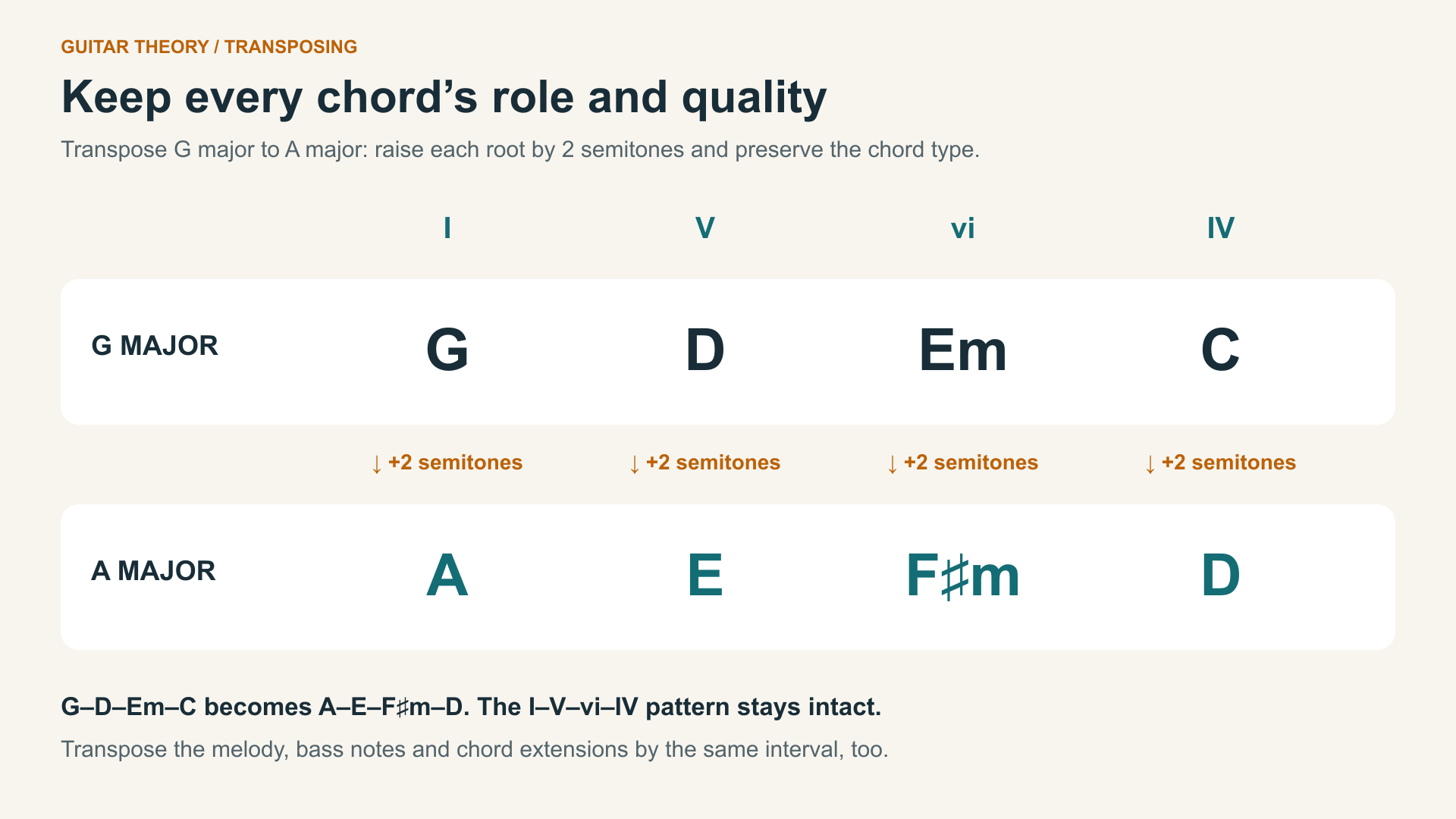
Each chord has a root, a quality, and a role in the key. Roman numerals describe scale-degree roles, not the order in which chords appear. In G major, G-D-Em-C is I-V-vi-IV. Transposing up a whole step gives A-E-F♯m-D in A major. Preserve the major or minor quality and any extensions, and transpose melody notes and bass notes by the same interval. If you haven’t read the full introduction to how the circle works as a guitar theory tool, start there first. Then come back here for the transposing application.
What “How to Transpose” Actually Means
Transposing means shifting every chord and melody in a song by the same interval. The internal relationships stay identical. Only the pitch level changes. Think of it like moving a photograph up or down on a wall. The image doesn’t change. The position does.
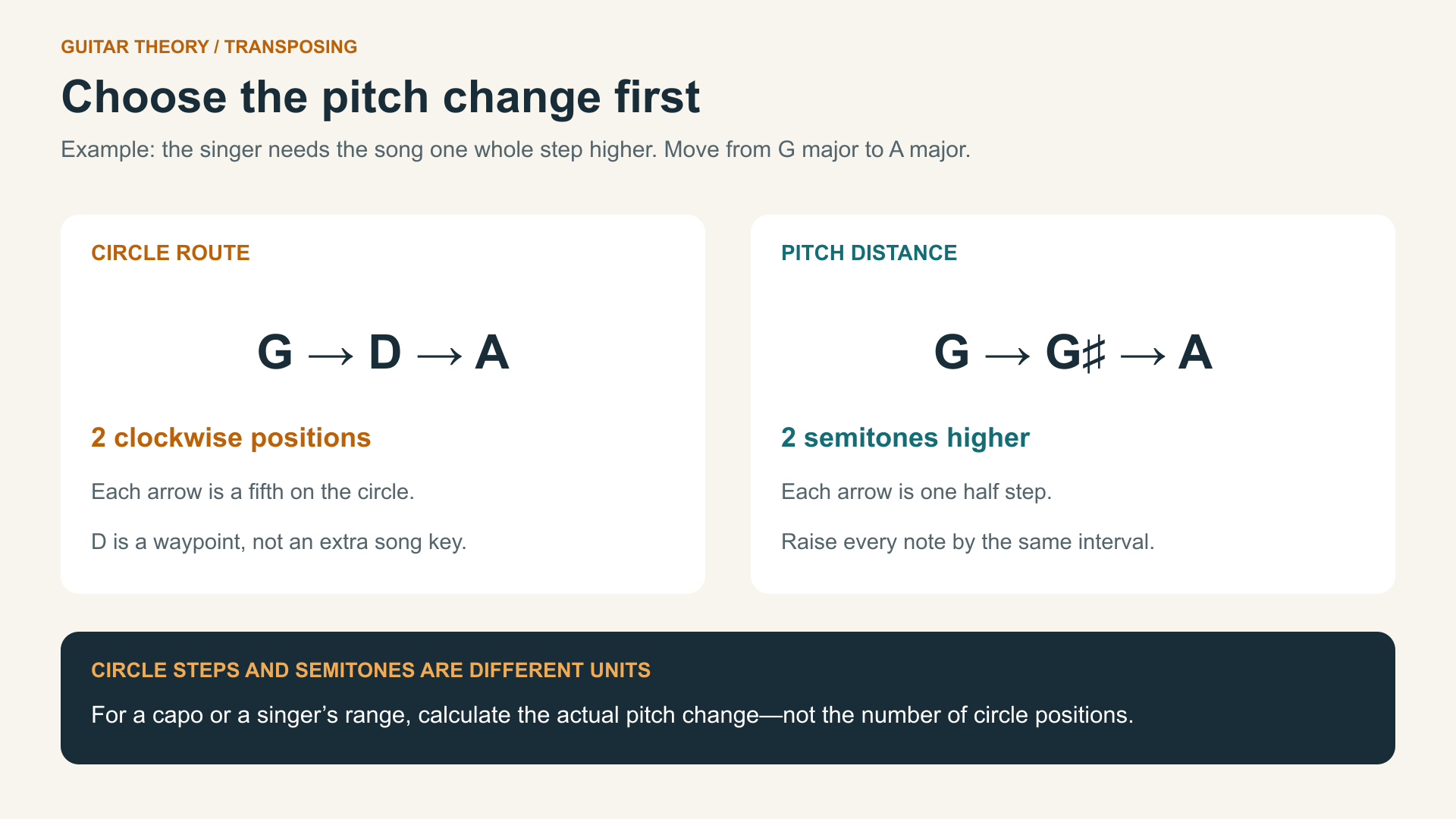
Begin by choosing the target key and the actual interval you want to move, such as up two semitones. Then shift every melody note, chord root, and bass note by that interval while preserving chord quality. The circle can help map the new root names, but its positions are fifth relationships, not semitone steps, and it does not specify an octave.
Moving Your Position on the Circle
Here is the core method. Identify which position on the circle your song currently lives at. Next, count how many steps you need to move. Moving clockwise takes you up by a perfect fifth. Moving counterclockwise takes you up by a perfect fourth. You can also think of counterclockwise as moving down by a fifth.
Every chord in the original progression has a function: the first chord, the fifth chord, the fourth chord, and so on. Those functions stay the same after you transpose. Once you land on your new position, simply rebuild the progression using the chords that belong to that new key. If you need a refresher on which chords naturally belong together, the article on building chord progressions with the circle covers exactly that.

The Singer’s Key Problem and How to Solve It
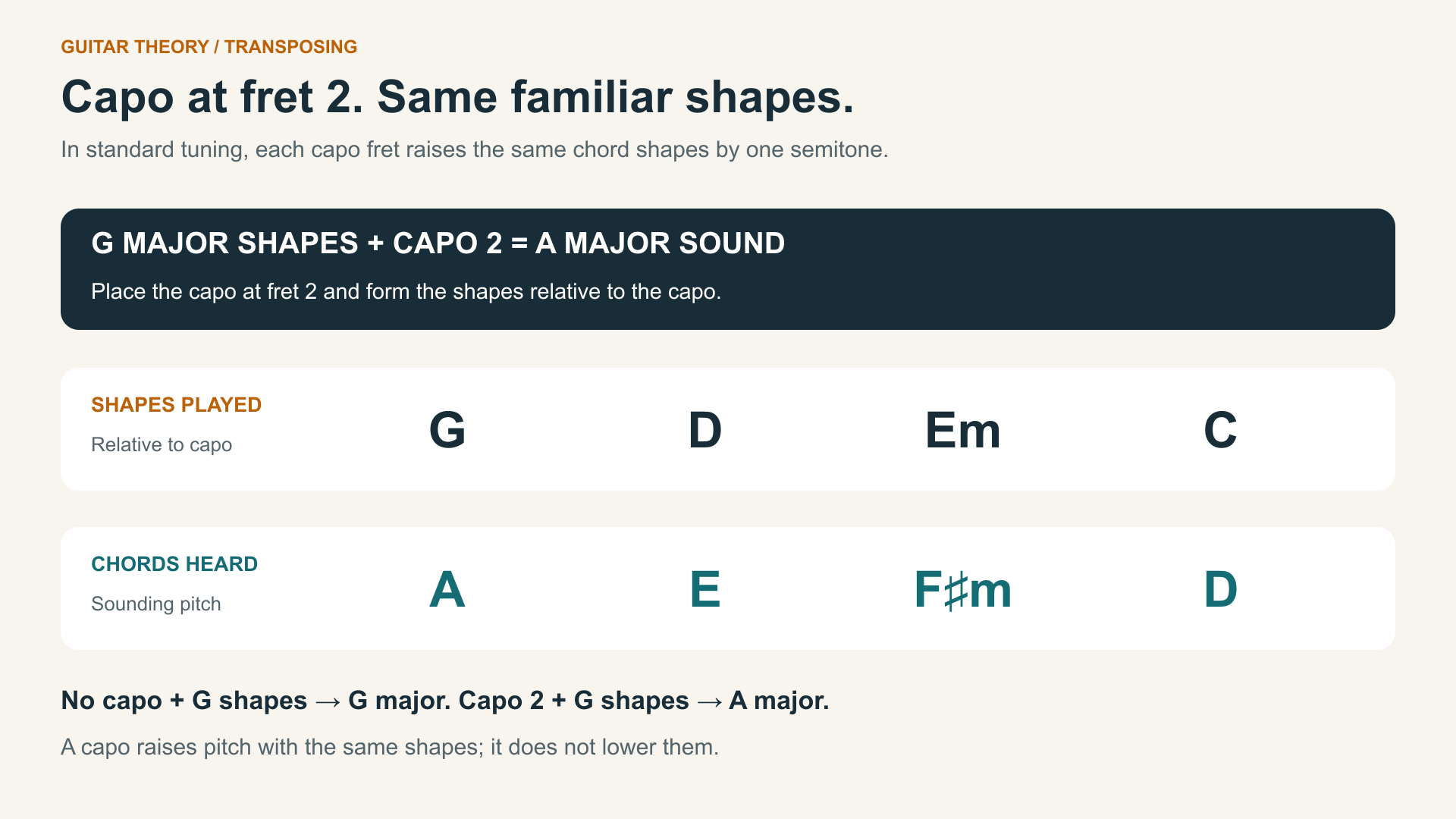
A full capo lets you raise familiar chord shapes. In standard tuning, each fret raises the same shapes by one semitone when you form them relative to the capo. With capo 2, G-D-Em-C shapes sound as A-E-F♯m-D.
Calculate the upward pitch difference from the shapes’ uncapoed key to the desired sounding key. From G to A, that is two semitones, so use fret 2. Do not use the number of circle positions as the capo fret number. A capo raises the same shapes; it does not lower them. For a lower key, choose different shapes, remove an existing capo if appropriate, or use another arrangement.
Capo as a Transposing Tool
A capo is a physical transposing device. It raises the pitch of every open string by the same interval. That effectively shifts your playing position without changing your chord shapes. Understanding how to transpose with the circle helps you choose the right capo position intelligently.
Start from your current key position on the circle. Count up to your target key. Each clockwise step corresponds to a specific number of semitones. Your capo position covers that difference. So instead of experimenting with every position until something sounds right, you calculate the move on the circle first. Then you place the capo with purpose. The chord shapes you already know stay intact. The key changes. That is the whole transaction.
Simple Modulation: Planned Key Changes Mid-Song
Modulation means establishing a new key during a piece. Transposing a chorus into a new key is one way to do that, but a modulation can also use new material or a gradual transition. Moving a riff to another pitch does not necessarily establish a new key.
Closely related keys can share useful pivot chords. C major and G major, for example, share C, Em, G, and Am. Those chords can help connect the keys, while a cadence such as D7-G can help establish G as the new tonic. The smoothness or drama of a key change depends on the transition, voicing, rhythm, and melody as well as the distance between keys.
For more on how adjacent keys relate, see the article on why neighboring chords on the circle work so well together.
The Practice Method That Makes It Stick
Knowing how to transpose in theory and actually doing it on a song are two different experiences. Here is the practice sequence that works.
Pick a song you know well. Identify the current key, choose a target key, and write down the intended pitch change in semitones. Label each chord’s scale-degree role where useful, then transpose every root by the same interval while preserving chord quality, extensions, and slash-chord bass notes. Transpose the melody too. Use the circle to check the new root relationships, then play the result slowly and listen.
Work through it slowly before you try to play it up to tempo. The first time you do this, the process will feel deliberate. By the fifth or sixth transposition, it will feel mechanical in the best sense. You stop solving a puzzle and start executing a procedure.
For context on how key signatures are structured before you start moving between them, the article on how the circle handles key signatures is a solid next step. And if you want to understand how relative minor keys factor into your transpositions, the piece on relative minor relationships fills that gap directly.
Changing Keys Becomes a Two-Step Move
Transposing becomes more reliable when you separate two decisions: choose the new pitch level, then move every part of the song by the same interval. The circle helps organize the new root relationships, while your chord shapes and melody bring them to life on the guitar.
The circle of fifths as a whole is built for exactly this kind of work. It is not a memorization exercise or a piece of music school decoration. It is a map. And maps are most useful when you have somewhere specific you need to go.
Practice smart and play hard at TrueFire!Start →
About the Education Team
Four music-industry veterans with decades of combined experience in music education, curation, and production at TrueFire and ArtistWorks. The TrueFire Studios Education Team plans and edits this content and works with our master-musician faculty to keep it accurate and genuinely useful.