


VG
Open Csus2 tuning is one of the quieter discoveries in the world of alternative tunings, but its payoff is distinctive. Where most open tunings resolve to a major or minor chord when you strum all six strings, open csus2 tuning leaves things deliberately unresolved. The open strings voice a suspended chord. That built-in tension creates a spacious, airy quality that sits beautifully under fingerstyle playing and ambient textures.
If you have been exploring what open tunings can offer, this one belongs on your list. The full picture of what makes open tunings worth the switch is a good place to orient yourself before diving into the specifics here. This article focuses on what makes open csus2 tuning unique, how its harmonic world is laid out. How to start using it creatively.
What Makes Open Csus2 Tuning Different
Most open tunings are built around a major or minor chord. Open Csus2 tuning is built around a suspended chord, which means no third is present. Instead, you get the root, the second, and the fifth. That absence of a third is the whole story. Without it, the tuning does not lean toward major or minor. It simply hangs in the air.
That quality is not a limitation. For ambient and contemplative playing, it is a tool. The open strings ring with a built-in openness that does not pull toward resolution. As a result, you can let notes sustain and overlap without the harmony clashing. Furthermore, this suspended quality becomes a texture rather than a problem to fix.
Compare this to what you get in standard tuning. There, creating sustained, overlapping ambient passages often requires careful voice leading. You need deliberate note choices to avoid muddiness. In open csus2 tuning, the strings themselves are doing part of that work for you.


This video is unavailable.
Get video-sync tab and notation for this lesson on TrueFire!Start →
The Harmonic Layout and Diatonic Chord World of Open Csus2 Tuning
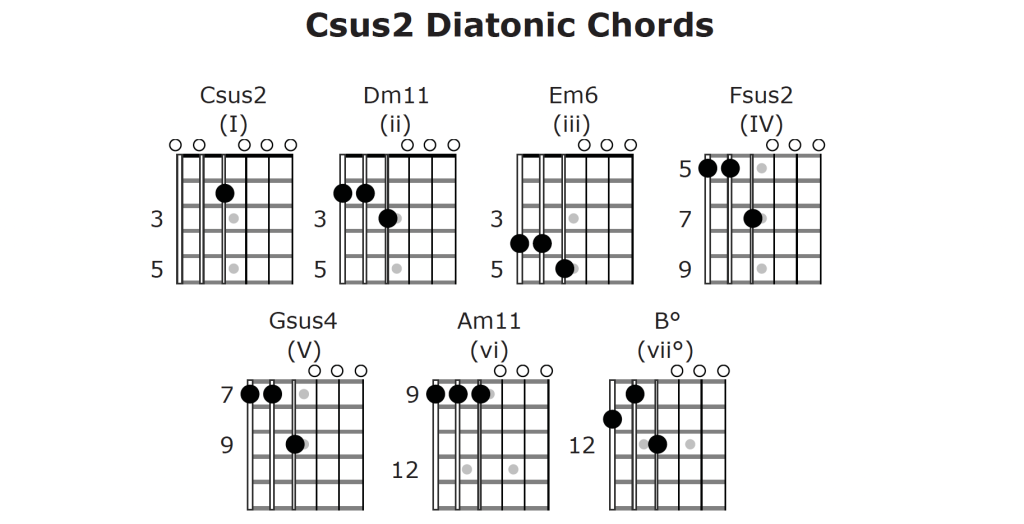
Because open csus2 tuning is built around a suspended voicing, the diatonic chord shapes on the neck look different from what you know in standard tuning. Familiar barre chord shapes do not produce the same results. Instead, you are working with a new layout. Learning the diatonic chord chart for this tuning is the most direct way in.
Vicki Genfan, whose work across multiple TrueFire courses explores alternative tunings in depth, is the educator guiding the video lesson that accompanies this article. Her approach is practical: map the diatonic chords first, then use a familiar progression to hear the tuning’s character in a context you already know.
The diatonic chords of open csus2 tuning reflect its suspended nature throughout. Some shapes will feel close to what you expect. Others will surprise you. In particular, the sus2 quality colors chords across the neck. That creates voicings that sound genuinely different from anything in a standard or major open tuning.
Why Suspended Harmony Works for Ambient Playing
Suspended harmony has a specific emotional quality. It is inherently open and unresolved. That makes it a natural fit for music that breathes. Think about fingerstyle playing that benefits from space between notes, where the resonance of the instrument is part of the composition. Open Csus2 tuning amplifies that quality.
In standard tuning, a sustained chord carries a clear harmonic identity. However, in open csus2 tuning, that identity is softer. The chord suggests without declaring. For ambient playing, that ambiguity is an asset. It gives the listener room to sit inside the sound rather than being directed somewhere specific.
Additionally, fingerstyle players benefit from the way open Csus2 tuning responds to light touch. The suspended voicing is already doing harmonic work. So simple melodic lines over open strings carry more weight. You do not need dense chord voicings to fill the sonic space.
The “Let It Be” Progression as a Practice Map
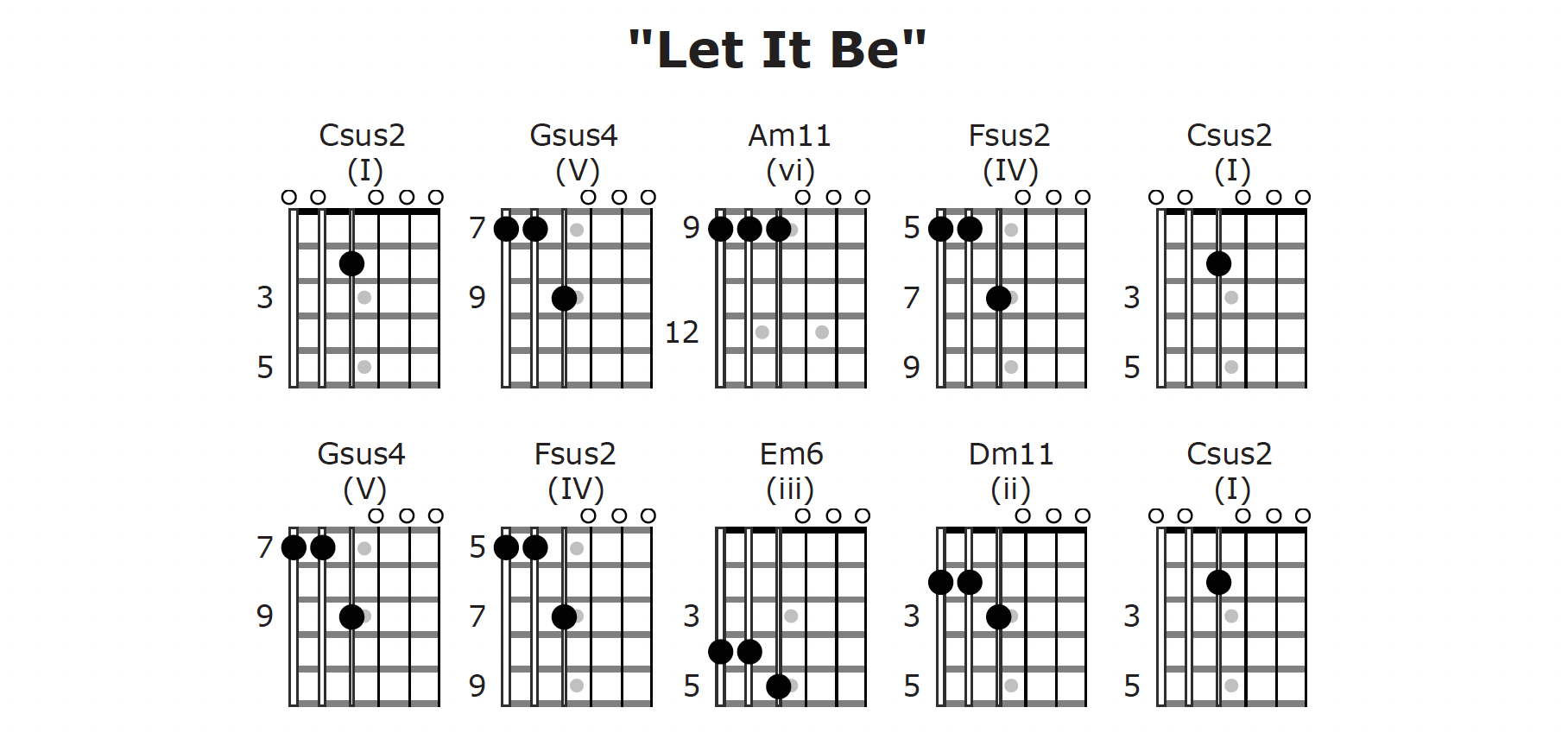
One of the most effective ways to understand a new tuning’s character is to run a familiar progression through it. That is exactly what Vicki does in the video lesson, using the chord changes from “Let It Be.” Because you already know how that progression sounds, you can focus entirely on how open csus2 tuning colors it differently.
The result is illuminating. A progression that feels grounded in standard tuning takes on a different quality through a suspended open tuning. Specifically, the suspended character of the open strings bleeds into the chord changes. The effect is subtle but unmistakable. The music still moves through recognizable harmony, but with a softer, more open feel underneath.
This approach also gives you a practical reference point. Once you hear how a known progression behaves in open csus2 tuning, you have a clearer sense of what the tuning does to your own chord ideas. For example, progressions that felt ordinary in standard tuning may gain texture when filtered through this suspended harmonic palette.
Common Mistakes When Learning a Suspended Tuning
The most common mistake players make with open Csus2 tuning is trying to use it like a major open tuning. There is no third in the voicing. Shapes that rely on thirds for their identity will not behave as expected. Therefore, you need to approach the neck fresh rather than mapping old shapes onto new territory.
A second mistake is avoiding the open strings. The open strings in open Csus2 tuning are the point. Letting them ring, layering melody over them, and using them as a harmonic bed is where the tuning’s character lives. Instead of fretting around them, lean into them deliberately.
Finally, do not rush when first learning the tuning. A slower tempo range gives you time to hear how each note resonates against the open strings. It also matches the reflective, spacious music this tuning naturally serves.
How to Start Exploring Open Csus2 Tuning Today
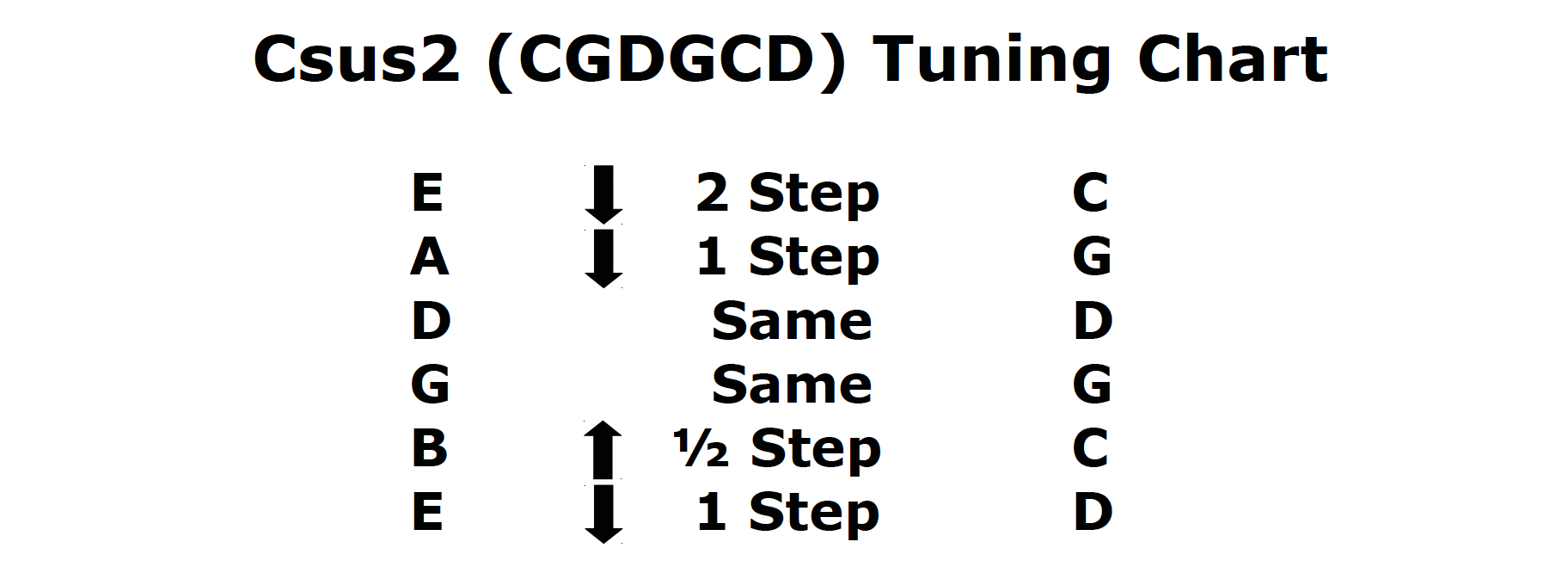
Start by tuning to open csus2 and simply playing the open strings. Listen to the suspended quality without playing anything on the neck. That sound is the tuning’s identity. Internalizing it early will shape every decision you make afterward.
Next, work through the diatonic chord chart in the video lesson. Do not try to memorize everything at once. Instead, learn a few shapes and use them to build short progressions. Then bring in the “Let It Be” changes as a reference, following along with Vicki’s video to hear how a suspended open tuning filters a familiar harmonic landscape.
Open Csus2 tuning is not as widely discussed as open D chord shapes and their straightforward layout or the blues-rooted world of open G. It is a different animal than the modal ambiguity of DADGAD. It is also distinct from the darker, cinematic quality of open Emin11. Each of those tunings has its own logic and emotional range. Open Csus2 tuning occupies a specific corner of that world: spacious, suspended, and ideal for music that values breathing room over harmonic declaration. If you are looking for a genuinely different texture for your fingerstyle writing or ambient playing, this tuning delivers it. And when you are ready to go further, the full survey of open tunings gives you the broader map.
Dig deep with Vicki Genfan in her Top-Ranked TrueFire library!Start →
Continue Learning
Explore the rest of this series:
- 11 Open Tunings for Guitar Every Player Should Know (And Why They’re Worth the Switch)
- Open D Guitar Chords: How to Tune, Play Diatonic Chords, and Sound Great Fast
- Open G Guitar Chords: How to Navigate the Tuning Behind Blues and Classic Rock
- DADGAD Guitar Chords: How to Use the Modal Tuning Favored by Celtic and Fingerstyle Players
- Open Emin11 Guitar Tuning: How to Get a Dark, Cinematic Sound From Open Strings
- 6 Unusual Open Guitar Tunings Worth Exploring (With Diatonic Chords and Etude Performances)
About the Education Team
Four music-industry veterans with decades of combined experience in music education, curation, and production at TrueFire and ArtistWorks. The TrueFire Studios Education Team plans and edits this content and works with our master-musician faculty to keep it accurate and genuinely useful.
Featured Contributor
VG
Vicki’s mastery of guitar borders on pure alchemy. Audiences are mesmerized by the waves of sound Vicki creates with just two hands, her voice, 29 alternate tunings, and and the percussive technique she calls slap-tap.