


VG
Open Dchords have a quality that’s hard to describe until you hear it: warm, full, and immediate. Strum the open strings, and you’re already playing a complete, ringing chord. That’s the promise of this tuning, and it delivers from the first moment. In this article, you’ll learn how the tuning is structured and where the diatonic chords live on the neck. You’ll also find practical guidance so the learning curve doesn’t slow you down. If you’re new to open tunings generally, start with our complete guide to open tunings for guitar first, then come back here. This article is specifically about understanding Open D as a harmonic system, not just a set of shapes to memorize.
Why Open D Guitar Chords Feel Different From Standard Tuning
The first thing to understand about open d chords is that your standard-tuning muscle memory doesn’t transfer. The shapes you’ve spent years building are gone. For some players, that’s frustrating. For others, it’s liberating. Either way, it’s temporary.
Because the open strings already form a full major chord, every chord relationship on the neck is built on top of that foundation. That changes how intervals are distributed across the strings. As a result, shapes that felt awkward in standard tuning sometimes become natural here, and vice versa.
The tuning rewards players who think in terms of chord tones and intervals rather than memorized patterns. In other words, you’re better off asking “where does the root sit?” than “what shape do I use?” That mental shift pays off across the whole neck, not just in the first few positions.
How the Tuning Is Structured
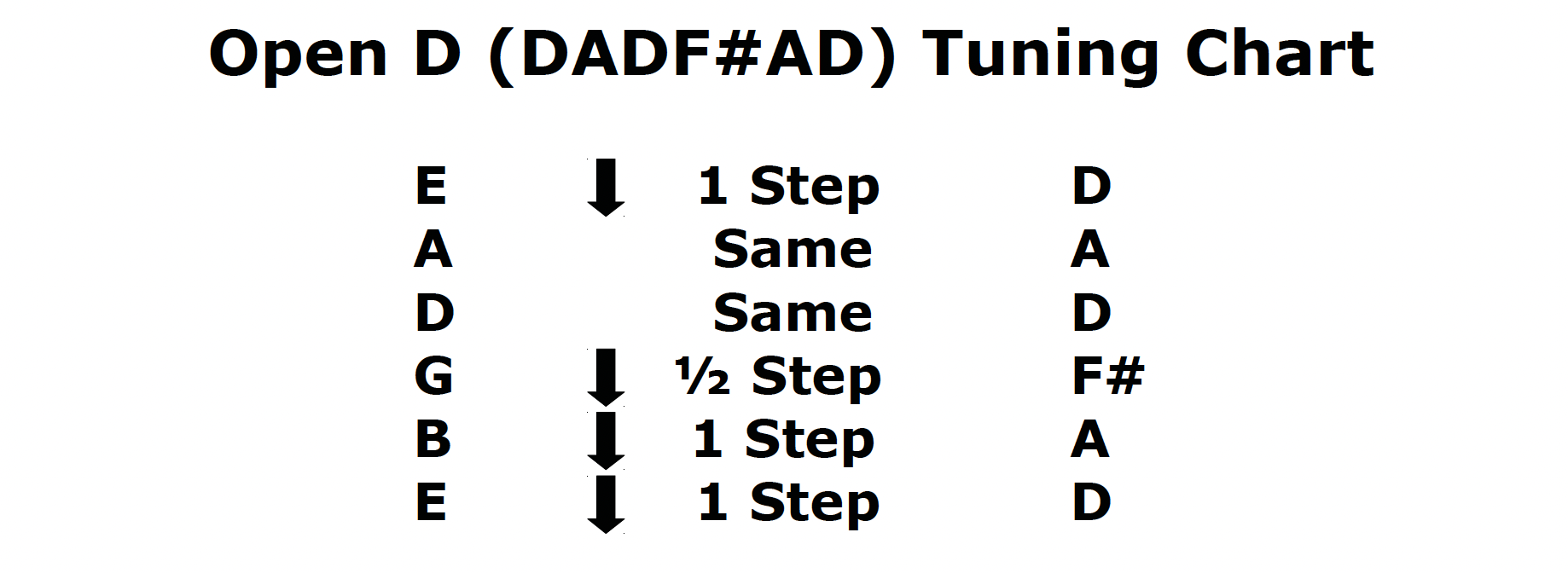
To understand open D chords, you need to understand the logic of the tuning itself. The lowest string stays at its standard pitch. The next string drops a whole step. The two middle strings remain unchanged. The second string drops a half step, and the highest string drops a whole step.
The result is that the open strings spell out a major chord across all six strings. That’s what makes the tuning so immediately playable. You can strum without fretting anything and get a full, resonant sound. That’s also why it’s a favorite for slide playing. A straight bar or bottleneck across any fret produces a clean, in-tune chord instantly.
Vicki Genfan, one of TrueFire’s most creative fingerstyle voices, teaches this tuning with an emphasis on understanding the layout before worrying about the shapes. Once you hear how the strings interact, the chord relationships start to make sense on their own.


This video is unavailable.
Get video-sync tab and notation for this lesson on TrueFire!Start →
Where the Diatonic Open D Chords Live
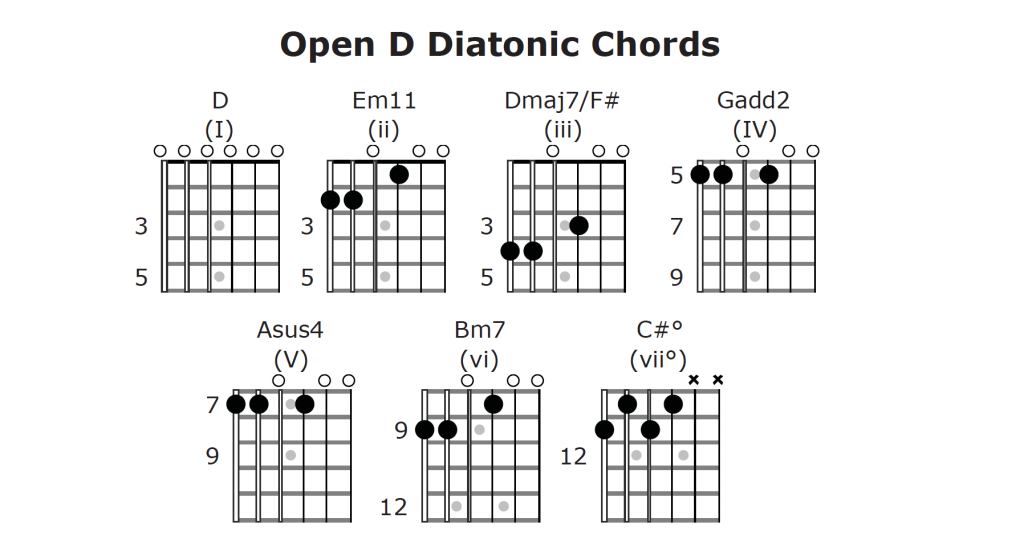
This is the section most players skip, and it’s a mistake. The diatonic chords of Open D don’t sit where you’d expect them. However, once you map them out, the logic is consistent and repeatable.
The one chord is, of course, the open strings. The four chord sits at a lower region of the neck, and the five chord is nearby. Those three chords alone give you a complete blues or folk progression. For example, a basic twelve-bar form becomes very approachable once you locate just those two shapes.
The two, three, six, and seven chords require a bit more exploration. Some involve partial barres. Some involve open-string drones. Others use voicings that simply don’t exist in standard tuning. That’s actually one of the rewards: open d chords can produce lush, resonant voicings with very little left-hand effort.
Vicki’s video maps out the full diatonic set shape by shape. You can follow along and hear each chord in context. That’s the right way to absorb this material. The sound of each voicing is as important as its position on the neck.
The “Let It Be” Approach to Learning Open D Chords
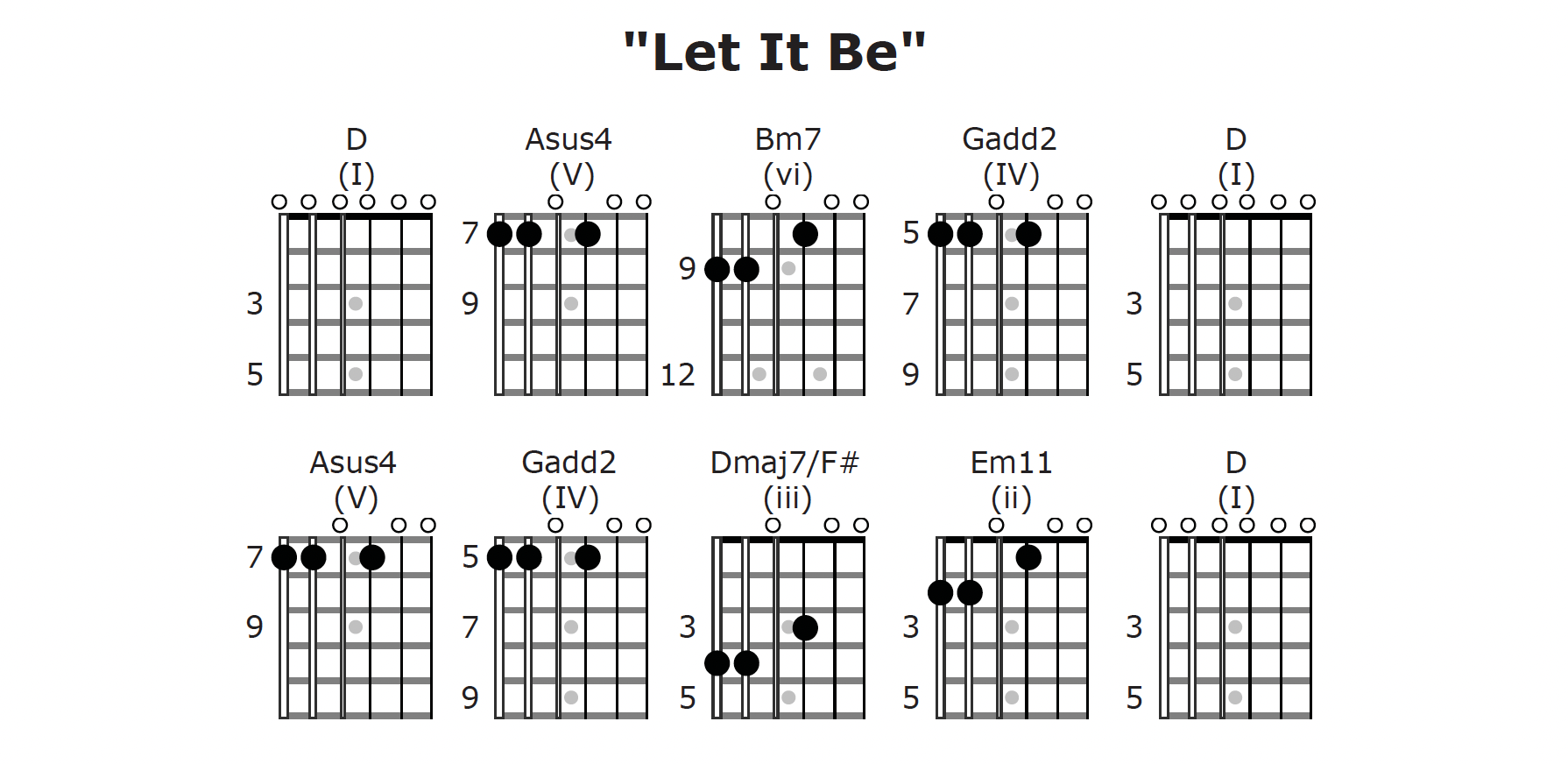
One of the smartest things you can do with a new tuning is walk a familiar progression through it. Vicki uses a progression modeled on the chord movement in “Let It Be” as a guided tour of open d chords in practice.
The progression is useful precisely because you already know how it feels harmonically. Therefore, when you play it in Open D, your ear tracks the chord changes while your hands learn where those changes live. You’re not guessing at whether a shape sounds right. Instead, you already know what’s coming. That lets you focus entirely on the physical location of each chord.
This approach is far more effective than drilling a chord chart in isolation. The musical context gives you anchors. As a result, the shapes stick faster because they’re connected to something your ear already recognizes.
Open D and Slide Guitar
Open D is one of the most natural tunings for slide playing. Understanding why helps you use it more intentionally. Because the open strings form a complete major chord, a straight bar at any position produces a chord with the same quality. That consistency is invaluable when you’re moving a slide quickly up and down the neck.
In standard tuning, a straight barre produces a major chord. However, the surrounding strings don’t necessarily support the harmony the same way. In Open D, the whole instrument rings together. The bass strings, the mid strings, and the treble strings all reinforce the same chord when the bar is straight. That creates the characteristic fullness this tuning is known for.
For fingerstyle playing, the drone strings become a different kind of tool. You can fret individual chord tones on upper strings while the open bass strings sustain underneath. The result is a layered sound. It takes significant left-hand technique in standard tuning but arrives almost naturally in Open D.
Common Mistakes When Learning Open D
The biggest mistake is treating open D chords like a shortcut. The tuning is approachable, but it still has a learning curve. Players who skip the diatonic chord work and jump straight to slide playing often develop a limited vocabulary that doesn’t grow.
A second mistake is ignoring the bass strings. Because the tuning is so resonant, it’s tempting to strum everything all the time. However, controlling which strings you let ring, and which you mute, is where the real musicality lives. Spend time on that.
Finally, don’t abandon standard tuning to spend all your time in Open D. The best use of any open tuning is contrast. If you’re curious about other options in this territory, the approach to Open G chords covers a closely related tuning. Similarly, DADGAD’s modal character offers a very different kind of open-string resonance. Both are worth understanding alongside Open D.
How to Practice Open D Chord Progressions Effectively
Start with the one, four, and five chords. Get them under your fingers at a slow, comfortable pace before adding anything else. Then introduce one diatonic chord at a time. Learn its sound before its shape.
Next, try Vicki’s “Let It Be” progression. Play it slowly, listen carefully, and notice how the open strings interact with each fretted chord. That interaction is the heart of the tuning.
Once those progressions feel familiar, explore the voicings that are unique to Open D. Some of the most satisfying Open D chords in this tuning have no standard-tuning equivalent. Those are the ones worth writing songs around.
Open D Is a Tuning Worth Committing To
For a deeper look at how Open D sits within the broader world of alternate tunings, come back to our open tunings overview. It gives you the context to understand why certain tunings serve certain styles. Open D is one of the clearest examples. Its warmth, its slide-friendliness, and its fingerstyle potential make it one of the most satisfying open tunings to write and perform in. The diatonic chord work is the investment that makes all of that possible.
Dig deep with Vicki Genfan in her Top-Ranked TrueFire library!Start →
Continue Learning
Explore the rest of this series:
- 11 Open Tunings for Guitar Every Player Should Know (And Why They’re Worth the Switch)
- Open G Guitar Chords: How to Navigate the Tuning Behind Blues and Classic Rock
- DADGAD Guitar Chords: How to Use the Modal Tuning Favored by Celtic and Fingerstyle Players
- Open Emin11 Guitar Tuning: How to Get a Dark, Cinematic Sound From Open Strings
- Open Csus2 Guitar Tuning: How to Use a Suspended Open Tuning for Ambient and Fingerstyle Playing
- 6 Unusual Open Guitar Tunings Worth Exploring (With Diatonic Chords and Etude Performances)
About the Education Team
Four music-industry veterans with decades of combined experience in music education, curation, and production at TrueFire and ArtistWorks. The TrueFire Studios Education Team plans and edits this content and works with our master-musician faculty to keep it accurate and genuinely useful.
Featured Contributor
VG
Vicki’s mastery of guitar borders on pure alchemy. Audiences are mesmerized by the waves of sound Vicki creates with just two hands, her voice, 29 alternate tunings, and and the percussive technique she calls slap-tap.