


VG
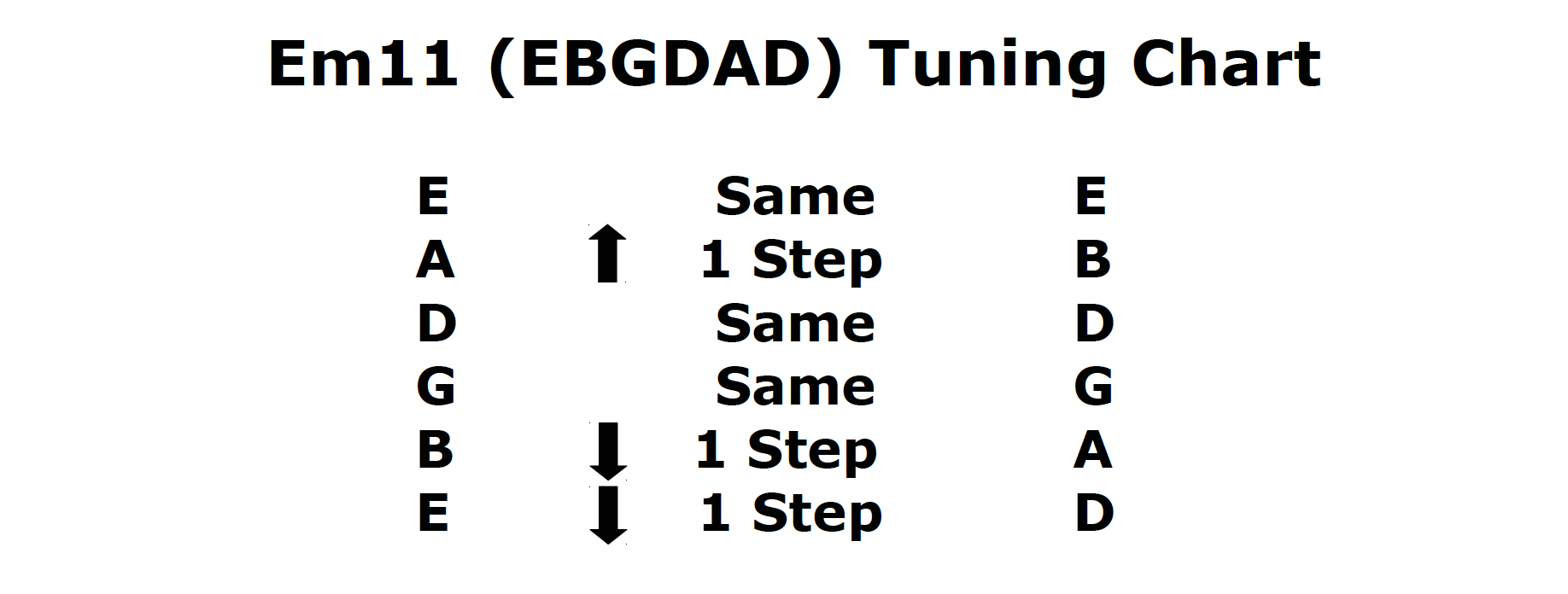
Open Emin11 tuning is one of the most atmospheric options in the whole landscape of open tunings for guitar. Strum the open strings and a rich, layered minor-11 chord rings out before you fret a single note. That voicing carries an inherently spacious, unresolved quality. It suits cinematic textures, ambient playing, and introspective songwriting in a way that standard tuning simply cannot replicate.
Vicki Genfan, one of TrueFire’s most innovative fingerstyle educators, uses this tuning to demonstrate exactly how much harmonic character lives in a set of open strings. The catch is real: such a specific voicing reshapes the entire fretboard, and familiar chord shapes do not transfer. However, that tradeoff is the price of something genuinely distinctive, and it is worth paying.
What Open Emin11 Tuning Actually Sounds Like
The first thing to understand about open Emin11 tuning is the feeling it creates before any technique enters the picture. Strum it open and you hear something spacious, moody, and unresolved. That quality is not an accident. Minor-11 harmony naturally sits between tension and stillness. As a result, it pulls the ear forward without demanding resolution.
That is different from most open tunings. Open major tunings like Open D or Open G resolve cleanly into a bright, settled sound. Open Emin11 does the opposite. It hovers. For songwriters working in cinematic, ambient, or introspective styles, that hovering quality is the whole point.
Vicki uses this tuning partly because of what it does emotionally. The minor-11 voicing built into the open strings is dense and layered. In standard tuning, that kind of chord voicing is difficult to achieve cleanly. In open Emin11, it is simply the starting point.


This video is unavailable.
Get video-sync tab and notation for this lesson on TrueFire!Start →
Why This Voicing Is Nearly Impossible in Standard Tuning
A minor-11 chord stacks several intervals on top of each other. Getting all those notes to ring cleanly and simultaneously on a guitar in standard tuning requires compromises. You typically drop notes from the voicing, rearrange them awkwardly, or accept string muting that thins the sound.
Open Emin11 solves that problem structurally. Because the open strings are already tuned to form that chord, every note of the voicing rings freely. There is no muting required. In fact, the more strings you let ring, the richer the sound becomes. That is a rare situation on guitar, and it explains why the tuning feels so immediately lush.
For comparison, consider how DADGAD works. DADGAD gives you a suspended open sound that avoids committing to major or minor. Open Emin11 makes a different choice. It commits fully to minor, then extends the harmony upward into the eleventh. The result is darker and more harmonically complex.
The Fretboard Tradeoff You Need to Accept
Here is the honest part: open Emin11 tuning does not forgive familiarity. Shapes you have used for years in standard tuning will not work here. Barre chord patterns shift. Chord voicings land in unexpected places. Because the open strings are tuned to such a specific chord, the interval relationships across the neck change entirely.
This is not unique to open Emin11. Every open tuning carries this cost. However, the specific voicing here makes the learning curve steeper than, say, Open D or Open G. Those tunings are built on major chords that share more DNA with standard tuning’s common shapes.
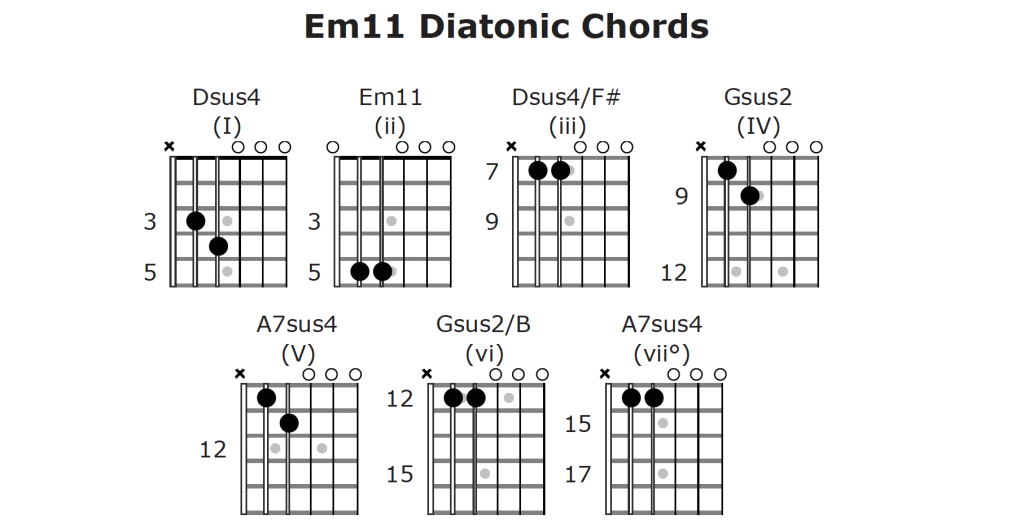
The good news is that the diatonic chord chart maps out exactly where the key chords live in the new tuning. Working through that chart methodically gives you the vocabulary you need to write and improvise. Think of it as learning a new dialect. The underlying grammar of harmony is the same; the shapes just live in different places on the neck.
How the Diatonic Chords Lay Out
The diatonic chords of open Emin11 follow minor harmony extended by the open voicing. That means the chords built on each scale degree carry the color of that rich, layered tuning into their voicings. Even chords that would normally sound plain and direct take on additional texture here.
Vicki’s video walks through the diatonic chord chart so you can hear each chord in context. Therefore, before you try to apply the chart on your own, listen to how each chord sounds against the open strings. That context matters. The goal is not just to know where the shapes are. The goal is to hear how they relate to the minor-11 atmosphere the tuning creates.
Start with the chords that appear most often in the progressions you already know. Then explore the less familiar scale-degree chords. Each one will feel different from its standard-tuning equivalent, but that difference is the point.
Playing “Let It Be” in Open Emin11 Tuning
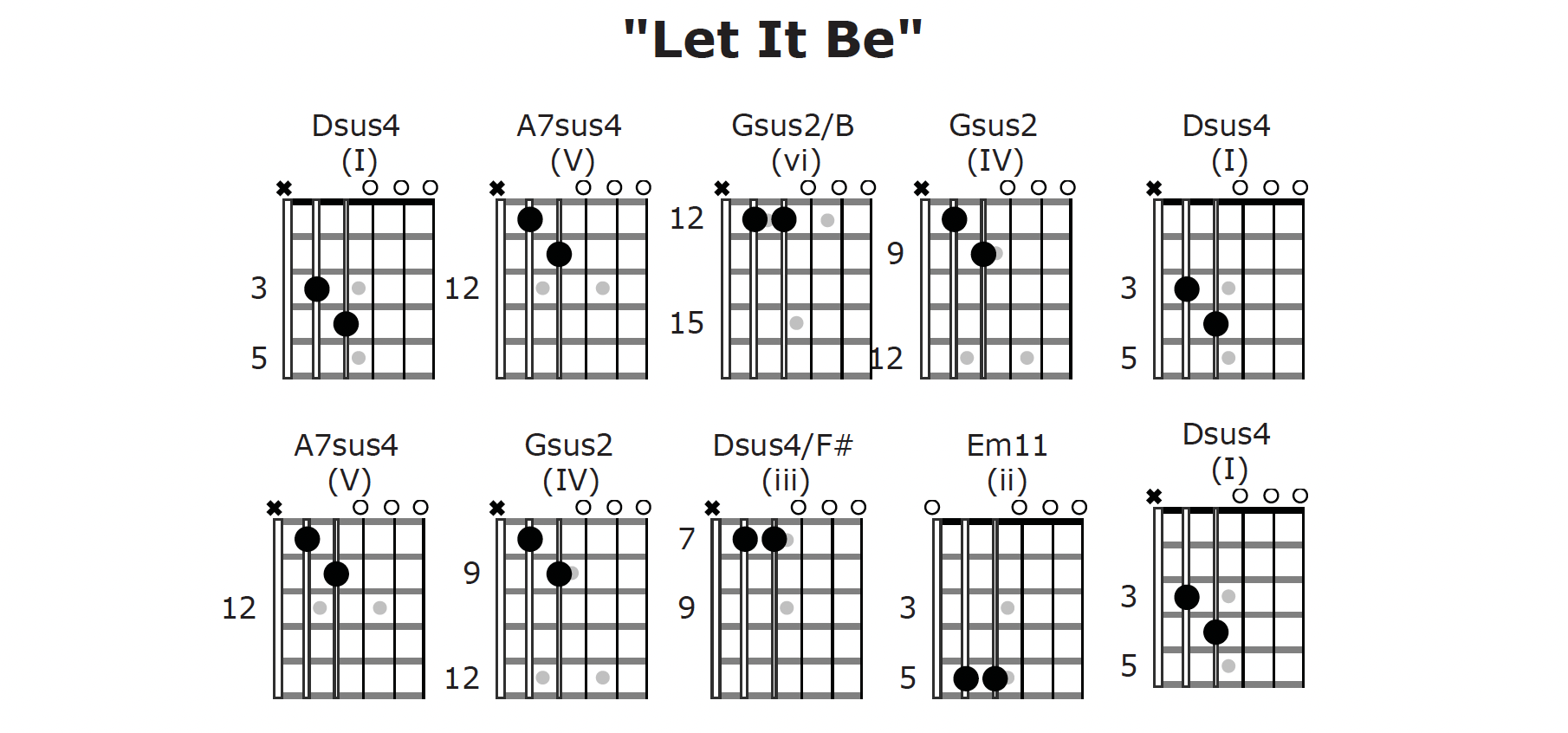
One of the most effective demonstrations in Vicki’s course involves taking a familiar major-key progression and running it through open Emin11 tuning. “Let It Be” is a clear, well-known progression. In standard tuning, it resolves warmly and openly. In open Emin11, the same progression takes on a darker, more complex coloring.
That shift happens because the tuning imposes minor-11 harmony on every chord relationship. Notes that would normally pull the progression toward a bright resolution instead carry a layer of minor color. The result is not wrong. It is a reinterpretation, and it is a genuinely useful compositional tool.
This is the kind of insight that open Emin11 tuning rewards. Familiar progressions become raw material for something new. The tuning does not erase the original emotional logic of the song. Instead, it filters it through a darker lens.
Applying Open Emin11 to Your Own Playing
The most practical starting point is to tune to open Emin11 and simply strum the open strings for a minute before doing anything else. Let the sound of the chord settle in. Then work through the diatonic chord chart Vicki provides in the video, one chord at a time.
After that, try the “Let It Be” progression. Even if you know the song well, playing it in this tuning will feel unfamiliar at first. That unfamiliarity is useful. It forces you to listen instead of relying on muscle memory. You will start hearing the tuning’s character more clearly.
For more ambient and suspended textures in a different harmonic direction, Open Csus2 is worth exploring alongside this tuning. And if you want to survey the full range of what open tunings can do, the broader guide to unusual open tunings maps out several more options with diatonic chord resources included.
Who Open Emin11 Tuning Is Really For
Open Emin11 is not the most intuitive starting point for someone new to alternate tunings. The voicing is rich and specific, and the fretboard relearning takes time. For that reason, players who have already spent time with open major tunings or modal options like DADGAD will adapt more quickly.
However, the players who will get the most from open Emin11 are the ones chasing something atmospheric. Songwriters who want a dark, cinematic harmonic foundation. Fingerstyle players who want complex chord textures without stacking them note by note. Players who want to sit inside a minor-11 sound and write from that place.
That is a specific creative goal. Open Emin11 tuning meets it directly. Few other tunings offer that combination of immediate lushness and built-in harmonic complexity. Start with Vicki’s video, work through the chord chart, and let the tuning show you what it can do.
Dig deep with Vicki Genfan in her Top-Ranked TrueFire library!Start →
Continue Learning
Explore the rest of this series:
- 11 Open Tunings for Guitar Every Player Should Know (And Why They’re Worth the Switch)
- Open D Guitar Chords: How to Tune, Play Diatonic Chords, and Sound Great Fast
- Open G Guitar Chords: How to Navigate the Tuning Behind Blues and Classic Rock
- DADGAD Guitar Chords: How to Use the Modal Tuning Favored by Celtic and Fingerstyle Players
- Open Csus2 Guitar Tuning: How to Use a Suspended Open Tuning for Ambient and Fingerstyle Playing
- 6 Unusual Open Guitar Tunings Worth Exploring (With Diatonic Chords and Etude Performances)
About the Education Team
Four music-industry veterans with decades of combined experience in music education, curation, and production at TrueFire and ArtistWorks. The TrueFire Studios Education Team plans and edits this content and works with our master-musician faculty to keep it accurate and genuinely useful.
Featured Contributor
VG
Vicki’s mastery of guitar borders on pure alchemy. Audiences are mesmerized by the waves of sound Vicki creates with just two hands, her voice, 29 alternate tunings, and and the percussive technique she calls slap-tap.