


VG
Open g chords have been central to some of the most recognizable music ever recorded. From Delta blues to the Rolling Stones, this tuning shows up everywhere once you start listening for it. The reason is simple: strum the open strings and a full, ringing chord comes back at you with no fretting required. That resonant, droning quality is immediately available. It makes the tuning ideal for slide work, rhythm playing. Anything where you want the guitar to breathe on its own.
However, the tradeoff is real. Standard chord shapes no longer apply, so you are trading a familiar fretboard for a new one. The complete guide to open tunings covers the broader payoff-vs-tradeoff picture. This article focuses specifically on open G: how the diatonic chords lay out, where to find them. How to start navigating the tuning with confidence.
Why Open G Guitar Chords Have Such a Distinctive Sound
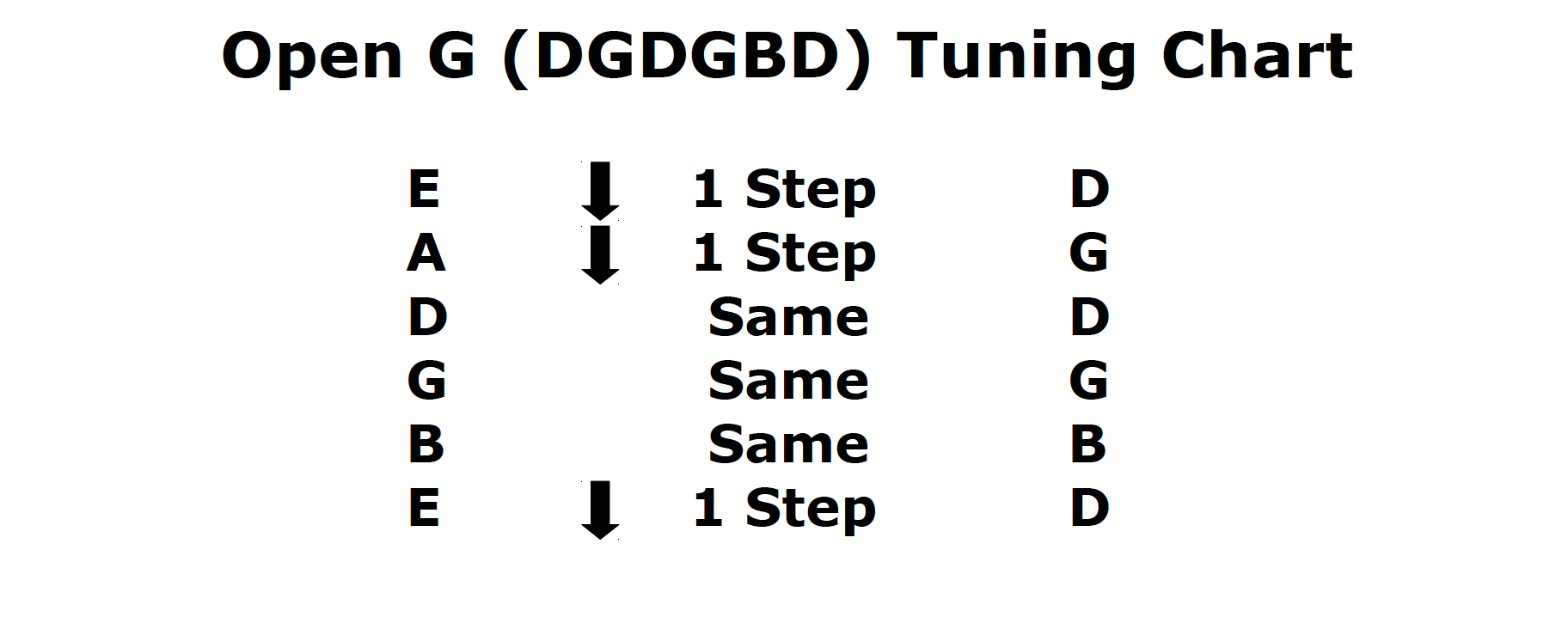
The open strings in this tuning are tuned to a major chord. Strum them without touching a fret and you get a full, resonant voicing right away. That built-in starting point changes how the guitar feels to play. Because of it, open G rewards a lighter touch. The guitar rings out freely between chord changes, and that sustain becomes part of the sound rather than something to manage.
This is also why the tuning is so well-suited to slide playing. The bottleneck can move straight across all the strings at any position and land on a chord. In standard tuning, that does not happen. Here, it does. As a result, slide and rhythm playing feel more connected in open G than in most other tunings.
The historical weight behind this tuning is real. Blues players have used it for generations, and classic rock guitarists built some of their most iconic riffs around it. So when you pick it up, you are stepping into a long tradition.


This video is unavailable.
Get video-sync tab and notation for this lesson on TrueFire!Start →
The Diatonic Chord Layout in Open G Chords
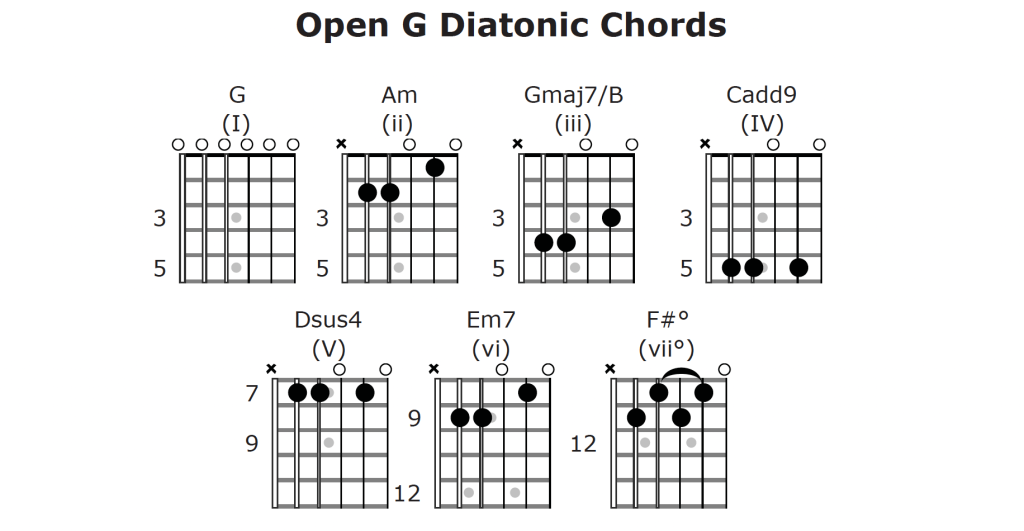
This is where players often get stuck. The diatonic open G chords do not look like anything from standard tuning. The fretboard feels disorienting at first. However, the underlying logic is consistent. Once you see the pattern, it becomes navigable quickly.
The major chord is the open strings. That is your starting point. From there, each diatonic chord sits at a specific position on the neck. The relationships between them stay fixed. The one chord, four chord, and five chord all follow a clear pattern. Minor chords and seventh chords fall into the same system.
TrueFire educator Vicki Genfan walks through this layout in detail in her course. She shows each shape visually so you can see exactly where your fingers go. That is far more useful than trying to work it out abstractly. Once you have the chord chart in front of you and see how it maps to the neck, the positions start to stick.
In practice, most of what you need for blues and classic rock sits in a compact area of the neck. You do not have to range across the entire fretboard to play through a standard progression. That is one reason the tuning is so approachable once the initial adjustment period passes.
Using “Let It Be” as a Roadmap Through Open G Chords
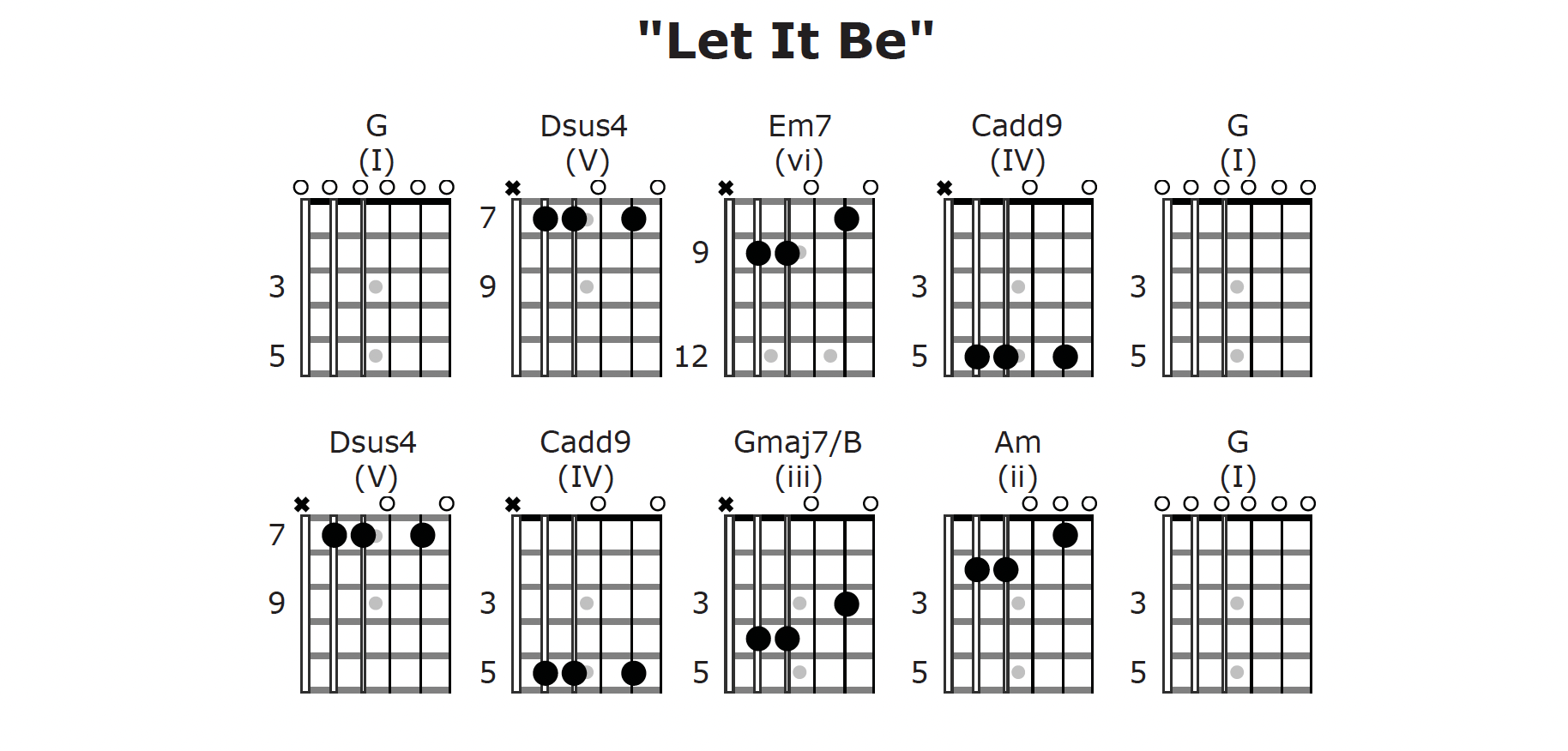
One of the most effective ways to orient yourself in open G guitar chords is to run a familiar progression through the tuning. Vicki Genfan uses the chord changes from “Let It Be” for exactly this purpose. Because you already know how that progression sounds, your ear gives you immediate feedback on whether the shapes are correct.
That familiarity is genuinely useful. When you are learning a new tuning, everything feels uncertain. However, a chord progression you already know removes one layer of uncertainty. You can focus on the physical shapes and positions. You are not also trying to hear whether the harmony sounds right.
Vicki walks through the “Let It Be” changes in the video, showing each open G shape in real time. Specifically, she demonstrates how the chord transitions feel different in this tuning compared to standard. Certain voicings ring out in a way that standard tuning simply cannot replicate. Following along with her playing is the clearest way to hear and see the tuning in action.
Common Adjustments Players Make in Open G
Standard barre chord shapes do not carry over. That is the central adjustment. In standard tuning, a barre chord at almost any position gives you a usable major chord. In open G guitar chords, a straight barre across all strings also gives you a major chord at any position. That is actually one of the tuning’s strengths. However, the minor and seventh chord shapes require new fingering.
Most players find that the minor chord shapes take the most getting used to. They sit in positions that feel counterintuitive at first. For example, the shape you need for the minor chord built on the second scale degree is different from anything in your standard tuning vocabulary. Give yourself time with those shapes specifically.
Seventh chords, on the other hand, often feel more natural. Because of how the open strings are tuned, adding a seventh to a chord frequently requires only one or two additional fingers. In other words, the tuning makes dominant seventh voicings relatively easy to access. That is one reason open G chords are so central to blues playing.
The open D approach to diatonic chords covers similar terrain from a different angle. It is worth comparing the two layouts once you have a feel for open G. The contrast clarifies the logic of each tuning.
When to Reach for Open G Guitar Chords
Open G is not a novelty tuning. It is a full harmonic system, and it suits specific musical contexts better than others. Blues, whether acoustic or electric, is the most obvious application. Classic rock rhythm parts are another. Slide guitar in any style is a natural fit.
However, open G also works for fingerstyle playing. Because the open strings ring sympathetically, fingerpicked lines have a harp-like quality. That quality is hard to get in standard tuning. If you play DADGAD-style Celtic or fingerstyle guitar, the approach to open strings as a harmonic resource will feel familiar. The two tunings sound quite different, but the underlying concept connects.
The ambient and fingerstyle applications of suspended open tunings push that idea further. For now, the main point is this: open G rewards players who commit to learning its chord layout rather than treating it as a temporary experiment.
Getting the Most Out of Open G Guitar Chords
Vicki Genfan’s course gives you the chord chart, the shapes, and the progressions in video form. You can see every position rather than guessing at it. Start with the diatonic chord layout. Then play through the “Let It Be” changes until the transitions feel smooth. After that, try writing your own short progression using only the chords from the chart.
The broader guide to open tunings puts open G in context alongside other systems worth exploring. Once the open G guitar chords feel comfortable, that wider view will help you understand which tuning fits which musical moment.
This tuning has earned its place in the history of the instrument. Spend time with it and you will hear why.
Dig deep with Vicki Genfan in her Top-Ranked TrueFire library!Start →
Continue Learning
Explore the rest of this series:
- 11 Open Tunings for Guitar Every Player Should Know (And Why They’re Worth the Switch)
- Open D Guitar Chords: How to Tune, Play Diatonic Chords, and Sound Great Fast
- DADGAD Guitar Chords: How to Use the Modal Tuning Favored by Celtic and Fingerstyle Players
- Open Emin11 Guitar Tuning: How to Get a Dark, Cinematic Sound From Open Strings
- Open Csus2 Guitar Tuning: How to Use a Suspended Open Tuning for Ambient and Fingerstyle Playing
- 6 Unusual Open Guitar Tunings Worth Exploring (With Diatonic Chords and Etude Performances)
About the Education Team
Four music-industry veterans with decades of combined experience in music education, curation, and production at TrueFire and ArtistWorks. The TrueFire Studios Education Team plans and edits this content and works with our master-musician faculty to keep it accurate and genuinely useful.
Featured Contributor
VG
Vicki’s mastery of guitar borders on pure alchemy. Audiences are mesmerized by the waves of sound Vicki creates with just two hands, her voice, 29 alternate tunings, and and the percussive technique she calls slap-tap.