


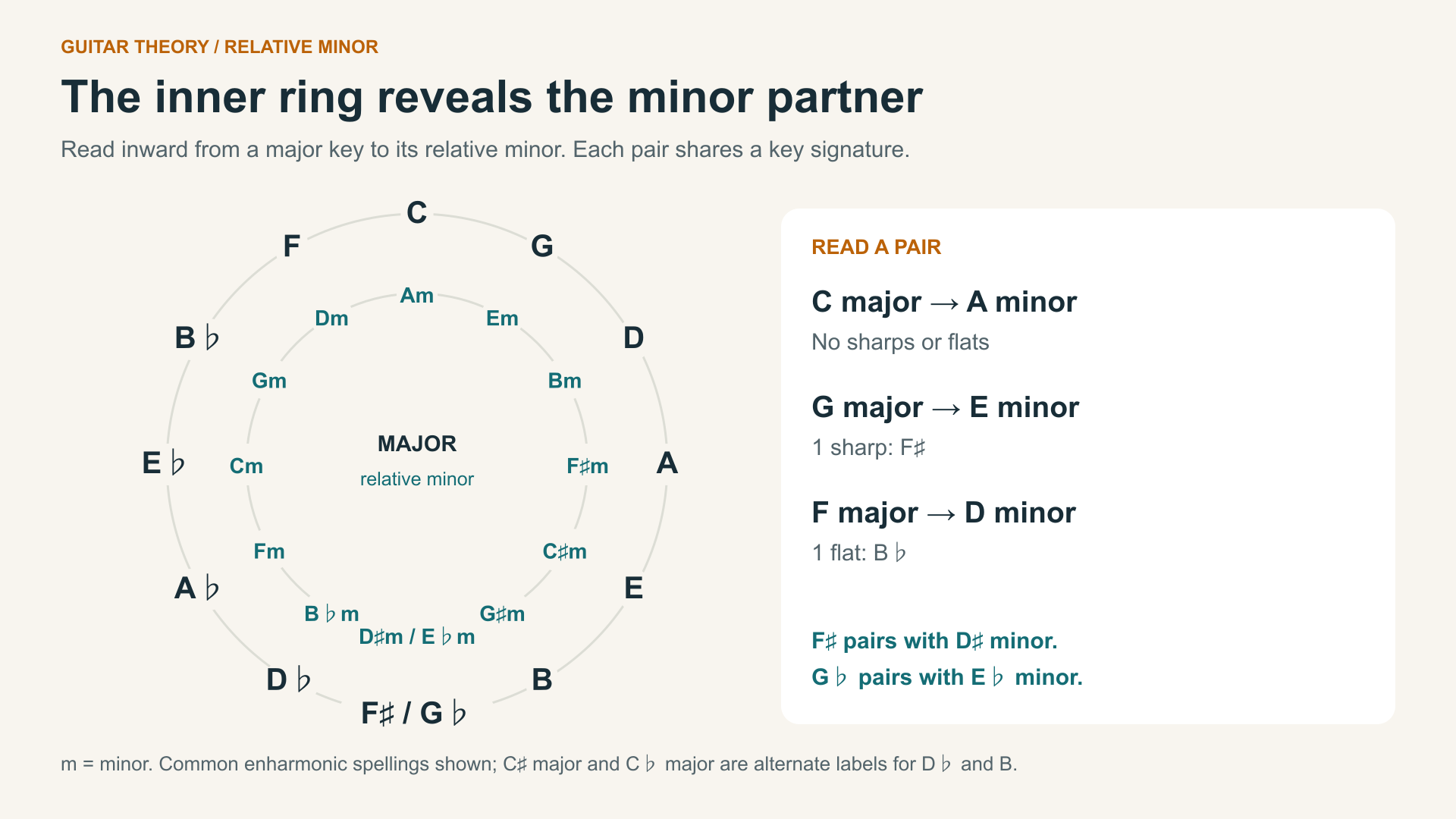
The relative minor might be the most useful concept in guitar harmony that most players never fully absorb. You’ve probably played in both major and minor contexts, but if you treat them as separate territories requiring separate knowledge, you’re working twice as hard as you need to. Every major key has a relative minor that shares its key signature; the major scale and relative natural minor scale contain the same notes. The circle of fifths doesn’t just hint at this relationship.
Instead, it displays it visually, right there in the inner ring, so you can see it instead of calculating it. If you want to understand how the circle works as a complete harmonic map, the full guide to the circle of fifths is the place to start. This article focuses on one specific payoff: understanding the relative minor and what it means for your playing.
What “Relative Minor” Actually Means
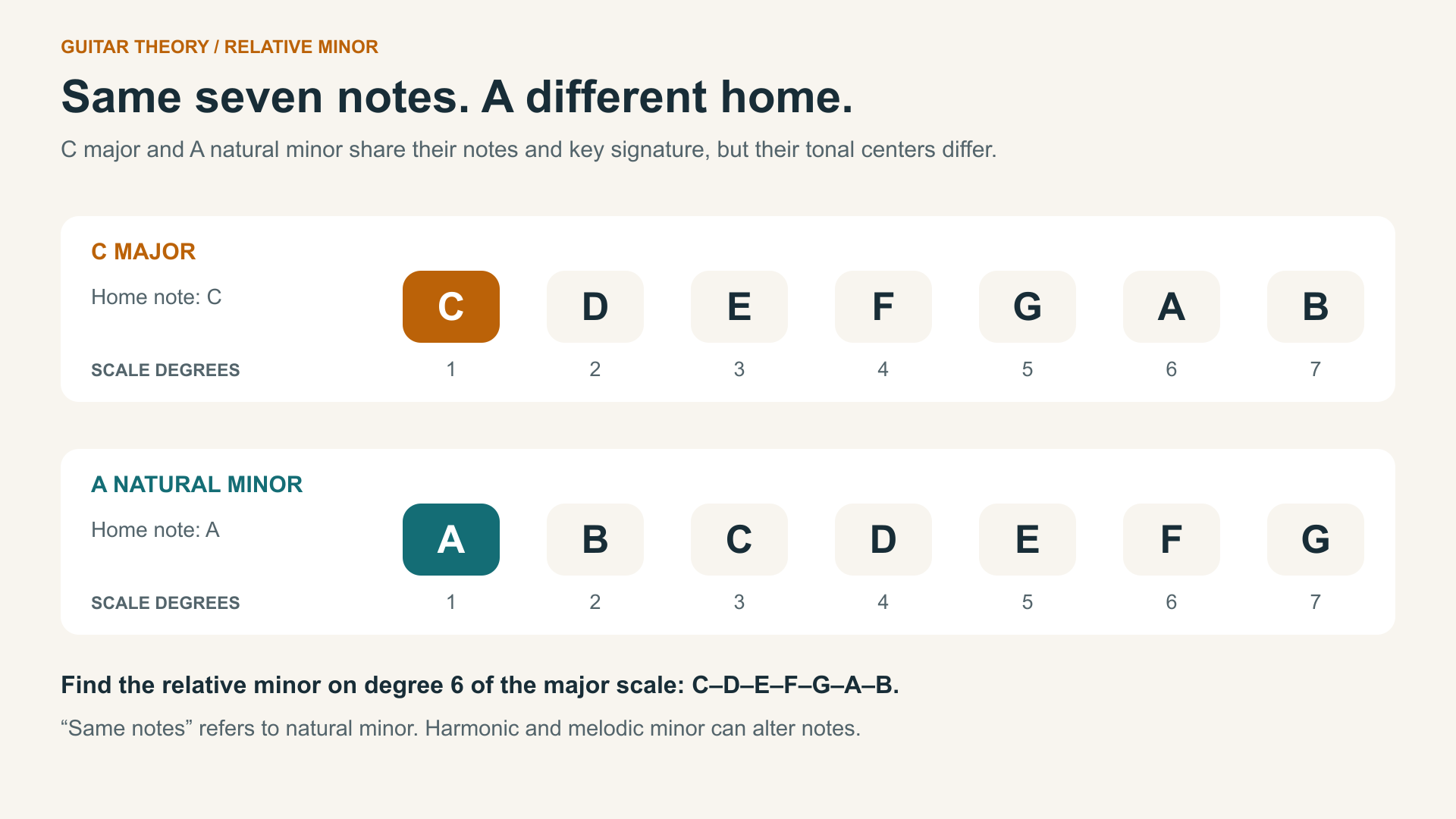
A major key and its relative minor share a key signature. The relative minor tonic is scale degree 6 of the major scale, or three semitones below the major tonic. C major and A minor are relative keys; C major and C minor are parallel keys because they share a tonic.
C major and A natural minor use the same seven notes, but the melody and harmony establish different home notes and chords. Merely starting on another note, or ending on any minor chord from the major key, does not necessarily establish the relative minor. The specific partner matters: in C major it is A minor, not D minor or E minor.
How the Circle Shows the Relative Minor
The circle of fifths has two rings. The outer ring displays the major keys. The inner ring displays their relative minors, each one sitting directly inside its partner. That placement isn’t decorative. Instead, it’s the whole point.
Because the pairings are physically adjacent on the circle, you can read them at a glance. There’s no formula to recall and no mental math to run. You look at the outer ring and find your major key. The relative minor is right there beside it on the inner ring. For anyone learning how to read the circle of fifths for the first time, this inner ring is often the feature that makes the whole diagram click into place.
The visual logic is consistent all the way around the circle. Every major key has exactly one relative minor. Every relative minor has exactly one major partner. The relationship is always the same distance apart in the note collection, which is why the inner ring works as a clean, unbroken second layer rather than a scattered list.

Why They Share Notes (and Why That Matters for Chords)
A major scale and its relative natural minor generate the same seven diatonic triads. C major and A natural minor both contain C, Dm, Em, F, G, Am, and B diminished. Those chords have different functions depending on whether C or A is the tonal center.
Minor-key music also commonly changes scale degrees 6 and 7. In A minor, raising G to G♯ creates the leading tone and allows E or E7 to pull strongly toward Am. Those chords are common in A minor even though they are not built entirely from the C major/A natural minor note collection.
For guitarists, this means familiar shapes provide useful shared material. You still need to hear the tonic and learn how minor-key harmony uses that material, including its common altered notes.
The Tonal Shift: Same Notes, Different Mood
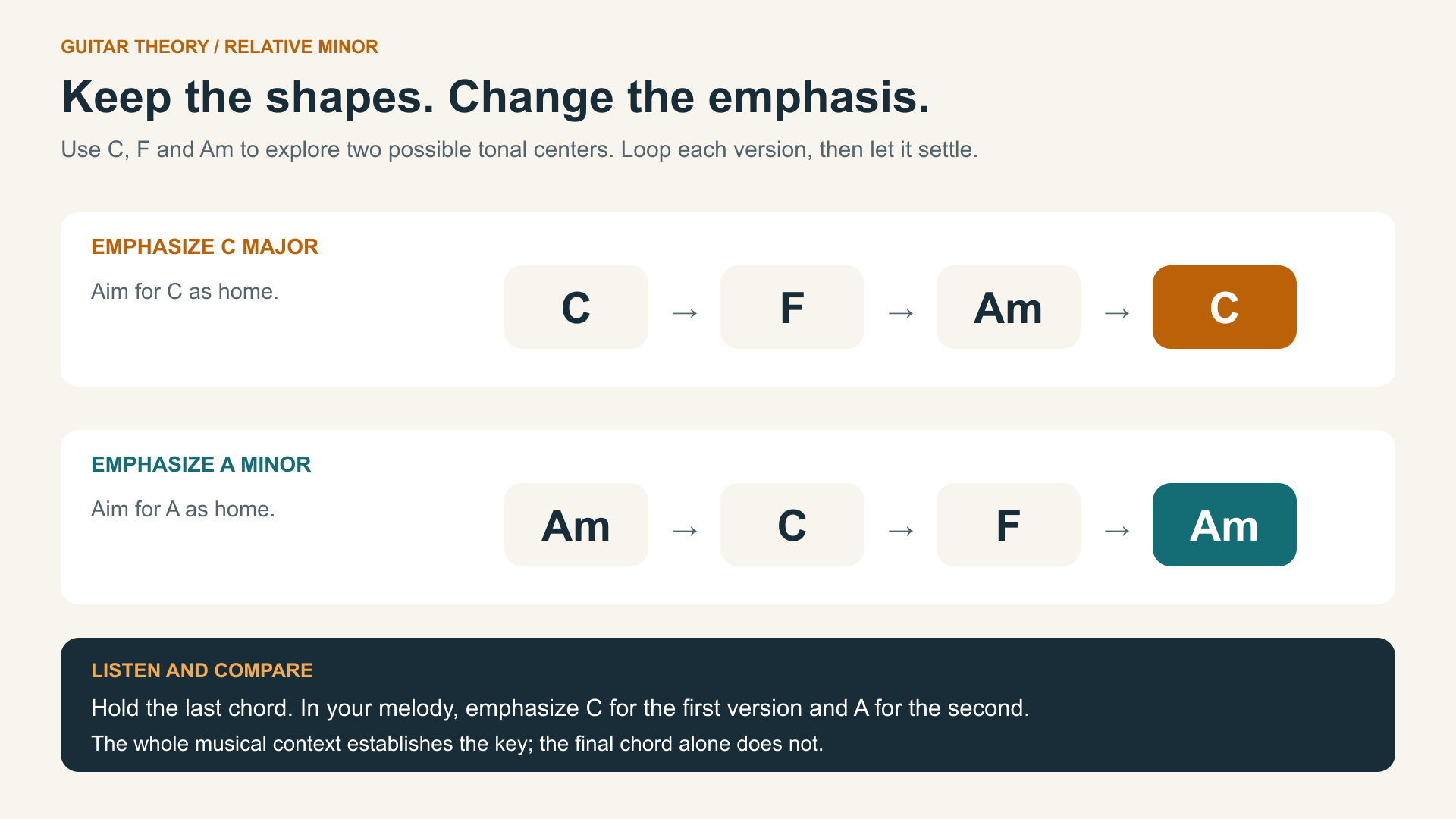
Try C-F-Am-C, then Am-C-F-Am. Repeat each version and hold its final chord. In the first, emphasize C in the melody and bass; in the second, emphasize A. Listen for a change in which note and chord feel like home.
The full musical context establishes the tonal center. A minor chord at the end of a phrase may still function within the original major key, so the last chord alone does not prove that the key has changed. Rhythm, duration, melody, bass, and recurring resolutions all contribute.
Relative keys can create useful contrast with shared notes and shapes. Major often sounds brighter and minor darker, but mood also depends on tempo, register, rhythm, and arrangement. Knowing the notes gives you a head start; controlling their tonal roles takes practice.
A Quick Exercise to Lock In the Relative Minor
Understanding the concept is one thing. Hearing it is another. So try this practical exercise first.
Use the three chords C, F, and Am. Play C-F-Am-C, letting C settle. Then play Am-C-F-Am, letting Am settle and emphasizing A in a simple melody. Repeat both versions so your ear has time to compare their tonal centers.
Check the circle: A minor sits inside C major because it is C major’s relative minor. Ask whether your second version actually makes A feel like home. If the effect is unclear, hold Am longer, repeat it at strong points in the phrase, or add an A bass note. The diagram identifies the relationship; your musical context makes it audible.
Understanding how key signatures connect to the circle will help you see why these shared notes appear in both keys with no contradictions. And once you start building progressions deliberately, the logic of adjacent chords on the circle will show you how to move between major and relative minor contexts smoothly.
Doubling Your Harmonic Territory Without Learning New Notes
If you know a major scale well, you already know the note locations for its relative natural minor. That gives you a useful starting point, but fluency in the minor key also means recognizing its tonic, phrasing toward it, and understanding common minor-key chord changes.
Treat the inner ring as a guide to another tonal context for familiar notes. A song can move between a major key and its relative minor, or leave their relationship deliberately ambiguous. Simply shifting register or starting a solo on another note does not establish that change; melody and harmony need to support the intended tonal center.
The circle of fifths overview frames all of this as part of a larger harmonic map. The relative minor is one of the most immediately usable features on that map. So use it: every major scale you know also gives you the notes of a relative natural minor. Practice hearing and using each tonal center.
Practice smart and play hard at TrueFire!Start →
About the Education Team
Four music-industry veterans with decades of combined experience in music education, curation, and production at TrueFire and ArtistWorks. The TrueFire Studios Education Team plans and edits this content and works with our master-musician faculty to keep it accurate and genuinely useful.