


FV
Voice leading means moving each note of a chord the shortest distance to the next chord. It’s the reason some players’ chord changes sound smooth while others sound jumpy. This guide explains voice leading in plain terms, then puts it to work in two classic progressions, with Frank Vignola’s video lessons from his Inversion Excursion course.
What Is Voice Leading?
Each note in a chord is called a voice, like singers in a choir. A triad has three voices: a low one, a middle one and a high one. When the chord changes, each voice moves to a note in the next chord.
Smooth voice leading follows two simple ideas. First of all, if a note is in both chords, it stays put. Then the other notes move to the nearest note in the new chord, ideally by just a fret or two.
Why Inversions Make Voice Leading Easy
Without inversions, chords jump around the neck. For example, going from an open C chord to a barre F chord moves your whole hand. With inversions, however, you can choose the version of each chord that’s closest to where your hand already is.
In the video below, Frank introduces the I–IV–V section of his course.
-0:00

This video is unavailable.

This video is unavailable.
Voice Leading in a I–IV–V Progression
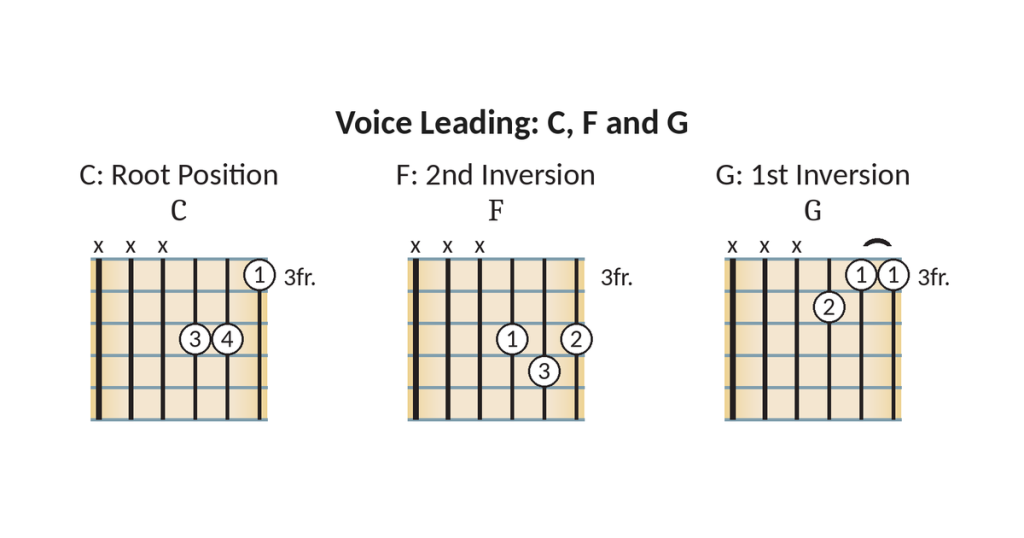
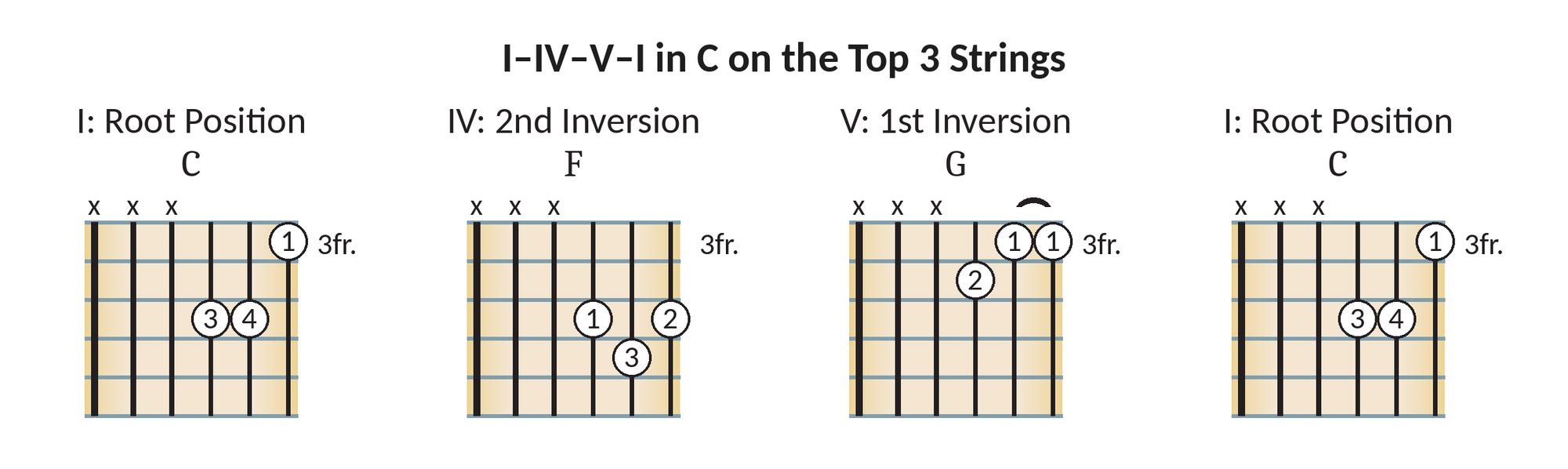
I–IV–V is the backbone of countless songs. In the key of C, those chords are C, F and G. Here’s one compact way to play them on the top three strings.
- C (root position): x x x 5 5 3. Ring finger, pinky and index finger.
- F (2nd inversion): x x x 5 6 5. Index finger on the G string, ring finger on the B string, middle finger on the high E string.
- G (1st inversion): x x x 4 3 3. Middle finger on the G string, then lay your index finger across the B and high E strings.
Each code runs from the low E string (left) to the high E string (right). A number is the fret, and “x” means don’t play that string.
Follow Each Note
- C to F: the note C stays on the G string at the 5th fret. Meanwhile, E moves up one fret to F, and G moves up two frets to A.
- F to G: these two chords share no notes, so all three voices move. Still, each one moves only one to three frets.
- G to C: the note G stays on the high E string at the 3rd fret. Then B moves up to C, and D moves up to E.
Notice that these are the same top-string shapes from our guide to triad inversions, just moved to new frets. Frank’s lesson below covers the I–IV–V progression with his own choice of inversions.
-0:00
This video is unavailable.
Watch Frank play these shapes:
-0:00
This video is unavailable.
This video is unavailable.
This video is unavailable.
Voice Leading in Minor: i–iv–V
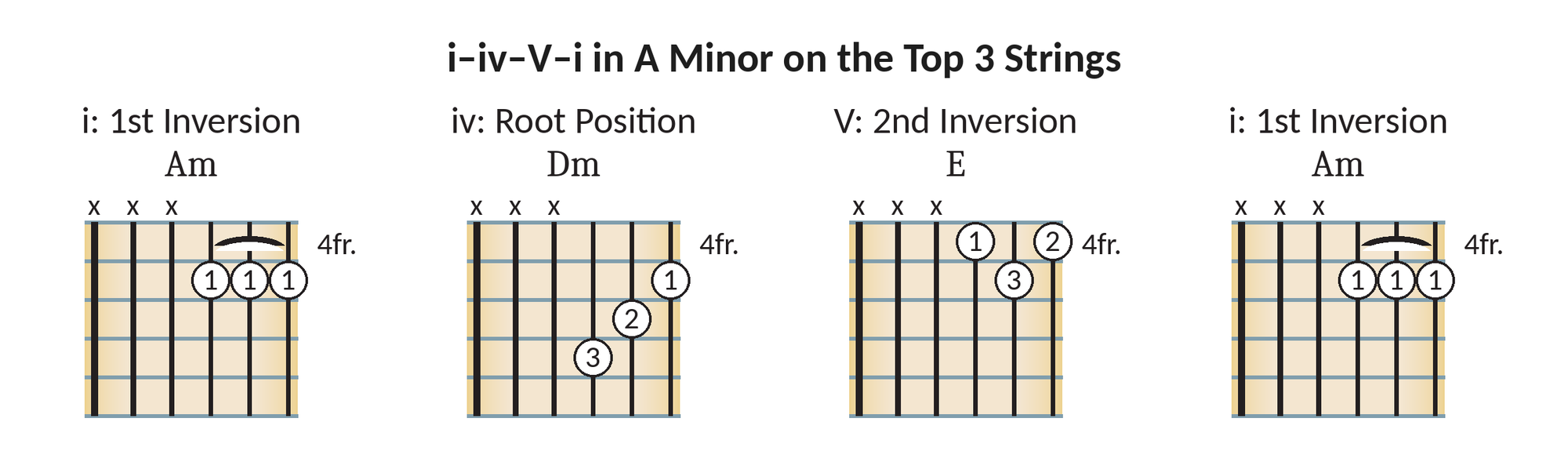
Minor keys work the same way. In A minor, the i, iv and V chords are Am, Dm and E. The V chord is E major rather than E minor, because its G-sharp pulls strongly back to A.
- Am (1st inversion): x x x 5 5 5. Lay your index finger across all three strings.
- Dm (root position): x x x 7 6 5. Ring finger, middle finger and index finger.
- E (2nd inversion): x x x 4 5 4. Index finger on the G string, ring finger on the B string, middle finger on the high E string.
Follow Each Note in Minor
- Am to Dm: A stays on the high E string at the 5th fret. Meanwhile, C moves up to D, and E moves up to F.
- Dm to E: like F and G in major, these chords share no notes. So all three voices move, by one to three frets each.
- E to Am: E stays on the B string at the 5th fret. Then B moves up to C, and G-sharp moves up to A.
That last move, G-sharp up to A, is what makes minor-key endings sound so final. In the video below, Frank applies the same ideas to the i–iv–V progression.
-0:00
This video is unavailable.
This video is unavailable.
Three Rules for Smooth Voice Leading
- Keep shared notes. If a note is in both chords, leave that finger where it is.
- Move the rest by the smallest step. Look for the nearest note in the new chord.
- Choose inversions near your hand. Instead of jumping to a new area of the neck, pick the inversion closest to where you are.
Listen to the Top Note
Voice leading also creates a hidden melody on the highest string. In the C progression above, the top notes are G, A, G and G. Likewise, in A minor they’re A, A, G-sharp and A. As a result, your chords start to sound like a tune instead of a list of shapes.
How to Practice Voice Leading
- Play C, F, G and back to C, four beats each, very slowly.
- As you change, say which note stays and which notes move.
- Next, do the same with Am, Dm, E and back to Am.
- Finally, sing or hum the top note of each chord while you play.
Keep Going
Voice leading ties this whole series together. To learn the top-string shapes used here, read our guide to triad inversions. Then add moving bass notes with our guide to slash chords. For the full picture, start at our pillar guide to chord inversions.
To see where I, IV and V come from in any key, read our guide to the harmonized scale.
Inversion Excursions – 124 video lessons and 800+ pages of charts! Start →
Continue Learning
Explore the rest of this series:
- Easy Chord Inversions: Guitar Shapes That Move Up the Neck
- Triad Inversions: 3 Easy Shapes on the Top 3 Strings
- 1st Inversion Chords: Easy Triads on the Middle Strings
- 2nd Inversion Chords: Easy Triads on the Low Strings
- Slash Chords: Easy Inversions With a New Bass Note
About the Education Team
Four music-industry veterans with decades of combined experience in music education, curation, and production at TrueFire and ArtistWorks. The TrueFire Studios Education Team plans and edits this content and works with our master-musician faculty to keep it accurate and genuinely useful.
Featured Contributor
FV
Frank’s stunning virtuosity has made him the guitarist of choice for many of the world’s top musicians, including Ringo Starr, Madonna, Donald Fagen, Hank Jones, Lionel Hampton, John Lewis, the Boston Pops, the New York Pops, and guitar legend Les Paul, who named Vignola to his “Five Most Admired Guitarists List” for the Wall Street Journal.