

FV
With chord inversions, guitar players can play the same chord in several places on the neck, each with its own sound. An inversion simply changes which note of the chord sits on the bottom. This guide explains how inversions work, why they make chord changes smoother, and where to find them. It uses charts and video lessons from jazz guitarist Frank Vignola’s Inversion Excursion course.
What Are Chord Inversions? Guitar Basics
Most chords you play start as a triad, a chord built from three notes. A C major chord, for example, uses C, E and G. You can stack those three notes in any order, and the chord is still C major.
However, the order changes the sound, because your ear hears the lowest note most clearly. That’s why guitarists name each version by its bottom note.
Root Position, 1st Inversion and 2nd Inversion
- Root position: the root is the lowest note. For C, that’s C, then E, then G.
- 1st inversion: the 3rd is the lowest note. For C, that’s E, then G, then C.
- 2nd inversion: the 5th is the lowest note. For C, that’s G, then C, then E.
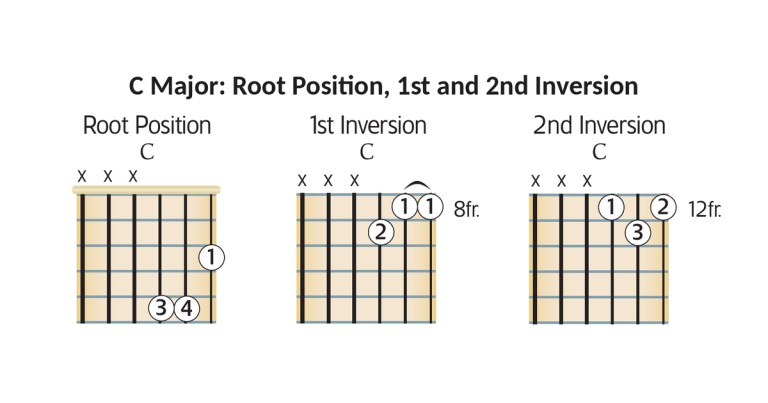
On the top three strings, those three versions of C look like this:
- Root position: x x x 5 5 3.
- 1st inversion: x x x 9 8 8.
- 2nd inversion: x x x 12 13 12.
Each code runs from the low E string (left) to the high E string (right). A number is the fret, and “x” means don’t play that string. Also note that Frank’s charts number the strings from the thinnest. So the 1st, 2nd and 3rd strings are the high E, B and G strings.
Hearing the Difference
Each inversion has its own flavor. Root position sounds solid and settled. A 1st inversion sounds lighter, because the 3rd is on the bottom. Meanwhile, a 2nd inversion sounds a little unsettled, as if it wants to move somewhere.
Try it now. Play x x x 5 5 3, then x x x 9 8 8, then x x x 12 13 12, and listen to how the mood shifts. In the video lesson below, Frank introduces the C major inversions.
-0:00 

This video is unavailable.
This video is unavailable.
Why Guitarists Use Inversions
Without chord inversions, guitar players keep jumping back to the same open shapes. Inversions fix that in three ways.
- Smoother chord changes. If you choose the inversion closest to the chord you’re already playing, your fingers barely move. This is called voice leading, and our guide to voice leading shows how it works.
- The same chord anywhere on the neck. Instead of jumping back to open position, you can play C at the 3rd, 8th or 12th fret.
- New bass notes. Changing the lowest note gives a familiar chord a fresh color. That’s where slash chords like C/E come from.
There’s also a fourth benefit. Small three-note shapes leave room for a bass player, a piano or a second guitar. That’s why rhythm players in jazz, soul and pop lean on them so often.
Major and Minor Inversions Together
Minor chords invert the same way. An A minor triad uses A, C and E. In root position, A is on the bottom. In 1st inversion, C is on the bottom, and in 2nd inversion, E is on the bottom.
Frank’s course pairs C major with A minor for a good reason. A minor is the relative minor of C, so the two chords share two notes, C and E. Our guide to the relative minor explains that connection.
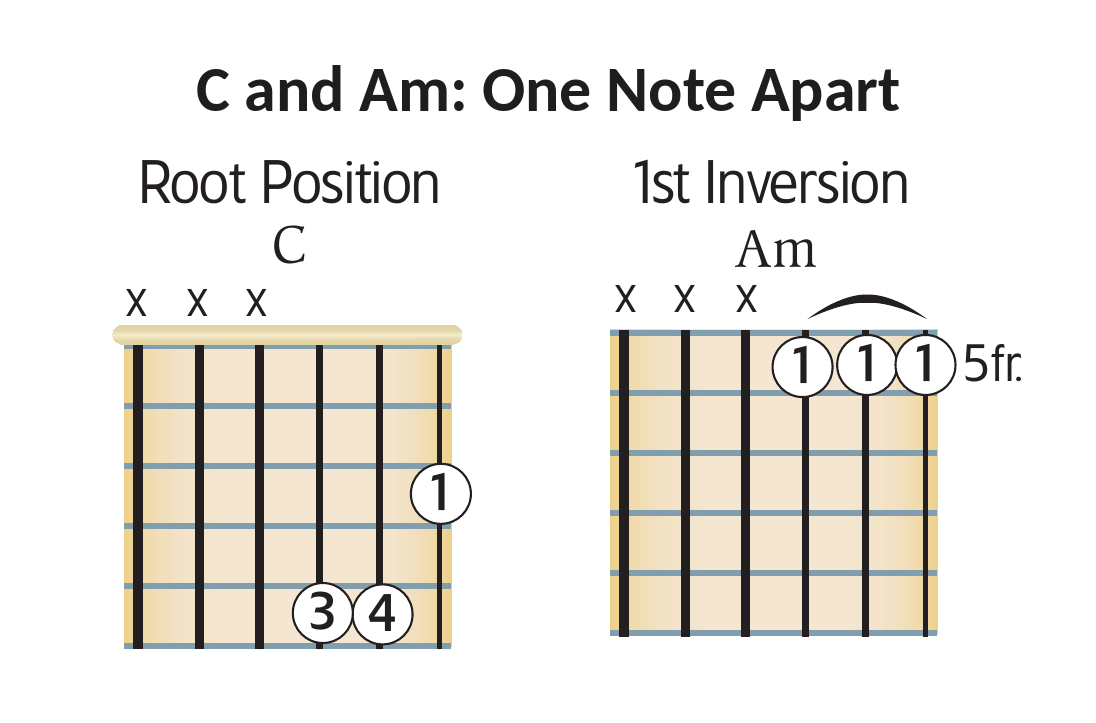
C and Am: One Note Apart
Because they share two notes, many C and Am shapes differ by just one note. For example, compare C in root position (x x x 5 5 3) with Am in 1st inversion (x x x 5 5 5). Only the high E string changes, from G at the 3rd fret to A at the 5th fret.
In the video lesson below, Frank introduces the A minor inversions.
-0:00 This video is unavailable.
This video is unavailable.
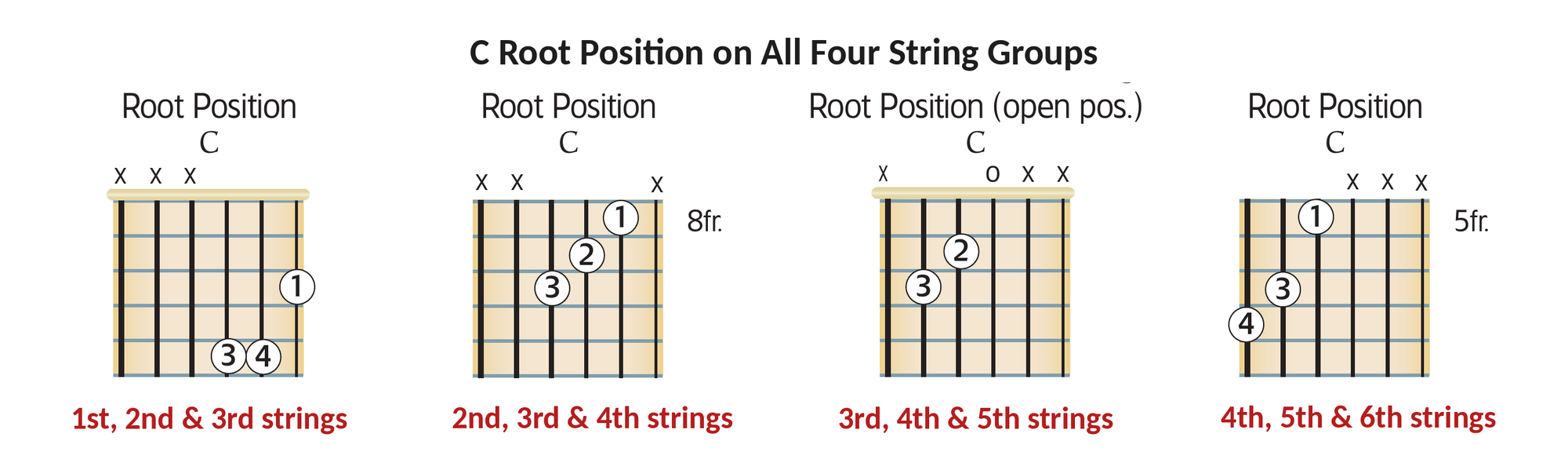
The Four String Groups
Frank teaches every triad on four groups of three neighboring strings. Each group gets its own guide in this series.
- 1st, 2nd and 3rd strings (high E, B and G): the brightest shapes. See our guide to triad inversions.
- 2nd, 3rd and 4th strings (B, G and D): warm, middle-range shapes. See our guide to the 1st inversion.
- 3rd, 4th and 5th strings (G, D and A): fuller shapes.
- 4th, 5th and 6th strings (D, A and low E): the deepest shapes. Both low groups are in our guide to the 2nd inversion.
The chart above shows C in root position on all four groups. In other words, one chord turns up in four completely different places.
Adding a Bass Note: Slash Chords
Frank also teaches spread-out shapes with a bass note on the 4th, 5th or 6th string. Two higher notes sit on top, with a string skipped in between.
When that bass note isn’t the root, you get a slash chord. For example, C with E in the bass is written C/E. Our guide to slash chords covers all of Frank’s bass-note shapes.
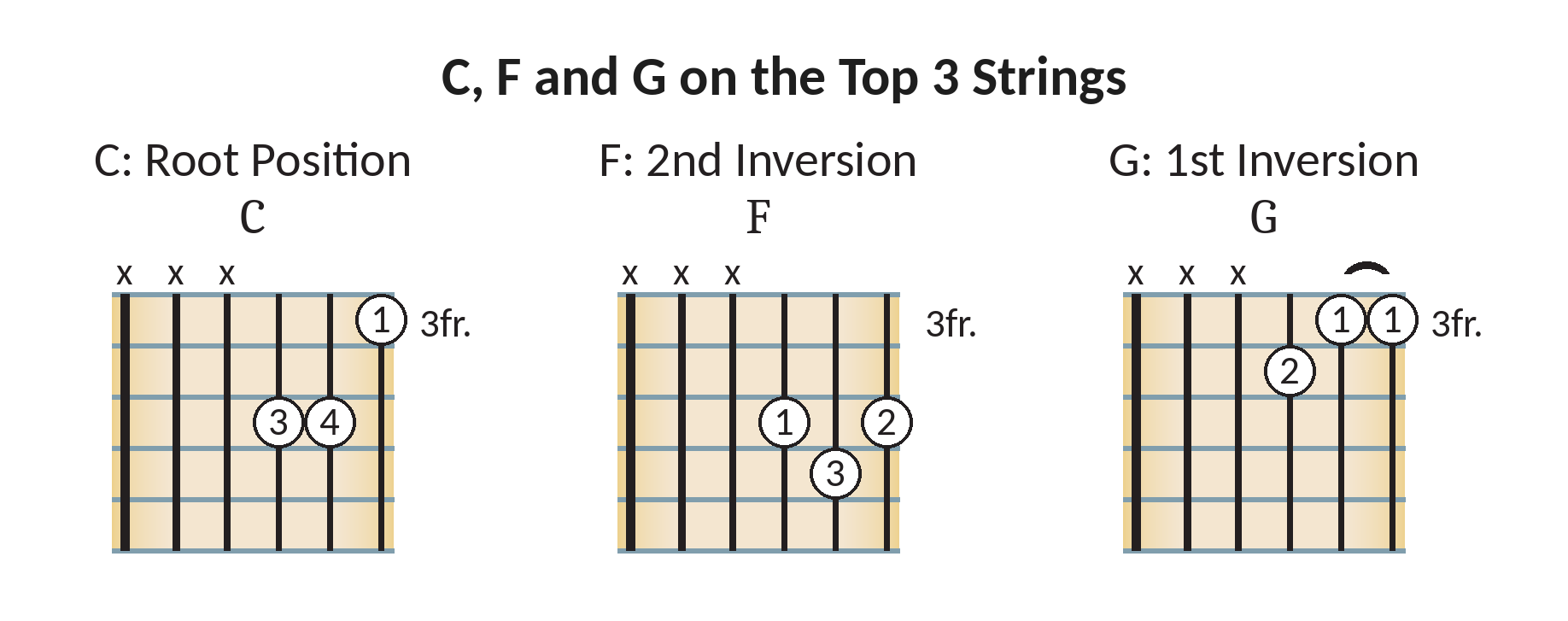
Inversions in a Chord Progression
Here’s the best part about chord inversions: guitar progressions get much easier. Take C, F and G, the three main chords in the key of C. On the top three strings, you can play all three without leaving frets 3 to 6.
- C: x x x 5 5 3 (root position).
- F: x x x 5 6 5 (2nd inversion).
- G: x x x 4 3 3 (1st inversion).
Notice that C and F both keep the note C on the G string at the 5th fret. Likewise, G and C share the note G on the high E string. Our guide to voice leading shows this progression step by step, with Frank’s lesson on it.
Chord Inversions: Guitar Practice in 10 Minutes a Day
- Pick one string group and one chord, such as C on the top three strings.
- Play root position, 1st inversion, and 2nd inversion, moving up the neck. Say each name out loud.
- Then play them back down the neck.
- Next, do the same with Am on the same strings.
- Finally, switch between C and Am in one area of the neck.
Above all, know which note is on the bottom. Once you can name the bottom note, the shapes start to make sense.
Do I Need to Read Music?
No. Every shape in this series comes with a chart and a fret code. In addition, each guide includes Frank’s video lessons, so you can watch and copy his hands.
Which Inversion Should I Learn First?
When learning chord inversions, guitar teachers usually start on the top three strings. The shapes are small, and they sound clear. So start with our guide to triad inversions.
How Many Inversions Does a Chord Have?
A triad has three positions: root position, 1st inversion and 2nd inversion. Four-note chords, such as C major 7, add a 3rd inversion. Frank covers those later in his course, and so will a future series here.
Are Inversions Only for Jazz?
Not at all. Frank is a jazz player, but inversions show up in pop, rock, country and R&B too. For instance, any time you see a chord like C/G in a songbook, that’s an inversion.
Keep Learning
Start with the top three strings in our guide to triad inversions. If triads are new to you, read our guide to easy guitar triads first.
For more on chord inversions, guitar lessons from Frank himself are a great next step. Start with the introduction to Frank Vignola’s Inversion Excursion. Then try our 15 free chord inversion lessons. Finally, to see how triads are built, read our guide to chord construction, from triads to 7ths.
Inversion Excursions – 124 video lessons and 800+ pages of charts! Start →
Continue Learning
Explore the rest of this series:
- Triad Inversions: 3 Easy Shapes on the Top 3 Strings
- 1st Inversion Chords: Easy Triads on the Middle Strings
- 2nd Inversion Chords: Easy Triads on the Low Strings
- Slash Chords: Easy Inversions With a New Bass Note
- Voice Leading: Smooth Chord Changes With Easy Inversions
About the Education Team
Four music-industry veterans with decades of combined experience in music education, curation, and production at TrueFire and ArtistWorks. The TrueFire Studios Education Team plans and edits this content and works with our master-musician faculty to keep it accurate and genuinely useful.
Featured Contributor
FV
Frank’s stunning virtuosity has made him the guitarist of choice for many of the world’s top musicians, including Ringo Starr, Madonna, Donald Fagen, Hank Jones, Lionel Hampton, John Lewis, the Boston Pops, the New York Pops, and guitar legend Les Paul, who named Vignola to his “Five Most Admired Guitarists List” for the Wall Street Journal.