



The Cadd9 chord is one of the easiest ways to make your playing sound richer right away. It takes the plain C chord you already know and adds one extra note on top. Better still, its most common shape shares two fingers with a popular G chord, so switching between them is almost effortless.
What Is a Cadd9 Chord?
A plain C major chord is built from three notes: C, E and G. A Cadd9 chord keeps all three and also adds a D. That D is the second note of the C major scale. Counted an octave higher, it’s called the ninth, which is where the “add9” name comes from.
Because the E is still there, Cadd9 still sounds like a major chord. The extra D simply sits on top and adds a bright, ringing quality. As a result, Cadd9 can replace a plain C in most strummed songs without changing the mood.
Cadd9 vs. Csus2
Chord charts sometimes mix these two up, but they sound different. Csus2 also contains a D. However, it drops the E, so it’s built from C, D and G.
Without the E, Csus2 is neither major nor minor, and it sounds hollow and unresolved. Cadd9, by contrast, keeps the E and sounds full and settled. So if a song calls for a bright C with some sparkle, Cadd9 is the one you want. For more on the difference, see our guide to sus chords, add9s and maj7s.
How to Play the Cadd9 Chord
There are two common ways to play it. Both are open-position shapes near the nut, so either one is easy to reach. The strings below are listed from the thickest (low E) to the thinnest (high E).
The Most Common Cadd9 Chord Shape
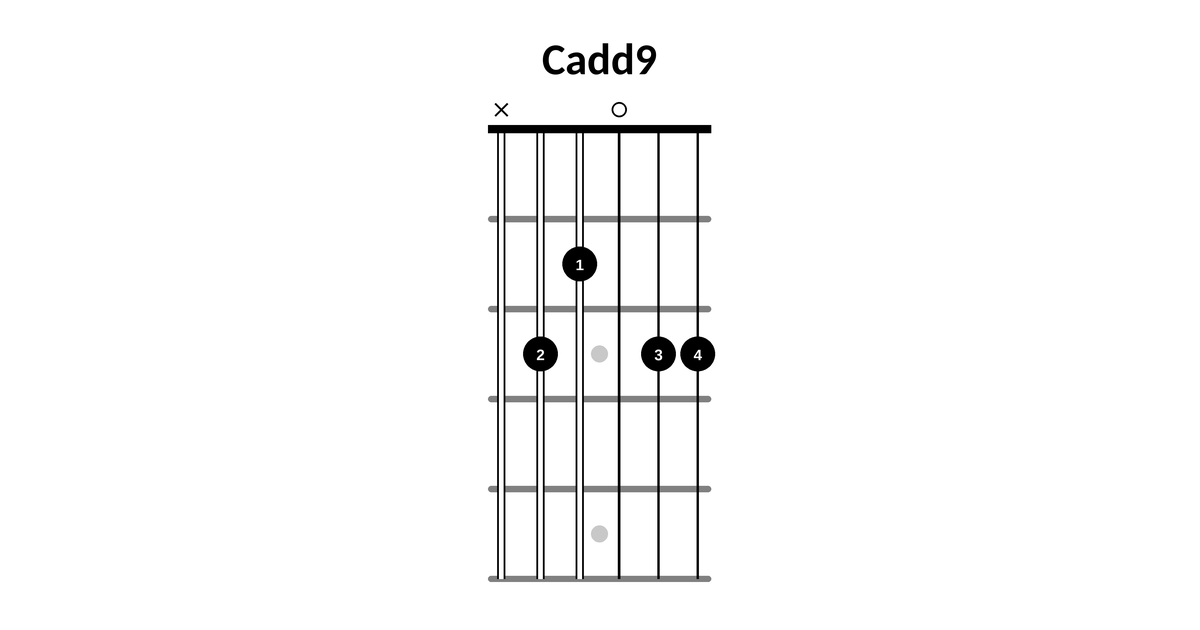
This is the shape most players use, and it’s the one that pairs so well with G. Its shape code is x32033.
- Low E string: don’t play it.
- A string: 3rd fret, middle finger.
- D string: 2nd fret, index finger.
- G string: open.
- B string: 3rd fret, ring finger.
- High E string: 3rd fret, pinky.
Strum from the A string down. If the low E keeps ringing, let the tip of your middle finger lean lightly against it to mute it.
A Three-Finger Version
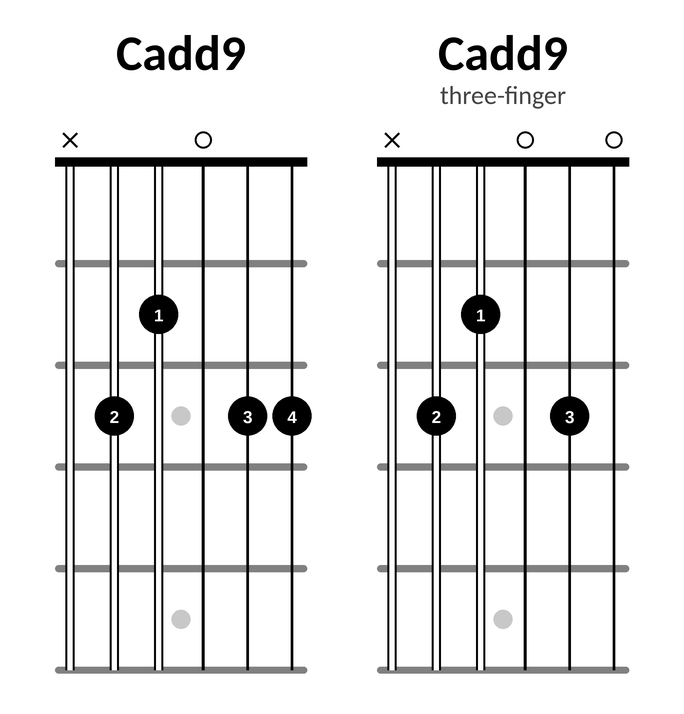
If the pinky stretch feels awkward at first, leave the high E string open instead. The shape code is x32030. Keep your middle finger on the A string, your index finger on the D string and your ring finger on the B string.
This version still contains C, E, G and D, so it’s a true Cadd9. However, it has a slightly lighter top end. Once your hand is comfortable, add the pinky back for the fuller sound.
Switching Between G and Cadd9
The real magic of this chord is how it connects to G. Use the G shape with your ring finger and pinky on the third fret of the B and high E strings. Its shape code is 320033.
- Low E string: 3rd fret, middle finger.
- A string: 2nd fret, index finger.
- D and G strings: open.
- B string: 3rd fret, ring finger.
- High E string: 3rd fret, pinky.
Then compare it with the Cadd9 chord shape. Your ring finger and pinky don’t move at all. Meanwhile, your middle and index fingers each shift over by one string. In other words, that’s the whole change.
Practice the Change in Three Steps
- Strum G for four beats, then Cadd9 for four beats. Repeat for one minute.
- Next, cut it to two beats each. Keep your ring finger and pinky planted the whole time.
- Finally, change on every beat. Don’t speed up until the change is clean.
Add Em7 and Dsus4 for a Full Progression
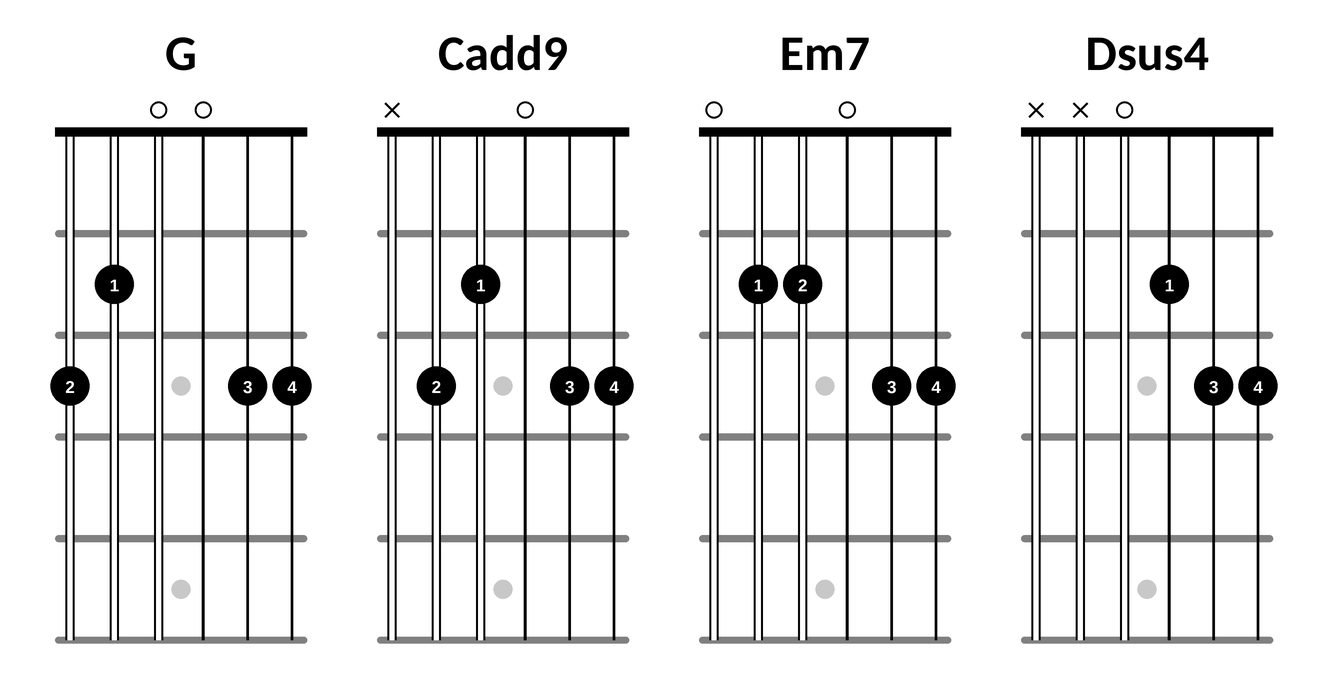
Two more chords share the same anchored ring finger and pinky. Em7 (022033) puts your index and middle fingers on the 2nd fret of the A and D strings. Dsus4 (xx0233) puts your index finger on the 2nd fret of the G string.
Together, G, Cadd9, Em7 and Dsus4 make a full progression in which two fingers never move. That’s why this family of shapes is so popular with acoustic strummers. Oasis’s “Wonderwall” is the famous example, built on this same anchored family of shapes.
Where the Cadd9 Chord Fits
The Cadd9 chord is a staple of acoustic pop, country and worship music. In those styles, it usually replaces a plain C in progressions built around G. For example, a G, C and D progression becomes G, Cadd9 and D.
It also works in the key of C, as a richer version of the home chord. However, try it in place of C one song at a time. In some songs the extra D can clash with the melody, so let your ear decide.
Common Cadd9 Chord Mistakes
A few small problems cause most of the trouble with this chord.
- The low E string rings. That adds an E in the bass and muddies the sound. Start your strum on the A string, or mute the low E with your middle finger.
- The G string gets muted. Your index finger on the D string can lean onto the open G. Arch your fingers so they come down on their tips.
- The pinky buzzes. Press close to the fret wire, not in the middle of the space. As a result, it takes less pressure and gives a cleaner note.
- Too much grip. Squeezing harder rarely helps. Instead, check finger placement first, then press only as hard as you need to.
Keep Going With Color Chords
Once Cadd9 feels natural, try its warmer cousin, the Cmaj7 chord. You can make it from a plain C by lifting one finger. If the plain C shape still needs work, start with our guide on how to play the C chord on guitar.
For the bigger picture, our pillar guide explains how sus, add9 and maj7 chords work together. And keep our complete guitar chord chart handy for the plain shapes these chords grow from.
View the “Ultimate Guitar Chord Chart” on TrueFire!Start →
Continue Learning
Explore the rest of this series:
- Sus Chords, Add9s and Maj7s: Guitar Chords That Make You Sound Pro
- The Cmaj7 Chord: A Warm, Dreamy Sound Made Easy
- The Dsus4 Chord (and Dsus2): Two Chords That Make D Interesting
- The Asus2 Chord (and Asus4): Add Motion to Your A Chords
- The Fmaj7 Guitar Chord: The Easy Way Around the Dreaded F
About the Education Team
Four music-industry veterans with decades of combined experience in music education, curation, and production at TrueFire and ArtistWorks. The TrueFire Studios Education Team plans and edits this content and works with our master-musician faculty to keep it accurate and genuinely useful.