


The Dsus4 chord and its partner, Dsus2, are the quickest way to bring a plain D chord to life. Both start from the open D shape you already know. Then you simply add or lift one finger. Together they create the tension-and-release movement you hear in countless folk, rock and country songs.
What Is a Dsus4 Chord?
A plain D major chord is built from three notes: D, F# and A. In a Dsus4 chord, the F# is replaced by G, the fourth note of the D major scale. So Dsus4 is built from D, G and A.
That F# is the third of the chord, and it’s what makes D sound major. Without it, Dsus4 is neither major nor minor. Instead, it sounds tense and unfinished, as if it’s leaning forward.
What “Suspended” Means
“Sus” is short for suspended. The name comes from classical music, where a note from one chord was held over into the next one before it settled down. The held note was “suspended” above the chord.
On guitar, the idea is the same. The G in Dsus4 sits just above the F#, so your ear wants it to fall back down. When you return to a plain D, that tension resolves. That small push and release is why the Dsus4 chord is so useful.
Dsus2: The Open, Airy Partner
Similarly, Dsus2 replaces the F# with E, the second note of the scale. So it’s built from D, E and A.
In practice, Dsus2 doesn’t pull as hard as Dsus4. It sounds open and airy rather than tense. As a result, you can rest on Dsus2 for a whole bar, while Dsus4 usually wants to move.
How to Play the Dsus4 Chord
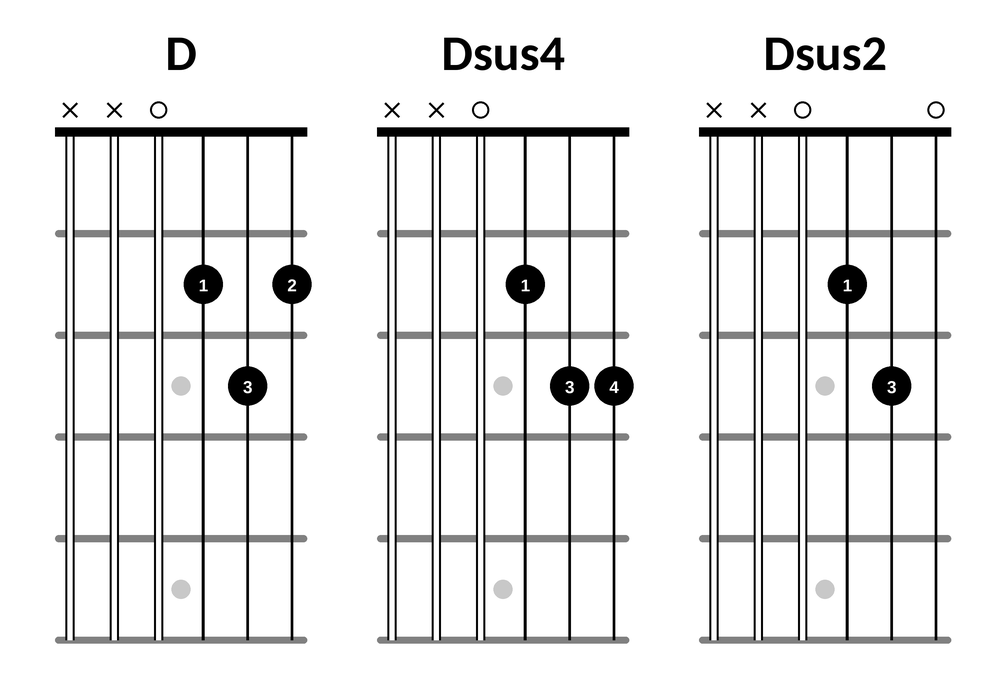
All three chords share the same open D starting point. The strings below are listed from the thickest (low E) to the thinnest (high E). For each chord, don’t play the low E or A strings.
Start With the Open D Chord
The open D shape code is xx0232.
- D string: open.
- G string: 2nd fret, index finger.
- B string: 3rd fret, ring finger.
- High E string: 2nd fret, middle finger.
The Dsus4 Chord Shape
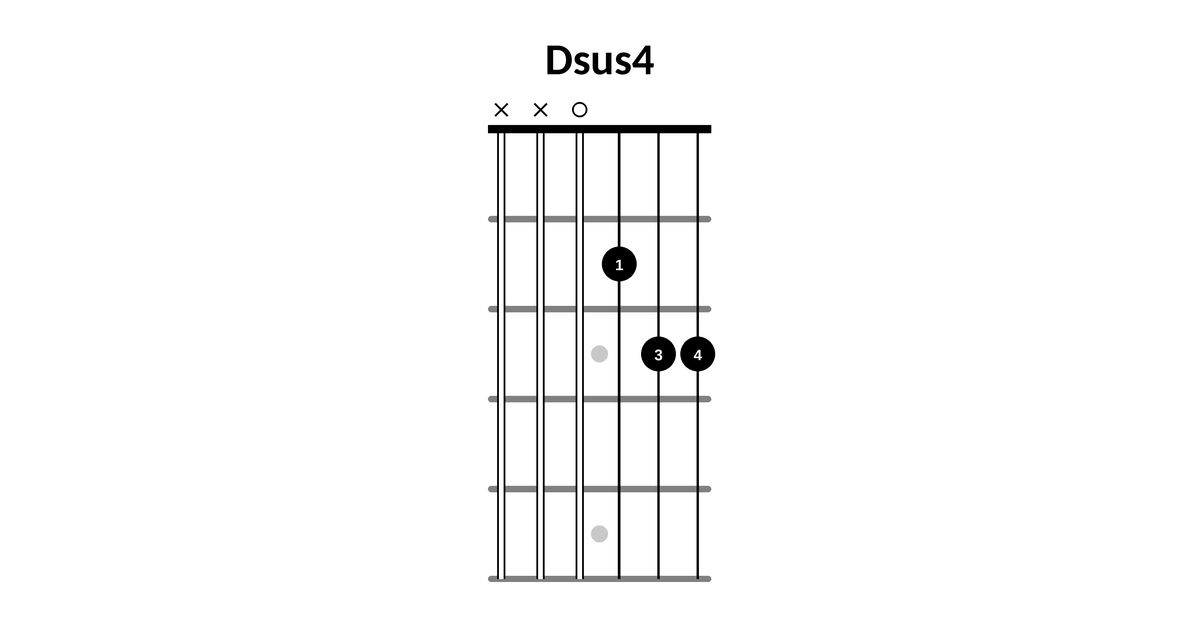
The Dsus4 shape code is xx0233. Keep your index and ring fingers where they are. Then put your pinky on the 3rd fret of the high E string.
- D string: open.
- G string: 2nd fret, index finger.
- B string: 3rd fret, ring finger.
- High E string: 3rd fret, pinky.
If you like, your middle finger can stay on the 2nd fret behind the pinky. Since the pinky is higher up the neck, it’s the note that sounds.
The Dsus2 Chord Shape
The Dsus2 shape code is xx0230. From the D chord, simply lift your middle finger and let the high E string ring open.
- D string: open.
- G string: 2nd fret, index finger.
- B string: 3rd fret, ring finger.
- High E string: open.
The D, Dsus4, D, Dsus2 Move
This move is the reason most players learn these chords. Your index and ring fingers never move, so only the fingers on the high E string change.
- Strum D for two beats.
- Add your pinky to make Dsus4, and strum two beats.
- Lift the pinky to return to D, and strum two beats.
- Lift your middle finger to make Dsus2, and strum two beats.
- Put the middle finger back down for D, and start again.
Once that feels smooth, try changing in the middle of a strum. For example, hammer your pinky onto the string right after you strum D, and you’ll hear the chord move without a new strum.
Where to Use the Move
This decoration works best on a chord that lasts a while. So if a song sits on D for a whole bar or more, add the Dsus4 move to keep it from sounding static.
It’s also a natural way to end a phrase. Play Dsus4 just before the last D, and the final chord will sound more settled. Many players use the same trick on A, with Asus4 and Asus2. Our guide to the Asus2 chord shows that version.
A Dsus4 Chord in the Key of G
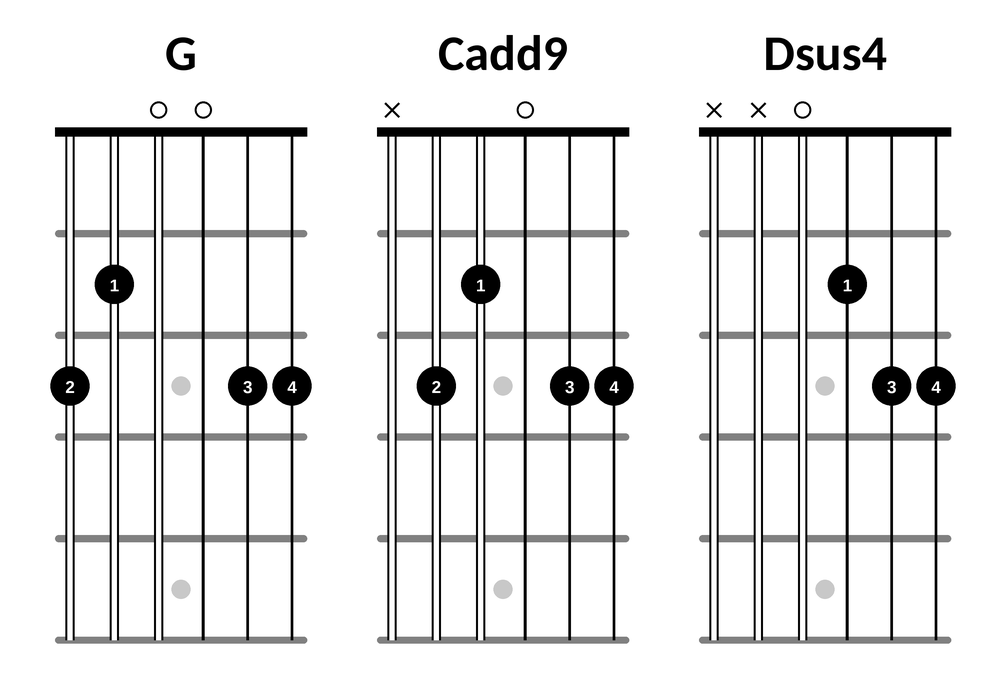
The Dsus4 chord also fits neatly with G and Cadd9. Look at where your ring finger and pinky sit: on the 3rd fret of the B and high E strings. That’s exactly where they sit in the G (320033) and Cadd9 (x32033) shapes, too.
As a result, you can play G, Cadd9 and Dsus4 while two fingers stay planted the whole time. Only your index and middle fingers move. Our guide to the Cadd9 chord also walks through that family of shapes.
Common Dsus4 Chord Mistakes
A few small habits make these chords sound muddy.
- Strumming all six strings. The low E string in particular clashes with the chord. Start your strum on the D string.
- Muting the high E string. For Dsus2 the high E must ring open. Keep your ring finger arched so it doesn’t touch it.
- Moving every finger. Your index and ring fingers should stay planted through the whole move. If they lift, the change gets slower.
- Overusing the move. Decorate a long D now and then rather than every bar. Otherwise the effect wears thin.
Keep Going With Sus Chords
To make these changes smoother, read our guide on changing guitar chords between E, A and D smoothly. Then try the same sus moves on A in our guide to the Asus2 chord.
For the full family of color chords, read our pillar guide to sus chords, add9s and maj7s. And keep our complete guitar chord chart handy for every plain shape.
View the “Ultimate Guitar Chord Chart” on TrueFire!Start →
Continue Learning
Explore the rest of this series:
- Sus Chords, Add9s and Maj7s: Guitar Chords That Make You Sound Pro
- The Cadd9 Chord: The Easiest Way to Sound Instantly Better
- The Cmaj7 Chord: A Warm, Dreamy Sound Made Easy
- The Asus2 Chord (and Asus4): Add Motion to Your A Chords
- The Fmaj7 Guitar Chord: The Easy Way Around the Dreaded F
About the Education Team
Four music-industry veterans with decades of combined experience in music education, curation, and production at TrueFire and ArtistWorks. The TrueFire Studios Education Team plans and edits this content and works with our master-musician faculty to keep it accurate and genuinely useful.