



The Fmaj7 guitar chord is the friendly alternative to the full F chord that stops so many beginners. It uses three fingers, no barre and one open string. Better still, it sounds warm and rich, and it fits into many songs where F is written.
Why the Full F Chord Is So Hard
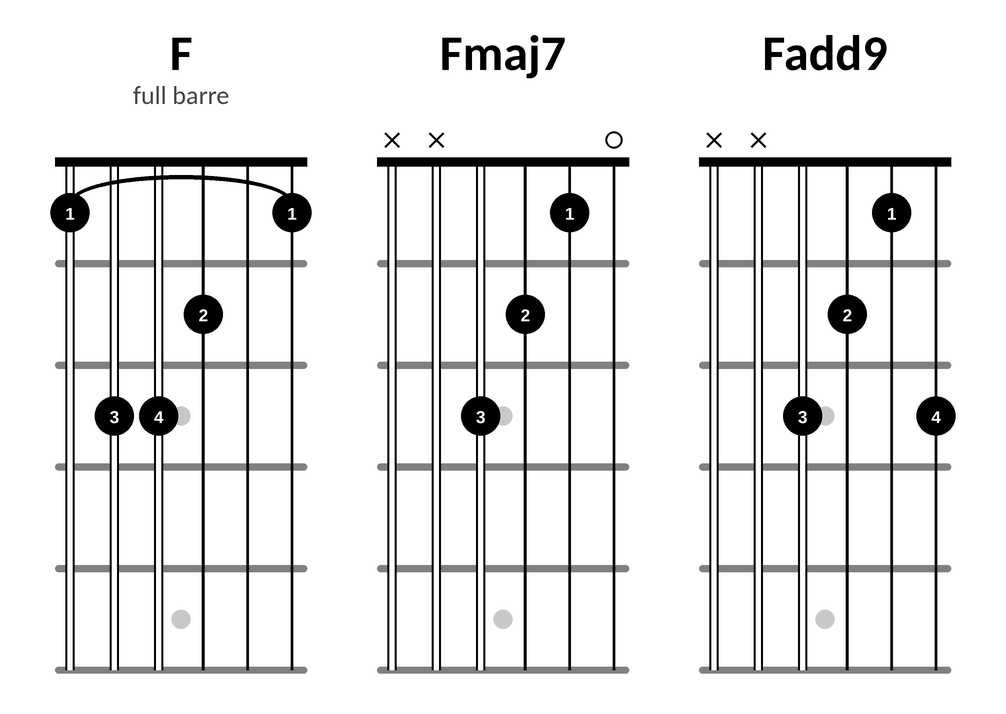
The standard F chord is a barre chord. Its shape code is 133211. Your index finger has to press all six strings at the 1st fret while three other fingers press notes above it.
That takes strength, accuracy and a lot of practice. For many beginners, it’s the first chord that feels truly impossible. As a result, songs with an F in them get skipped, or the F gets played with buzzing, muted strings.
You’ll want to learn the full F eventually, and our guide on how to play the F chord on guitar walks you through it. In the meantime, the Fmaj7 guitar chord lets you play those songs today.
What Is an Fmaj7 Guitar Chord?
A plain F major chord is built from F, A and C. Fmaj7 adds one more note: E. That E is the seventh note of the F major scale, so the chord is called a major 7.
Why the Fmaj7 Guitar Chord Can Replace F
In the key of C, both F and Fmaj7 use only notes from the C major scale. So in most songs in C, the Fmaj7 guitar chord does the same job as F. It just adds a soft, dreamy color.
However, listen to the melody. If the singer holds an F note over the chord, the open E string can rub against it. In that case, try Fadd9 (below) instead.
How to Play the Fmaj7 Guitar Chord
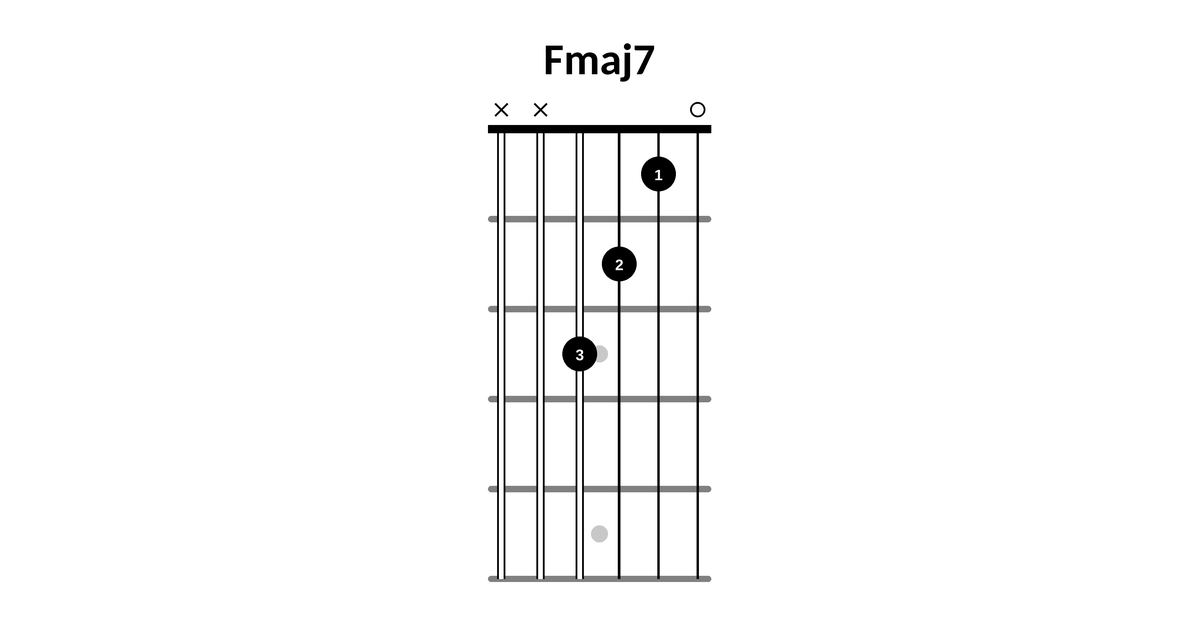
The Fmaj7 shape code is xx3210. The strings below are listed from the thickest (low E) to the thinnest (high E).
- Low E string: don’t play it.
- A string: don’t play it.
- D string: 3rd fret, ring finger.
- G string: 2nd fret, middle finger.
- B string: 1st fret, index finger.
- High E string: open.
The fingers form a neat diagonal line, one fret and one string apart. Keep them arched so the high E string can ring.
Which Strings to Strum
Start your strum on the D string, so F is the lowest note. The open A string won’t clash, since A is part of the chord, but it weakens the F in the bass. The low E string is the one to avoid most, because it puts a muddy E underneath.
Fadd9: A Second Easy Option
For a slightly different color, add your pinky to the 3rd fret of the high E string. That makes Fadd9, shape code xx3213. Its notes are F, A, C and G.
Fadd9 has no E, so it won’t rub against an F in the melody. It sounds bright and full, and it’s another easy stand-in for F.
Changing to Fmaj7 From C and Am
The Fmaj7 guitar chord is easy to reach from the chords it usually sits next to. In both changes below, your index finger stays on the 1st fret of the B string.
From C to Fmaj7
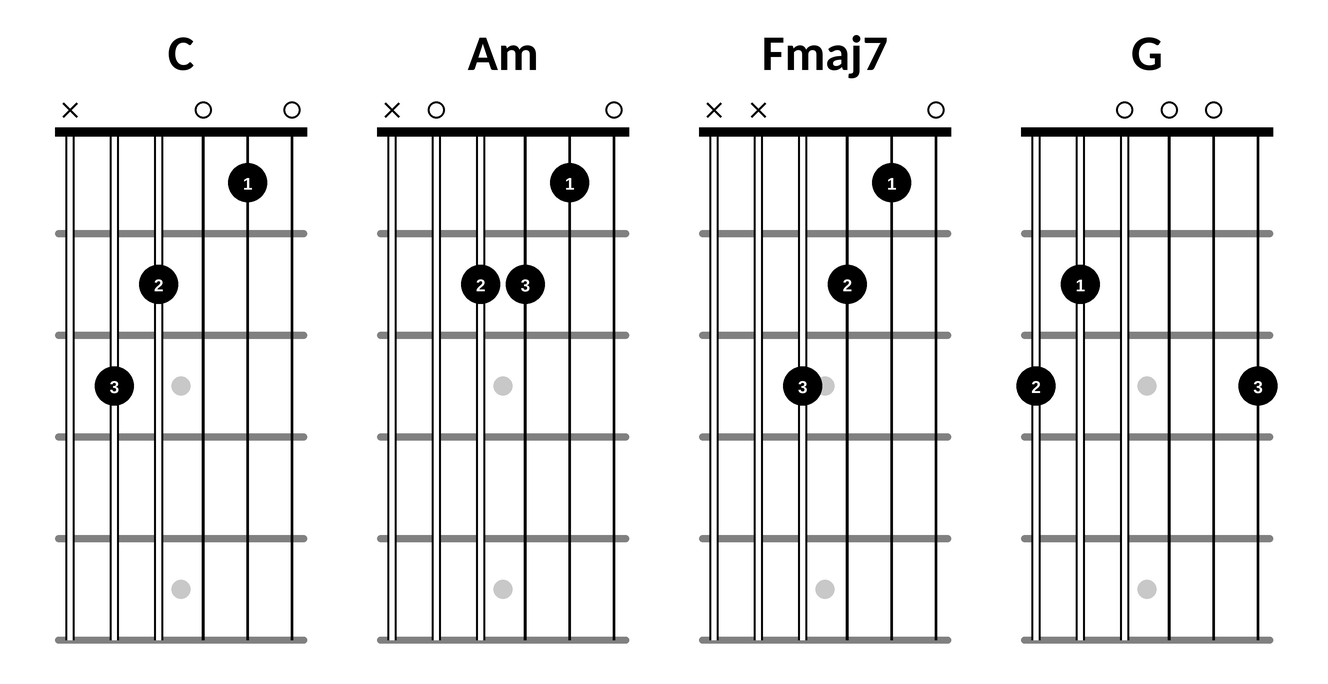
C has the shape code x32010. To move to Fmaj7, leave your index finger where it is. Then move your ring finger from the A string to the D string, and your middle finger from the D string to the G string.
In other words, the two fingers each shift over by one string, toward the floor. That’s the whole change.
From Am to Fmaj7
Am has the shape code x02210. Once again, your index finger stays on the 1st fret of the B string. Your middle and ring fingers trade strings, with the ring finger moving up to the 3rd fret of the D string.
This change takes a little more practice. Go slowly at first, and keep the index finger planted as your anchor.
Practice Fmaj7 in a Real Progression
C, Am, F and G is one of the most common progressions in pop music. Swap Fmaj7 in for F, and you can play it today without a barre.
- Strum C, Am, Fmaj7 and G, four beats each.
- Keep your index finger on the B string through C, Am and Fmaj7.
- Repeat for two minutes, then cut each chord to two beats.
Then try it with real songs. Our list of must-play guitar songs with C, Am, F and G chords is a great place to start. Use Fmaj7 wherever F appears, and let your ear decide when it fits.
For a dreamier sound, try alternating Cmaj7 and Fmaj7. Our guide to the Cmaj7 chord shows how those two shapes connect.
Common Fmaj7 Guitar Chord Mistakes
Most problems come from extra strings or a muted high E.
- Strumming all six strings. The low E string clashes. Start on the D string.
- Muting the high E string. The open E is part of the chord. Arch your index finger so its underside doesn’t touch it.
- Using it in every song. If the melody leans hard on F, Fmaj7 can sound slightly off. Try Fadd9 or the full F instead.
- Never learning the full F. Fmaj7 is a great stand-in, not a permanent replacement. Keep working on the barre version in short sessions.
Keep Going With Color Chords
When you’re ready for the full barre version, read our guide on how to play the F chord on guitar. Next, pair this chord with the Cmaj7 chord for a classic two-chord sway.
For the full family of color chords, read our pillar guide to sus chords, add9s and maj7s. And keep our complete guitar chord chart nearby as a reference.
View the “Ultimate Guitar Chord Chart” on TrueFire!Start →
Continue Learning
Explore the rest of this series:
- Sus Chords, Add9s and Maj7s: Guitar Chords That Make You Sound Pro
- The Cadd9 Chord: The Easiest Way to Sound Instantly Better
- The Cmaj7 Chord: A Warm, Dreamy Sound Made Easy
- The Dsus4 Chord (and Dsus2): Two Chords That Make D Interesting
- The Asus2 Chord (and Asus4): Add Motion to Your A Chords
About the Education Team
Four music-industry veterans with decades of combined experience in music education, curation, and production at TrueFire and ArtistWorks. The TrueFire Studios Education Team plans and edits this content and works with our master-musician faculty to keep it accurate and genuinely useful.