


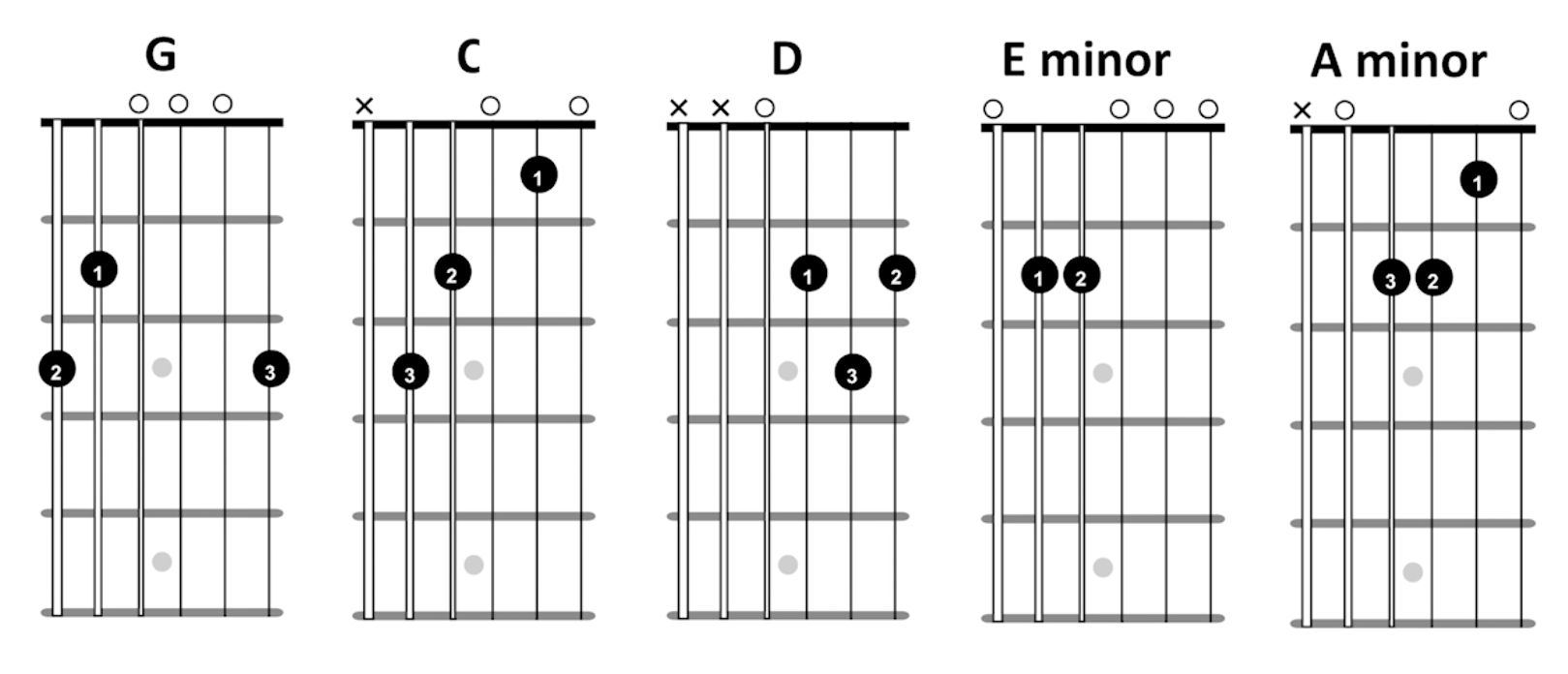
You can play 794 popular guitar songs with just five easy chords: G, C, D, E minor and A minor. That isn’t a gimmick. It’s simply how most songs are built, and once you see the pattern, a huge library of music opens up.
This series gives you five song lists, one for each of five popular genres: rock, blues, pop, Americana and traditional. Every song on every list uses only those five chord shapes. In addition, each list shows the song’s chord pattern and original key. For most songs, it also shows where to put your capo so you can play along with the record.
This guide explains why that works. First, you’ll see why a handful of chords goes so far. Next, you’ll learn what chord progressions are and why musicians write them as numbers. Then you’ll see how a capo puts the same five shapes in any key. Finally, you’ll get a quick tour of all five song lists.
You Don’t Need Hundreds of Chords to Play Hundreds of Songs
Open a chord book and you’ll find hundreds of chords. So it’s easy to assume you need to learn them all before you can play real music. Fortunately, you don’t.
Most popular guitar songs use only three or four chords. Even better, they use the same few chords over and over. Our five lists prove it. Of the 794 songs, 377 use just three chords and 266 use four. In fact, 363 of them need nothing but G, C and D.
In other words, the fastest path to playing songs isn’t learning more chords. Instead, it’s learning a few chords well and understanding how songs use them. Our earlier post, 5 Chords, Thousands of Songs, makes the same point. This series puts it into practice with real song lists.
Play 794 Hit Songs With These 5 Chords
The Major Scale Builds a Family of Chords
Every key starts with a major scale, a set of seven notes. You can build a simple chord on each of those notes, using only notes from the same scale. Musicians call this harmonizing the scale. The result is a family of seven chords that naturally sound good together. Three are major, three are minor and one is diminished. For example, in the key of G, the family is G, A minor, B minor, C, D, E minor, and F# diminished.
Our five easy chords are five members of that family: G, A minor, C, D and E minor. We left out B minor because it’s usually played as a barre chord. We also left out F# diminished, since popular songs rarely use it.
Most popular guitar songs draw almost all their chords from one family. That’s why their chords fit together so smoothly. Some songs also borrow a chord from outside the family for extra color. Our lists mark those borrowed chords with a “b” (flat) number, which we’ll explain below.
Same Five Shapes, Different Home Chords
Here’s the clever part. The same five shapes can sound bright, moody or swaggering, depending on which chord feels like home.
- When G feels like home, you get a bright major sound. That’s true for 644 of our 794 songs.
- When E minor feels like home, you get a darker minor sound, like Zombie by The Cranberries.
- When D feels like home, you get the swaggering classic rock sound of Gloria by Them.
A minor and C can play the home role, too. Either way, your fingers use the same five shapes.
What is a Chord Progression?
A chord progression is the series of chords a song moves through. Most songs repeat a short progression again and again. For example, a verse might cycle through four chords, and then the chorus might cycle through four more.
Songwriters often start with a progression and then write a melody on top of it. For guitarists, that’s great news. When you learn a song’s progression, you’ve learned most of the guitar part. Then you can strum along while you or a friend sings the melody.
Progressions also travel from song to song. So when you learn one common progression, you’ve already learned the chords to dozens of songs. That’s also why so many popular guitar songs feel familiar the first time you hear them.
Why Chord Progressions Are Written as Numbers
Musicians often write progressions as numbers instead of chord names. Each chord gets a number based on its place in the key’s family. The 1 chord is home, the chord the song keeps coming back to. Meanwhile, the 4 and 5 chords are the other two main chords.
In the key of G, the numbers line up like this:
- 1 = G
- 2m = A minor
- 4 = C
- 5 = D
- 6m = E minor
The “m” stands for minor. You’ll often see these written as Roman numerals, such as I-IV-V, but our lists use plain numbers to keep things simple. A “b” (flat) number, such as b7, marks a chord borrowed from outside the family. For instance, when D is home, C is the b7.
So why use numbers at all? Because numbers describe how chords relate to each other, not their exact pitch. A 1-4-5 progression is G-C-D in the key of G. In the key of A, the same pattern is A-D-E. Then in the key of E, it’s E-A-B. The chord names change, but the pattern and the feel stay the same.
That’s also why the numbers are so handy in our lists. When two popular guitar songs share the same numbers, they share the same chord pattern. As a result, learning one gets you well on your way to the other.
Why So Many Popular Guitar Songs Share the Same Progressions
Some chord moves simply sound satisfying. For instance, the 5 chord creates a little tension, and the 1 chord releases it. It’s like a question followed by an answer. That’s why songwriters in every era and every genre reach for the same moves.
A progression is a shared building block, much like a rhyme scheme in poetry. The melody, the lyrics and the rhythm are what make each song its own. As a result, two songs can share every chord and still sound nothing alike.
Our lists of popular guitar songs show just how common this is. Exactly 262 of our 794 songs use the same three-chord 1-4-5 progression. What’s more, it shows up in all five genres:
- Blues: Johnny B. Goode by Chuck Berry
- Rock: La Bamba by Ritchie Valens
- Pop: Three Little Birds by Bob Marley & The Wailers
- Americana: Ring of Fire by Johnny Cash
- Traditional: Amazing Grace
The four-chord sound is just as widespread. The 1-5-6m-4 pattern (G-D-Em-C) drives Wagon Wheel, How to Save a Life and No Woman, No Cry. Reorder those same four chords as 1-6m-4-5 (G-Em-C-D), and you get Stand by Me and I Will Always Love You. For a deeper look at that famous pattern, read Unveiling the Magic of Four-Chord Songs.
Of course, these songs aren’t all in the same key. Songs land in different keys mostly to suit the singer’s voice. However, the pattern doesn’t change, and that’s where the capo comes in.
How a Capo Puts Five Chord Shapes in Any Key
A capo is a small clamp that presses down all six strings at one fret. It shortens the strings, so everything you play sounds higher. Each fret raises the pitch by one half step.
The key point is that your chord shapes don’t change. You still play the same G, C, D, Em and Am shapes. However, with a capo on the second fret, your G shape sounds as an A chord. Likewise, your C shape sounds as a D, and your D shape sounds as an E.
Because every chord moves up together, the progression stays intact. So a 1-4-5 in G becomes a 1-4-5 in A. That’s how five shapes can reach any key, and it’s why they cover so many popular guitar songs. The capo changes the key while your fingers stay right where they are.
Explore 794 Popular Guitar Songs by Genre
Each list below collects popular guitar songs from one genre, with a full song table plus tips for playing that style. So pick the genre you love most and start there.

188 Easy Rock Guitar Songs
This list covers classic rock, alternative, Southern rock, pop-punk and indie folk-rock, from The Beatles, Neil Young and Tom Petty to Nirvana, Green Day and The Lumineers. You’ll learn four core rock patterns, including the swaggering sound of Gloria and the moody minor sound of Zombie. Then you’ll make these open chords sound like rock with hard-driving downstrokes. Start with the rock songs.
164 Classic Blues Songs Built on Three Chords
This list covers classic blues, blues-rock and early rock ‘n’ roll, from Muddy Waters and Howlin’ Wolf to Stevie Ray Vaughan and Chuck Berry. Most of these songs follow the 12-bar blues, and you’ll see exactly how it maps onto G, C and D. You’ll also learn how G7, C7 and D7 add instant blues flavor. Dig into the blues list.
162 Pop Songs on Guitar, From Soul to Reggae
This list covers pop and singer-songwriter hits, acoustic pop, classic soul and Motown, and reggae. It runs from Sam Cooke, The Supremes and Bob Marley to Ed Sheeran, Taylor Swift and Lewis Capaldi. You’ll meet the famous four-chord pop sound, plus two-chord grooves that make great first songs. Browse the pop list.
144 Country Songs on Guitar, Plus Folk and Bluegrass
This list covers classic and modern country, folk, Americana and bluegrass. It runs from Johnny Cash, Hank Williams and Bill Monroe to Bob Dylan, John Prine, Chris Stapleton and Luke Combs. About a third of these songs follow the exact 1-4-5 pattern. You’ll also learn the boom-chuck strum that makes three chords sound like a country band. Explore the Americana list.
136 Traditional Songs on Guitar for Every Occasion
This list covers hymns and spirituals, folk and campfire songs, children’s songs, holiday favorites and modern worship songs. It runs from Amazing Grace and Silent Night to Old MacDonald, Feliz Navidad and songs by Chris Tomlin, Hillsong and Elevation Worship. These songs are perfect for singing with family, friends or a congregation. Open the traditional list.
How to Start Playing Today
Ready to begin? Here’s the simplest plan:
- Learn the five chords: G, C, D, Em and Am.
- Pick the genre you love most.
- Start with songs that use only three chords. Every list has a CHORDS column, so they’re easy to spot.
- Put your capo on the fret shown and play along with the original recording.
When you’re comfortable, try songs with four or five chords. After that, you’ll be ready for your first new chord. F is the usual next step. Our top 10 must-play songs with C, Am, F and G will put it straight to work. Also, for an even smaller starting set, try our 229 easy guitar songs you can play with just four chords.
Five chords, one capo, and a little practice are all it takes. Then you’re ready to play hundreds of popular guitar songs you already know and love.
Thousands of song lessons available on TrueFire!Start →
Continue Learning
Explore the rest of this series:
- Play 188 Easy Rock Guitar Songs With Just 5 Chords
- Play 164 Classic Blues Songs With Just 5 Easy Chords
- Play 162 Pop Songs on Guitar With Just 5 Easy Chords
- Play 144 Country Songs on Guitar With Just 5 Easy Chords
- Play 136 Traditional Songs on Guitar With Just 5 Easy Chords
About the Education Team
Four music-industry veterans with decades of combined experience in music education, curation, and production at TrueFire and ArtistWorks. The TrueFire Studios Education Team plans and edits this content and works with our master-musician faculty to keep it accurate and genuinely useful.