

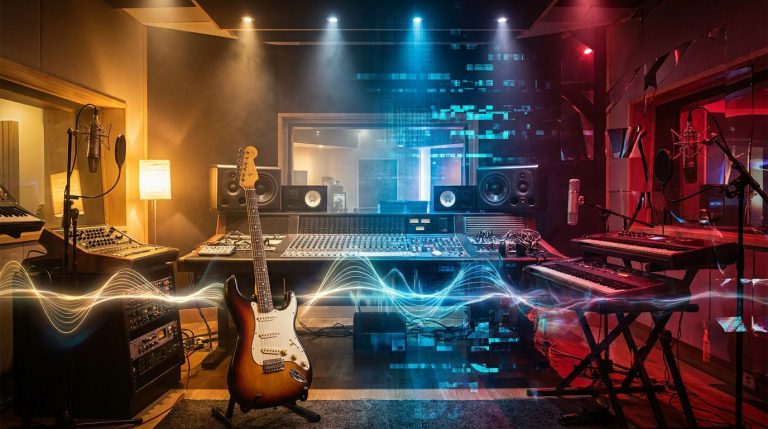
Music and AI now meet at almost every step of a musician’s work. That includes writing, recording, learning, releasing and getting paid. This series sticks to the record: published figures, court cases and the words of musicians, journalists, educators and industry leaders. We sort what they report into three groups: the good, the bad and the ugly.
Here’s how we sort it. The good covers documented benefits, such as time saved or new income. The bad covers documented costs, such as lost income or wrong information. Finally, the ugly covers legal and ethical fights over consent, impersonation and fraud.
What Counts as Music and AI?
Music and AI is a broad topic, so it helps to split it into three kinds of tools. Each kind raises different questions for musicians.
Tools That Make New Music
First, generative tools create new audio. Text-to-song services such as Suno and Udio turn a typed prompt into a full track, often with vocals. These systems learn from very large collections of existing recordings. As a result, the lawsuits against them concern what music they learned from and who should be paid. Our guide to AI music generators covers them in depth.
Tools That Copy a Voice
Second, voice tools copy the sound of a particular singer. Some artists license their own voices this way. However, the same technology can produce fakes of artists who never agreed. Our guide to AI voice cloning covers both sides.
Tools That Assist Musicians
Third, assistive tools help with a job a musician is already doing. For example, stem separation splits a finished mix into vocals, drums, bass and other parts. Other tools master a track or listen to you practice. Stem separation was the most common AI use in one Moises-sponsored survey, according to the report. Our guide to AI music production has the details.
The Good: Musicians Are Putting AI to Work
How Many Musicians Use AI Tools?
Several surveys on music and AI ask how musicians use the tools. However, the numbers depend on how each survey defines AI use. For example, LANDR sells AI music tools. In fall 2025, it surveyed more than 1,200 of its own users. It found that 87% of artists have incorporated AI into at least one part of their process. Hypebot republished the release. “Just like sampling reshaped music production, generative AI is a new creative lane,” said LANDR’s VP of Product, Patrick Bourget, in the company’s release.
A second survey measured regular use separately. Sonarworks commissioned a Sound On Sound survey of almost 1,200 music creators. In it, one in five producers was a regular AI user. In addition, almost half had tried AI experimentally.
AI Helped Finish the Last Beatles Song
One example came from the Beatles. In 2023, Paul McCartney explained how technology helped finish “Now and Then,” a song built from a John Lennon demo. “We were able to take John’s voice and get it pure through this AI, so that then we could mix the record as you would normally do,” McCartney told BBC Radio 4, according to CNBC.
In a GRAMMY.com interview about the song, remixer Giles Martin spoke about technology in general. “Technology doesn’t — and never has — made great records, but it creates a pathway,” Martin told GRAMMY.com. The song later won a Grammy, a story we cover in our guide to AI music production.
Practice Help and New Income
Other benefits get less attention. For instance, practice app Moises, which splits songs into parts for play-along practice, says it “serves more than 75 million users worldwide,” according to its newsroom. Our guide to learning guitar with AI looks at how these apps work.
Some musicians also report earning more. In a Water & Music survey for Moises, 26% of those earning from music said AI has increased their income. Fewer than 4% reported a decrease, and 56% reported no change, according to Moises. About 80% of that survey’s respondents came from Moises’ own users.
Licensing Deals
Licensing deals are another development in music and AI. In 2025, Universal Music Group signed agreements with Udio, and Warner Music Group signed with Suno. Our guide to AI music copyright has the details. Independent rights groups signed deals, too. “Our partnership with ElevenLabs demonstrates that music rightsholders can negotiate thoughtful, forward-looking agreements with AI companies,” said Merlin CEO Jeremy Sirota, whose company represents independent labels, in an August 2025 announcement.
The Bad: More AI Music, Harder to Spot
AI Tracks Top Half of Deezer’s Uploads on Peak Days
One documented cost of music and AI is volume. According to a July 2026 Deezer release, the streaming service receives nearly 90,000 fully AI-generated tracks every day. Deezer also says those tracks made up more than 50% of its total daily deliveries on peak days.
However, uploads are not the same as listening. Deezer says fully AI-generated music makes up between 1% and 3% of its streams, according to the same release.
Spam and Fraud
Fraud is a documented cost of music and AI. In 2025, up to 85% of streams on fully AI-generated tracks were fraudulent, according to the same release. Spotify has also reported removing spam tracks, not only AI-made ones. “In the past 12 months alone, a period marked by the explosion of generative AI tools, we’ve removed over 75 million spammy tracks from Spotify,” Spotify said in September 2025, according to Music Business Worldwide.
One Blind Test: Listeners Couldn’t Tell
A Deezer and Ipsos survey ran a blind test with two AI songs and one real song. Of 9,000 people in eight countries, 97% couldn’t tell fully AI-generated music from human-made music.
What Fans Say About Music and AI
Fans also say they value human-made music, according to a UK survey. The record-industry group BPI surveyed more than 1,750 UK music consumers in April 2025. Of them, 80.1% agreed that “music created by humans is more valuable to me than music generated by AI.” In addition, 81.5% agreed that music made solely by AI should be clearly labeled.
Interest in AI music may also be falling, according to a 2026 report from research firm Luminate covered by NPR. “Across the board, what we found is that consumers are net negative,” said Audrey Schomer, the Luminate analyst who wrote the report. “All that means is that people are more likely to feel uncomfortable than to feel comfortable with AI use.”
What Songwriters Say
PRS for Music published a survey of its members in January 2026. In it, 79% were worried about AI-generated music competing with human-made music, Digital Music News reported. “It is clear why creators are concerned,” said John Mottram, chief strategy officer at PRS for Music. He added: “Tech firms train models on copyright works without permission or payment, building commercial services designed to compete with or replace the human creators.”
Some songwriters have also responded directly. In January 2023, Nick Cave answered a fan who had sent him ChatGPT lyrics written in his style. His reply ran in his Red Hand Files newsletter. “Songs arise out of suffering, by which I mean they are predicated upon the complex, internal human struggle of creation and, well, as far as I know, algorithms don’t feel. Data doesn’t suffer,” Cave wrote, as reported by Rolling Stone.
The Ugly: Consent, Pay and the Courts
Creators’ Revenue at Risk
Many disputes over music and AI are about consent and pay. Several studies have tried to project the money at stake. CISAC, which represents authors’ societies around the world, commissioned a study from PMP Strategy. It estimated that music creators will see 24% of their revenues at risk of loss by 2028. A separate APRA AMCOS study put the figure at 23% by 2028 for Australia and New Zealand. That assumes no action is taken.
Musicians Push Back
Many objections focus on training AI with musicians’ work without permission. In January 2025, Paul McCartney spoke to the BBC about proposed UK copyright changes. “You get young guys, girls, coming up, and they write a beautiful song, and they don’t own it, and they don’t have anything to do with it. And anyone who wants can just rip it off,” McCartney said, according to AFP.
The UK Musicians’ Union says the effect on work has begun. “It is already happening and gobbling up opportunities for our members to make a living,” Naomi Pohl, its general secretary, said in 2024, according to CMU.
In February 2025, more than 1,000 musicians released a silent album, “Is This What We Want?”, in protest. “The government’s proposal would hand the life’s work of the country’s musicians to AI companies, for free, letting those companies exploit musicians’ work to outcompete them,” Ed Newton-Rex, a composer and AI developer who organized the album, told the Associated Press.
Voice Fakes and New Laws
Voice fakes are another flashpoint in music and AI. In 2023, a fake song using AI versions of Drake’s and The Weeknd’s voices “was streamed hundreds of thousands of times before it was pulled on April 17,” The Fader reported. In 2024, Tennessee passed its ELVIS Act to protect voice and likeness. Meanwhile, the federal NO FAKES Act cleared a Senate committee in June 2026, according to CMS.
Lawsuits and Rulings
Several fights have reached court. On July 31, 2026, a Munich court found that “Suno is in breach of both US and German copyright legislation,” Music Week reported. Suno said it was evaluating its options, including an appeal. The judgment is not yet final, according to law firm CMS. Then, in September 2026, Sony and Universal filed a new lawsuit against Suno in the U.S., according to Variety. We cover the legal fights in our guide to AI music copyright.
A Short Timeline of Music and AI
These dates trace key events in music and AI.
2021 to 2024
- 2021: Holly Herndon launches Holly+, an AI model of her own voice (The Fader).
- 2023: “Heart on My Sleeve,” a fake Drake and The Weeknd song, is pulled from streaming services (The Fader).
- 2023: Paul McCartney says AI helped finish a final Beatles song, “Now and Then” (CNBC).
- 2024: Tennessee passes the ELVIS Act, protecting voices against AI deepfakes (MusicRow).
- 2024: Randy Travis releases an AI-assisted song after a stroke (AP).
- 2024: Federal prosecutors charge a musician over an alleged AI streaming-fraud scheme (U.S. Attorney’s Office).
2025 to 2026
- 2025: “Now and Then” wins a Grammy (Loudwire), and UK musicians release a silent protest album (AP).
- 2025: Deezer starts tagging AI-generated music for listeners (Deezer).
- 2025: Universal settles with Udio (MBW), and Warner strikes a deal with Suno (SiliconANGLE).
- 2026: Fully AI-generated tracks pass 50% of Deezer’s daily uploads on peak days (Deezer).
- 2026: The NO FAKES Act clears the Senate Judiciary Committee (CMS).
- 2026: The musician charged in the streaming-fraud case is sentenced to 18 months in prison (Music Week).
- 2026: A Munich court rules against Suno (Music Week), and Sony and Universal sue it again (Variety).
What Musicians Can Do Now
Here are practical steps for musicians weighing music and AI, drawn from the guides in this series.
- Read the terms before you use an AI tool. Ownership and commercial-use rules vary by company and plan.
- Register your songs. Rights groups such as ASCAP and BMI now accept some partly AI-assisted works, but not fully AI-made ones (BMI).
- Check your streaming profiles. Several artists have found fake AI tracks posted under their names (AFP).
- Check AI-made lessons and tabs. Compare them with the recording or a trusted transcription before you practice.
- Keep your original files. Unprocessed stems and drafts let you undo any AI step and show your own work.
Explore the Series: Music and AI in Depth
Each guide below takes one topic and sorts the evidence into the good, the bad and the ugly.
AI Music Generators
This guide covers Suno, Udio and other text-to-song tools, plus the AI acts now reaching Billboard charts. Read the guide to AI music generators.
AI Voice Cloning
This guide covers artists who chose to use AI voices, the fakes that followed and new deepfake laws. Read the guide to AI voice cloning.
AI Music Production Tools
This guide covers stem separation, the Beatles’ Grammy-winning restoration and studies of creators’ income at risk. Read the guide to AI music production.
Learning Guitar With AI
This guide covers AI practice apps, the mistakes AI tools still make and scams that copy guitarists’ videos. Read the guide to learning guitar with AI.
AI Music Copyright
This guide covers label deals with AI companies, streaming fraud and the lawsuits over training data. Read the guide to AI music copyright.
Where Music and AI Stand Now
The evidence on music and AI points in more than one direction. Musicians and companies report uses for AI, from finishing a Beatles song to practice apps. At the same time, fully AI-made tracks now top half of Deezer’s uploads on peak days. Musicians, labels and lawmakers are also fighting over consent and pay. Each guide in this series lays out the record, so you can weigh it yourself.
Practice smart and play hard with TrueFire!Start →
Continue Learning
Explore the rest of this series:
- AI Music Generators: The Good, the Bad and the Ugly
- AI Voice Cloning in Music: The Good, the Bad and the Ugly
- AI Music Production Tools: The Good, the Bad and the Ugly
- Learning Guitar With AI: The Good, the Bad and the Ugly
- AI Music Copyright: The Good, the Bad and the Ugly
About the Education Team
Four music-industry veterans with decades of combined experience in music education, curation, and production at TrueFire and ArtistWorks. The TrueFire Studios Education Team plans and edits this content and works with our master-musician faculty to keep it accurate and genuinely useful.