

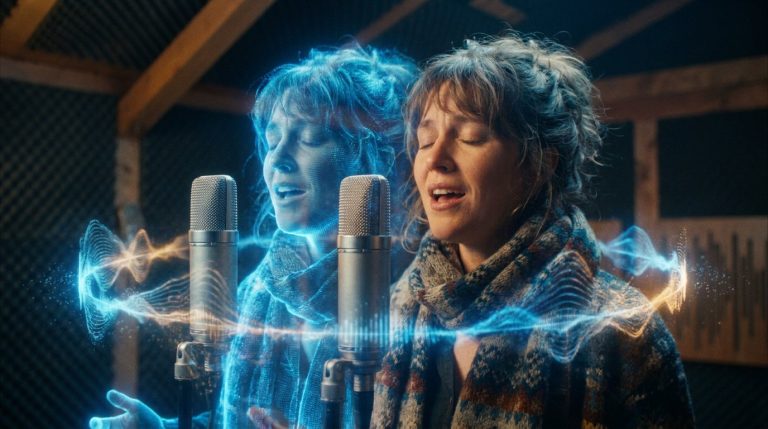
AI voice cloning lets software copy the sound of a singer’s voice. Some artists use it with consent, while others have found fakes of their voices online. This guide sorts the record into the good, the bad and the ugly. For the wider picture, see our overview of music and AI.
How AI Voice Cloning Works
AI voice cloning systems learn the sound of one voice from recordings of that voice.
Tools generally take one of two approaches. In the first, a person sings or speaks, and the software converts that performance into the target voice. In the second, the software generates new singing from typed lyrics and a melody. Either way, the result can sound like a specific singer who never performed those words.
That is why consent comes up in most of the cases below. The same tool can help an artist who chose it or impersonate one who didn’t.
The Good: Artists Who Chose to Use It
The documented benefits of AI voice cloning come from artists who chose to use it.
Randy Travis Returns With an AI-Assisted Song
In 2024, country singer Randy Travis released his first new song since a stroke, made with an AI-assisted vocal. “We’re hoping that maybe we can set a standard, where credit is given where credit is due — and artists have control over their voice and work,” his wife, Mary Travis, told the Associated Press.
The team built the voice from Travis’s own past recordings. “The result was two models: One with 12 vocal stems (or song samples), and another with 42 stems,” the AP reported. Those recordings spanned his career from 1985 to 2013.
Producer Kyle Lehning estimated how close the AI result was to the final track. “It’s hard to put an equation around it, but it was probably 70, 75% what you hear now,” Lehning told the AP. Cris Lacy, co-president of Warner Music Nashville, described the project’s aim. “This isn’t a stunt, and it’s not a parlor trick,” she told the AP.
Licensing a Voice on Your Own Terms
Other artists have offered their voices on their own terms. In 2023, Grimes invited fans to make songs with an AI version of her voice. “We ask for 50% splits on master recording royalties in exchange for a grimes feat and distribution,” Grimes wrote, according to Music Business Worldwide.
Earlier, experimental musician Holly Herndon launched her Holly+ voice model in 2021. “The voice is inherently communal, learned through mimesis and language, and interpreted through individuals,” Herndon wrote in a statement reprinted by The Fader.
Voice licensing is also offered commercially. AI company ElevenLabs says it “has paid more than $11 million to creators through the Voice Marketplace to date,” according to Music Business Worldwide. That company figure covers voice creators in general, not only singers.
The Bad: Fakes and Impersonation
The Fake Drake Song
The downside of AI voice cloning shows up when nobody asked permission. In 2023, a fake song called “Heart on My Sleeve” spread online, using AI versions of Drake’s and The Weeknd’s voices. It “was streamed hundreds of thousands of times before it was pulled on April 17,” The Fader reported.
Universal Music Group asked whether the music business wants to be “on the side of artists, fans and human creative expression, or on the side of deep fakes, fraud and denying artists their due compensation,” according to The Fader.
Fake Tracks on Real Artists’ Pages
Fakes have also appeared on real artists’ streaming pages. For example, British folk musician Emily Portman found AI tracks posted to her profile. “I just felt really uncomfortable and disturbed that people could be going to my profile… and then think ‘wow, what’s this?'” Portman told AFP.
Paul Bender, bassist for Hiatus Kaiyote, described how easy it is to post a song under another artist’s name. “It’s the easiest scam in the world,” Bender told AFP.
In July 2025, a fake AI song appeared on the official Spotify page of the late songwriter Blaze Foley. 404 Media first reported the story. “One of their talented software engineers could stop this fraudulent practice in its tracks, if they had the will to do so,” Craig McDonald, whose label distributes Foley’s music, told Consequence. In addition, “another fake song attributed to the late country icon Guy Clark, who passed away in 2016, was also taken down,” TechRadar reported.
The Ugly: Deepfakes and the Law
Artists Speak Out on AI
In April 2024, more than 200 artists signed an open letter from the Artist Rights Alliance. It warned that “some platforms and developers are employing AI to sabotage creativity and undermine artists, songwriters, musicians and rightsholders,” as reproduced by Music Week.
New Laws Target Deepfakes
Tennessee passed the ELVIS Act in March 2024. The law “establishes protections for every person’s unique voice and likeness against unauthorized artificial intelligence (AI) deepfakes and voice clones,” according to MusicRow. It passed unanimously, with a “93-0 vote in the House of Representatives and 30-0 in the Senate,” MusicRow reported. Country singer Luke Bryan spoke at the signing. “It’s hard to wrap your head around what is going on with AI, but I know the ELVIS Act will help protect our voices,” Bryan said, according to MusicRow.
The Federal NO FAKES Act
On June 18, 2026, the Senate Judiciary Committee unanimously advanced the federal NO FAKES Act, according to CMS. “Everyone deserves the right to own and protect their voice and likeness from AI deepfakes, no matter if you’re Taylor Swift or an 8th grader in Wilmington,” said Senator Chris Coons of Delaware, who co-sponsors the bill with Senator Marsha Blackburn, in a statement. The Recording Academy backed the bill. “As AI continues to reshape the music landscape, we strongly urge the full Senate to pass this essential legislation as soon as possible,” Grammys CEO Harvey Mason jr. said, according to GRAMMY.com.
Even so, the bill still needs votes in the full Senate and the House to become law. It also has critics. Free-speech groups urged the committee not to advance it in its current form, according to CMS. They included the Center for Democracy & Technology and the Electronic Frontier Foundation. In addition, Senators Ted Cruz, Mike Lee and Eric Schmitt raised free-speech concerns.
Platform Rules on AI Voice Cloning
Spotify has written its own rules. In September 2025, Spotify announced a policy on AI voice clones. “Vocal impersonation is only allowed in music on Spotify when the impersonated artist has authorized the usage,” the company said in its announcement.
Other countries are looking at the issue, too. On October 8, 2026, Euronews reported that Denmark was introducing a bill on rights over faces and voices. The government hopes it takes effect in early 2027. However, the planned Danish rules “do not constitute copyright in the strict sense,” according to the European Parliament’s research service782611.html).
How Artists Are Protecting Their Voices
Here are practical steps for dealing with AI voice cloning, based on the platform pages and cases above.
- Check your artist profiles. Portman, Foley’s label and others found fakes on real streaming pages.
- Report impersonation. Spotify’s help page tells artists to submit a claim through its legal form. It adds: “Select Publicity / Likeness as the report type.”
- Use likeness tools where offered. YouTube says its likeness detection “helps creators find content on YouTube where their face appears to be altered or generated by AI,” according to YouTube Help. For now, it detects faces only, and YouTube says it aims to add audio.
- Know your state’s law. Tennessee’s ELVIS Act covers voice clones, and the federal NO FAKES Act is pending.
- Put voice deals in writing. Grimes, for example, published her royalty terms alongside her invitation to fans.
Where AI Voice Cloning Stands
AI voice cloning has documented examples on both sides. Some artists chose it, while others were copied without consent. Meanwhile, new platform rules and laws are still taking shape. For the studio side of AI, see our guide to AI music production.
Practice smart and play hard with TrueFire!Start →
Continue Learning
Explore the rest of this series:
- Music and AI: The Good, the Bad and the Ugly
- AI Music Generators: The Good, the Bad and the Ugly
- AI Music Production Tools: The Good, the Bad and the Ugly
- Learning Guitar With AI: The Good, the Bad and the Ugly
- AI Music Copyright: The Good, the Bad and the Ugly
About the Education Team
Four music-industry veterans with decades of combined experience in music education, curation, and production at TrueFire and ArtistWorks. The TrueFire Studios Education Team plans and edits this content and works with our master-musician faculty to keep it accurate and genuinely useful.