

Guitar triads are the easy way to play the chords beginners dread. Each one uses just three notes on three strings, so there’s no full barre to fight. In fact, a few of them take only one finger. This guide explains what guitar triads are, shows the four shapes that matter most, and then turns five hard chords into easy ones.
What Are Guitar Triads?
A triad is a chord built from three notes. Almost every major and minor chord you know is a triad at heart. For example, your open C chord uses five strings, but it only contains three different notes: C, E and G. The other strings simply repeat some of them.
Guitar triads strip a chord back to those three notes, one per string. As a result, a chord that needs six strings and a barre can shrink to a small shape with two or three fingers.
The Root, the 3rd and the 5th
Each note in a triad has a job. The root names the chord, so the root of a C chord is C. Next, the 3rd decides whether the chord sounds major or minor. Finally, the 5th fills out the sound.
In C major, those notes are C, E and G. In C minor, the 3rd drops one fret to E-flat, so the notes are C, E-flat and G.
Major vs. Minor: One Note Apart
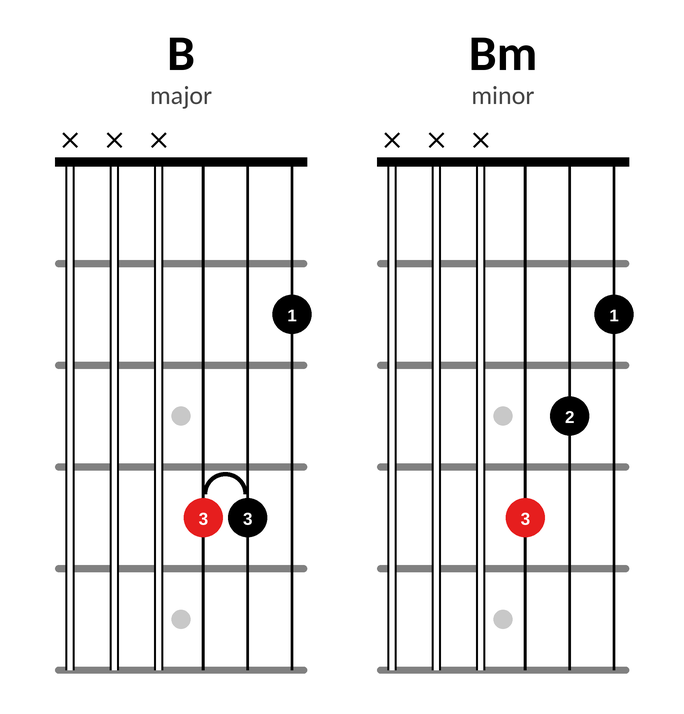
The difference between a major and a minor triad is a single note, the 3rd. Lower it by one fret, and a bright major chord turns darker. On the top three strings, that often means moving just one finger. For instance, the easy B and easy Bm shapes differ only on the B string.
Why Guitar Triads Make Hard Chords Easy
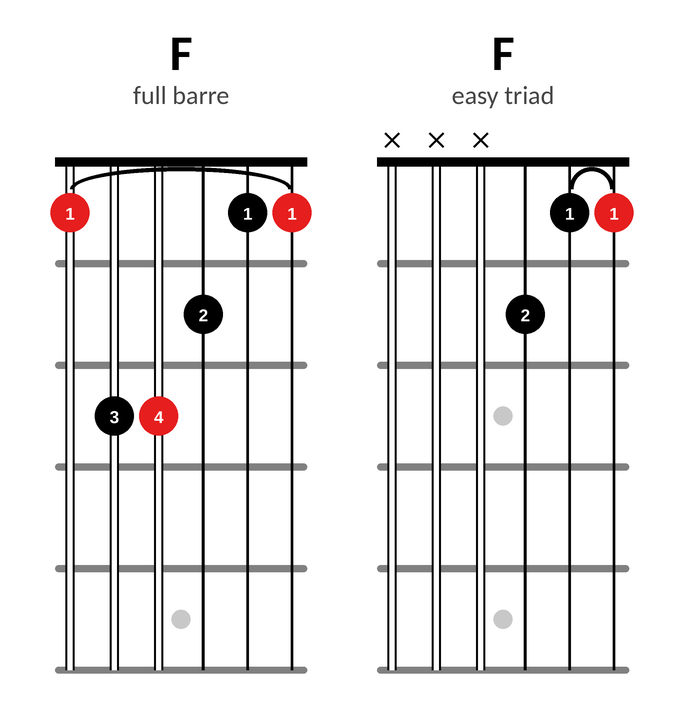
Chords like F, Bm and B give beginners trouble for one reason: the barre. A barre chord asks your index finger to press five or six strings at once, while your other fingers stretch around it. That takes hand strength most new players haven’t built yet.
Guitar triads skip the full barre entirely. Because they use only the top three strings, they need two or three fingers, and those fingers sit close together. They also sound clean and bright. That’s why rhythm players in soul, funk and pop lean on small triad shapes so often.
Are Triads a Shortcut?
Not really. A triad has every note of the chord, so it’s the same chord with fewer strings. A full barre chord simply stacks extra copies of those notes for a bigger sound. However, when you play with a bass player or a second guitarist, the small shape often fits better, since it leaves room for everyone else.
The Four Easy Triad Shapes
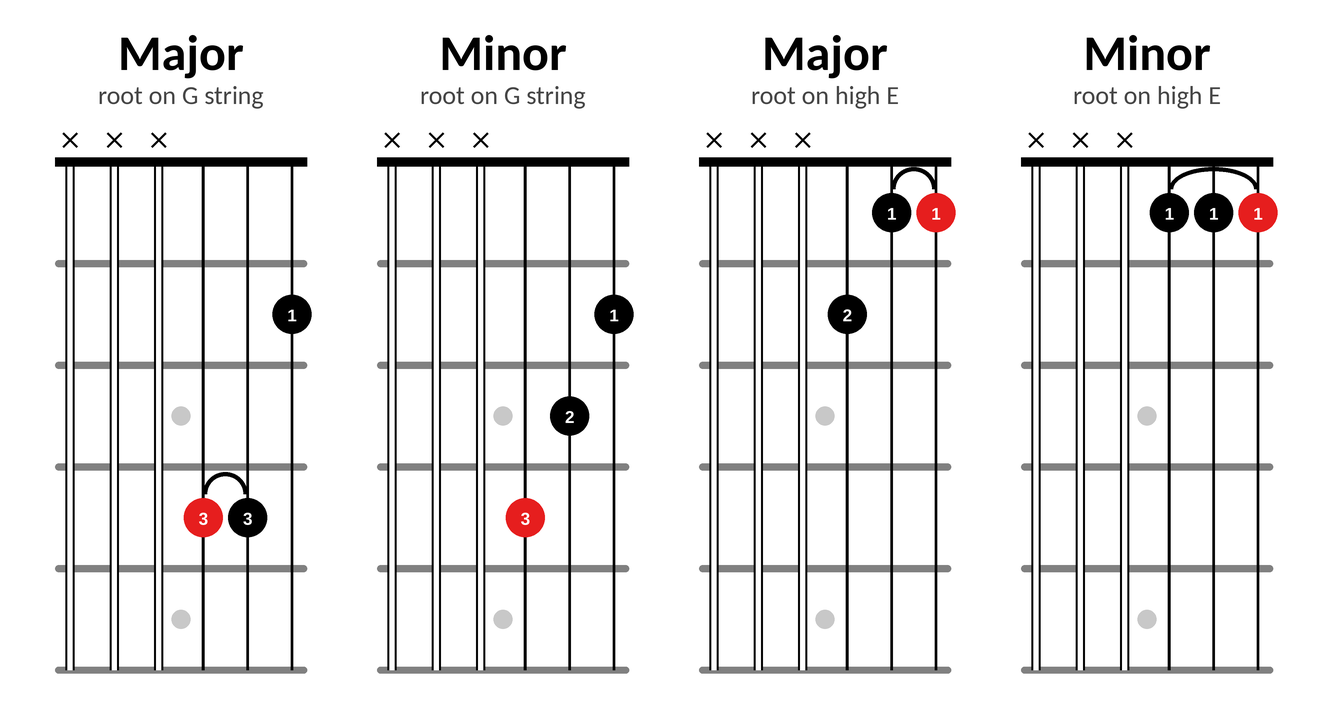
Every easy chord in this series comes from four small guitar triads. All four sit on the top three strings: the G, B and high E strings. Two of the shapes are major, and two are minor.
Each shape is written as a code from the low E string (left) to the high E string (right). A number is the fret, and “x” means don’t play that string. In the diagrams, the red dot marks the root, the note the chord is named after.
Shape 1: Major, With the Root on the G String
The code is x x x 4 4 2, which is B major. Lay your ring finger flat across the G and B strings at the 4th fret. Then put your index finger on the high E string at the 2nd fret. Slide the whole shape down one fret, and it becomes B-flat (x x x 3 3 1).
Shape 2: Minor, With the Root on the G String
The code is x x x 4 3 2, which is B minor. Use your ring, middle and index fingers, one per string. Slide it up one fret to x x x 5 4 3, and you have C minor.
Shape 3: Major, With the Root on the High E String
The code is x x x 2 1 1, which is F major. Your middle finger takes the G string, while your index finger lies flat across the B and high E strings.
Shape 4: Minor, With the Root on the High E String
The code is x x x 1 1 1, which is F minor. This might be the easiest chord shape on the guitar: one finger, flat across three strings. Move it to the 3rd fret, and it’s G minor.
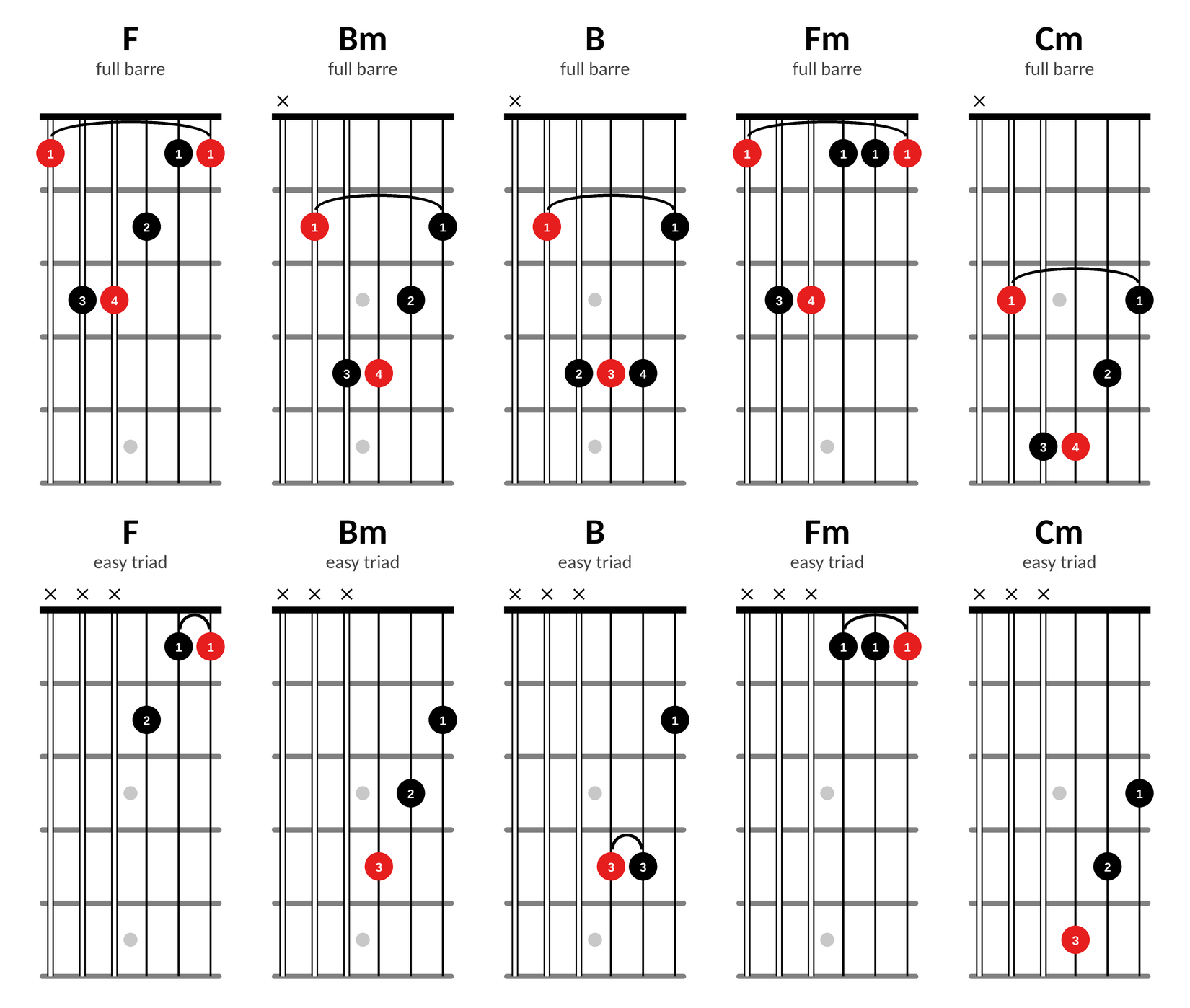
Five Hard Barre Chords Made Easy
Here are the five hard chords this series covers, along with the guitar triads that replace them. Every one skips a full barre.
- Easy F chord: x x x 2 1 1. The chord that stops more beginners than any other. Our guide to the easy F chord also shows a smooth switch from C.
- Easy Bm chord: x x x 4 3 2. It’s only one note away from an open D chord. See our guide to the easy Bm chord.
- Easy B chord: x x x 4 4 2. Two fingers instead of a crowded barre. Learn it in our guide to the easy B chord.
- Easy Fm chord: x x x 1 1 1. One finger, and it slides up the neck to make other minor chords. See our guide to the easy Fm chord.
- Easy Cm chord: x x x 5 4 3. The Bm shape, one fret higher. Our guide to the easy Cm chord shows a one-finger option too.
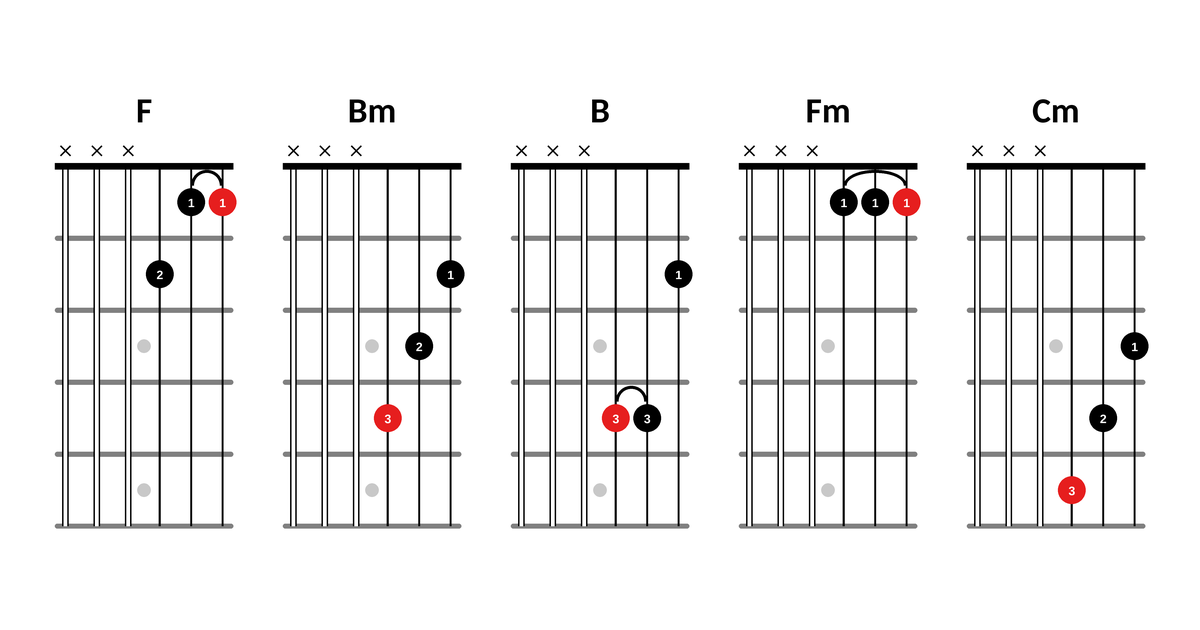
How to Play Guitar Triads Cleanly
Small shapes have one catch: you have to strum only three strings. These tips make that easy.
- Aim your strum. Start the strum at the G string and stop after the high E string. A short, light stroke works best.
- Keep the low strings quiet. If a low string rings by accident, let the finger on the G string lean back slightly so it touches the D string and mutes it.
- Press with your fingertips. Arch your fingers so each one touches only its own string. On the one-finger shapes, press firmly and evenly across all three strings.
- Try fingerpicking. Pluck the three strings with your thumb, index and middle fingers, and there’s no risk of hitting the wrong strings.
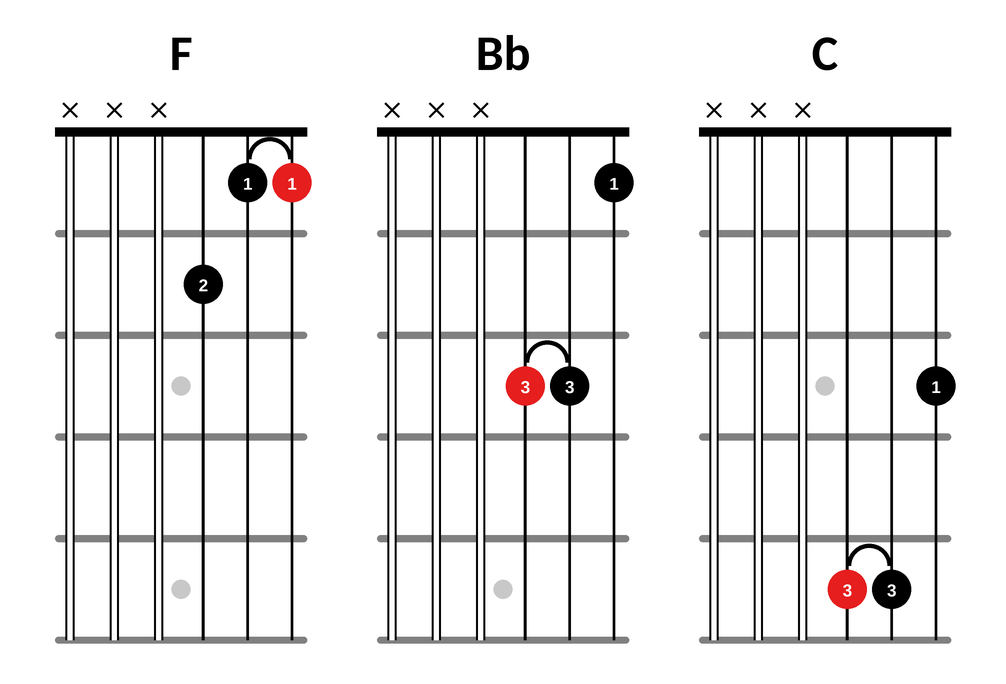
Play Guitar Triads in a Real Progression
Now try a progression: F, B-flat and C, the three main chords in the key of F. As full barre chords, that’s a workout. With triads, however, it’s easy.
- F: x x x 2 1 1.
- B-flat: x x x 3 3 1.
- C: x x x 5 5 3.
Play each chord for four beats, then go back to F. Notice that B-flat and C use the same shape, just two frets apart.
Why Guitar Triads Change So Smoothly
Small shapes mean small moves. For example, when you go from F to B-flat, the note on the high E string stays at the 1st fret, so your index finger never moves. Only the G and B string notes change. Then B-flat to C is one shape sliding up two frets. As a result, your hand barely travels, and the changes stay smooth.
Do Guitar Triads Sound Too Thin?
On their own, they sound lighter than a full barre chord, because they leave out the low strings. In a band, that’s usually a plus, since the bass player covers the low end. When you play alone, strum firmly and let the chord ring. Or use a four-string version, like the four-string F in our easy F chord guide.
Can I Play Guitar Triads on Other Strings?
Yes. Triads work on any three neighboring strings, such as the D, G and B strings. This series stays on the top three strings because the shapes are smallest and easiest there. Once these feel natural, our 15 free chord inversion lessons show how to move triads across the neck.
Should I Still Learn Barre Chords?
Yes, eventually. Barre chords give you a fuller sound, and many songs call for them. However, there’s no need to wait. Guitar triads let you play those songs now, while your hand builds the strength a barre takes.
Keep Learning
Next, pick one of the easy chords above and learn it well. The easy F chord is the best place to start, because F shows up in so many songs.
To see how triads grow into bigger chords, read our guide to chord construction, from triads to 7ths. Then see how triads hide inside every chord shape in CAGED system explained. Finally, when you’re ready for the full shapes, our free 10 Barre Chords chart has them all.
Explore 14 Comprehensive TRIAD Courses on TrueFire!Start →
Continue Learning
Explore the rest of this series:
- Easy F Chord: Skip the Barre With This 3-String Shape
- Easy Bm Chord: A 3-Finger Shape That Sounds Just Right
- Easy B Chord: The Small Shape That Replaces the Barre
- Easy Fm Chord: Play F Minor With One Finger
- Easy Cm Chord: A Simple 3-String Shape for C Minor
About the Education Team
Four music-industry veterans with decades of combined experience in music education, curation, and production at TrueFire and ArtistWorks. The TrueFire Studios Education Team plans and edits this content and works with our master-musician faculty to keep it accurate and genuinely useful.