


The easy Fm chord might be the simplest chord on the guitar. It takes one finger, laid flat across three strings at the 1st fret. Even so, it’s a real F minor chord, and the same shape slides up the neck to give you other minor chords too.
Why the Full Fm Chord Is Hard
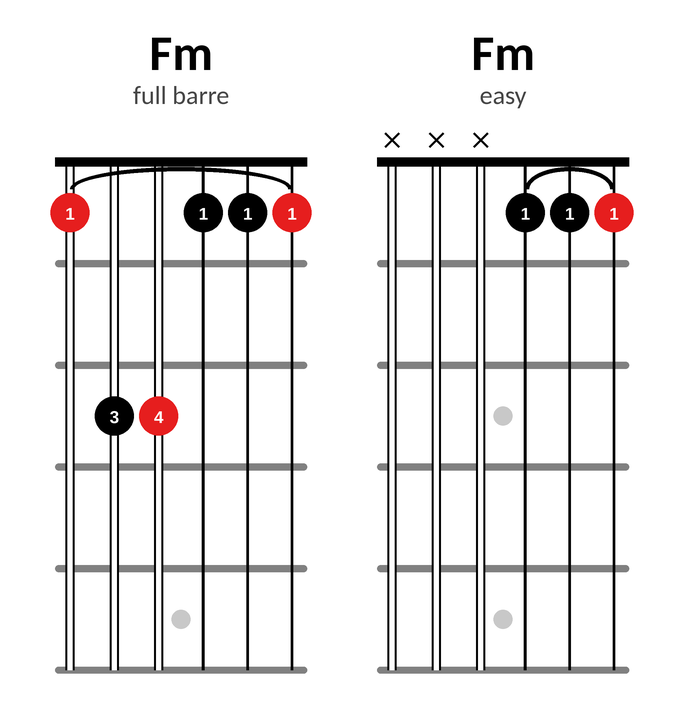
The usual F minor chord is a full barre at the 1st fret. Its shape code is 1 3 3 1 1 1. Your index finger presses all six strings, while your ring finger and pinky take the A and D strings at the 3rd fret.
That means the barre has to hold four strings cleanly on its own: the low E, G, B and high E strings. Meanwhile, no other finger helps. As a result, one weak spot in your barre leaves a string buzzing or dead. In addition, the 1st fret is where your hand has to stretch the most.
Where You’ll Hear F Minor
F minor shows up in songs in the key of C minor. However, it also appears in the key of C major, as a “borrowed” chord. In that role, it follows a plain F and adds a bittersweet moment before the song returns home to C. You’ll try that move below.
How to Play the Easy Fm Chord
By comparison, the easy version needs just one finger. Its shape code is x x x 1 1 1.
- Low E, A and D strings: don’t play them.
- G string: 1st fret, index finger.
- B string: 1st fret, index finger.
- High E string: 1st fret, index finger.
To play the easy Fm chord, lay your index finger flat across all three strings, close to the fret wire. Then strum only the top three strings, starting at the G string.
Tips for a Clean One-Finger Barre
- Roll the finger slightly. Tilt your index finger a little onto its thumb side. The bony edge presses more firmly than the soft middle.
- Watch the creases. If one string sounds dead, a finger joint crease may be landing on it. Slide your finger up or down a little until all three ring.
- Use the tip as a mute. Let the tip of your index finger touch the D string lightly, so it stays quiet.
What’s in the Easy Fm Chord
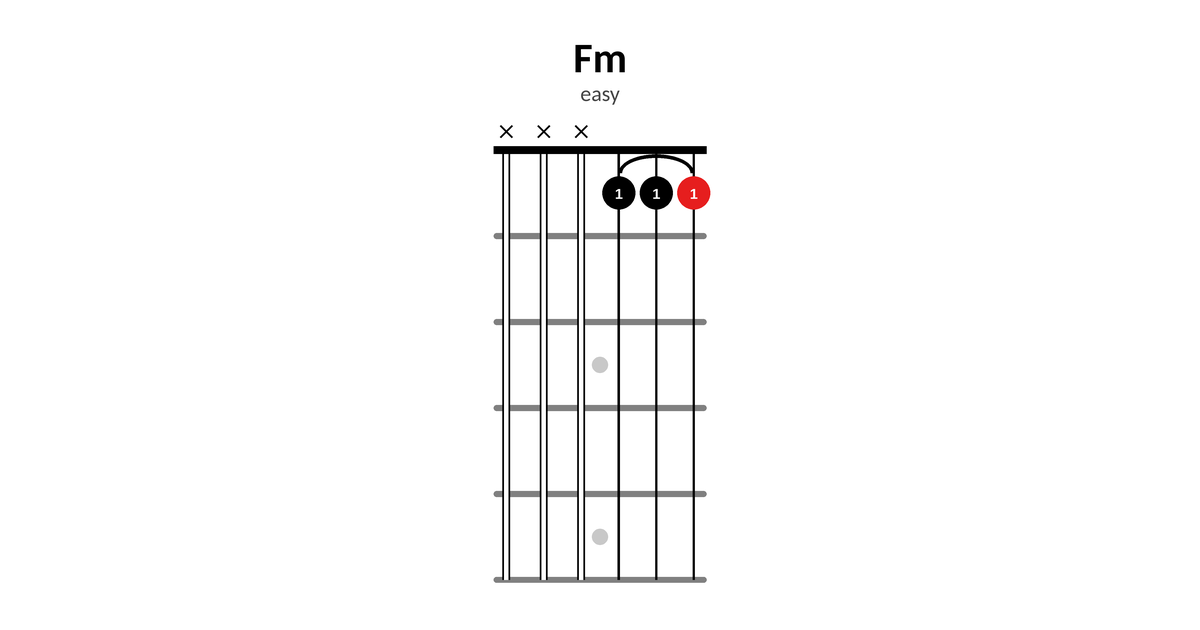
An F minor chord is built from three notes: F, A-flat and C. The easy Fm chord has all three. The G string gives you A-flat, the B string gives you C, and the high E string gives you F.
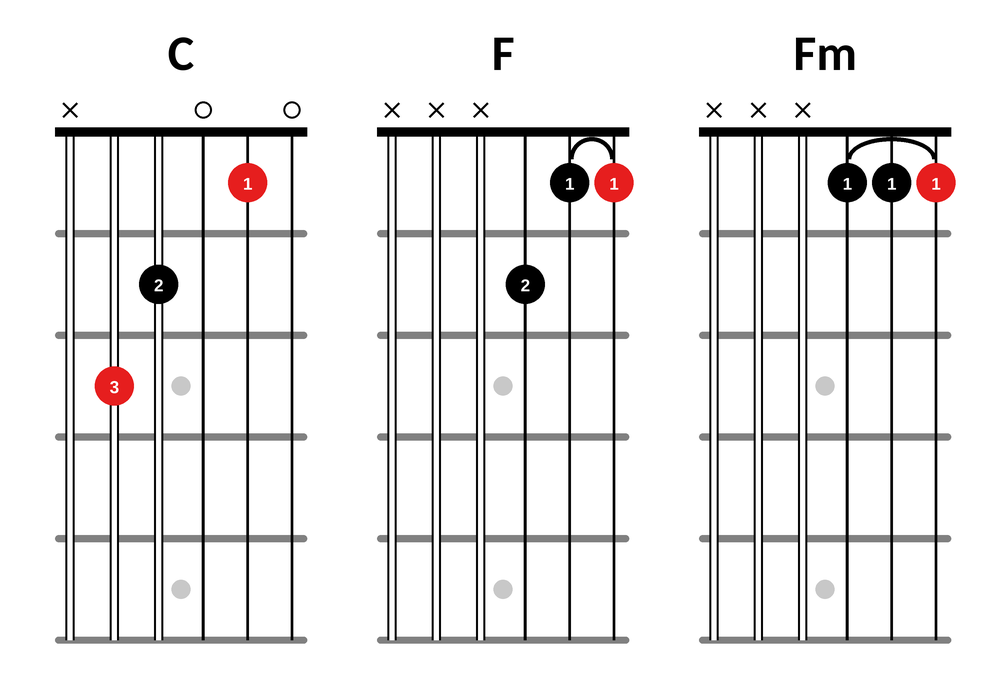
In the diagrams, the red dot marks F, the root of the chord. It sits on the high E string, so it’s the highest note you’ll hear.
Easy F vs. Easy Fm: One Note Apart
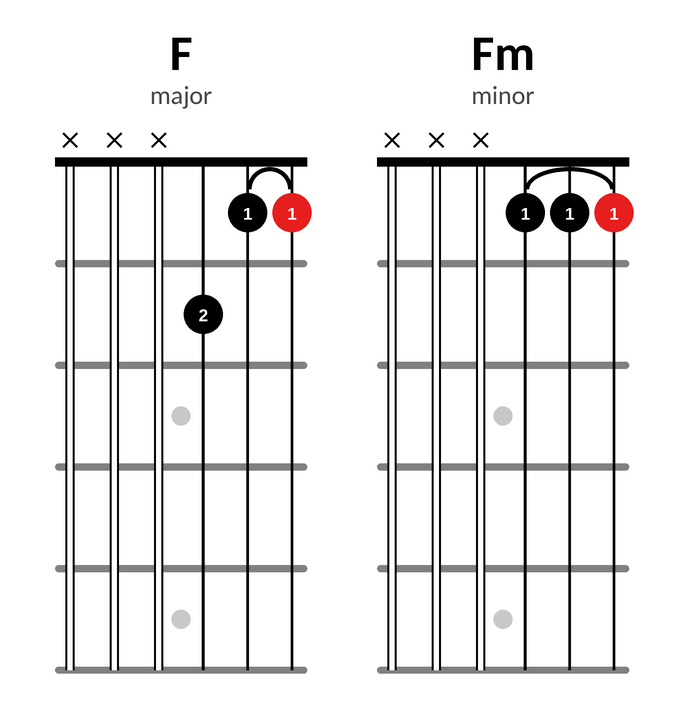
If you know the easy F chord, you’re one move away from Fm. Easy F is x x x 2 1 1, while easy Fm is x x x 1 1 1. Only the G string note changes, from the 2nd fret to the 1st.
To switch, lift your middle finger off the G string. Then flatten your index finger across the G string too. That one fret turns A into A-flat, which changes the chord from major to minor.
One Finger, Five Minor Chords
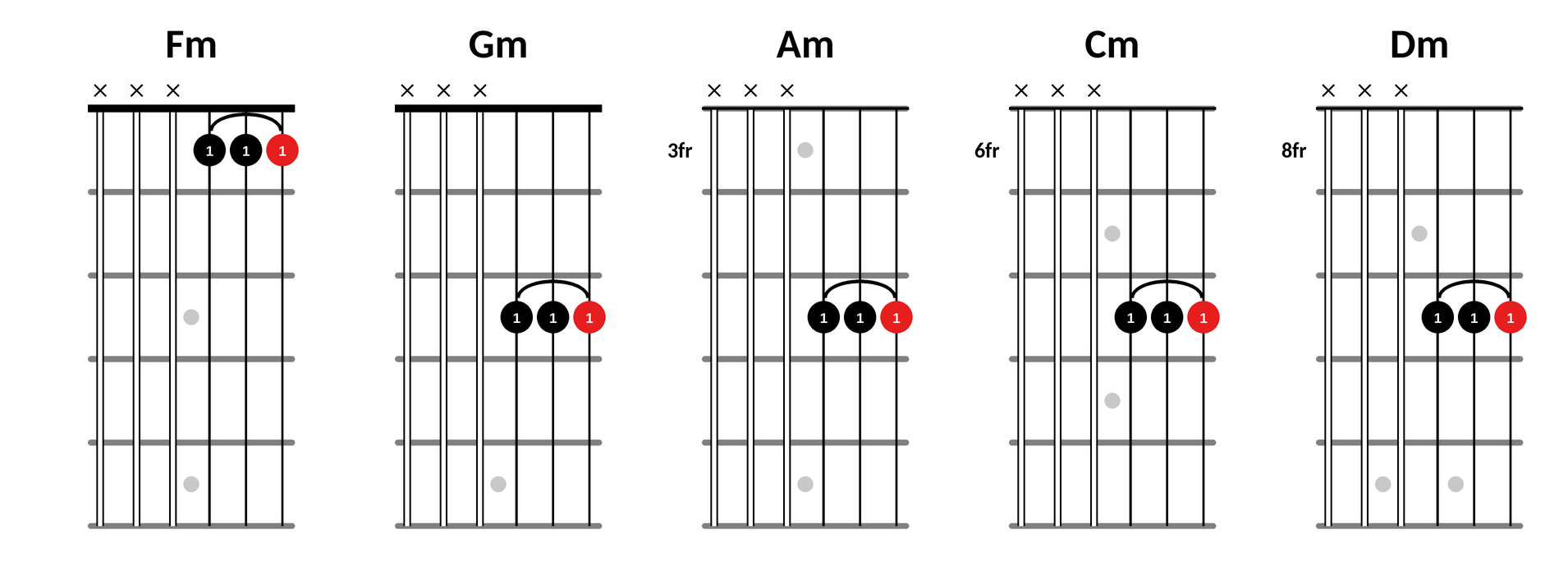
Here’s the best part. Slide the easy Fm chord up the neck, and it becomes a different minor chord at each spot. In fact, the note on the high E string always names the chord.
- F minor: 1st fret (x x x 1 1 1).
- G minor: 3rd fret (x x x 3 3 3).
- A minor: 5th fret (x x x 5 5 5).
- C minor: 8th fret (x x x 8 8 8).
- D minor: 10th fret (x x x 10 10 10).
Higher up, the frets sit closer together. So the barre often feels even easier at the 5th fret and above.
Play the Easy Fm Chord in a Progression
Now try that borrowed-chord move: C, F, Fm and back to C. Give each chord four beats.
- C: x 3 2 0 1 0.
- F: x x x 2 1 1.
- Fm: x x x 1 1 1.
- C: x 3 2 0 1 0.
Listen to the change from F to the easy Fm chord. Although just one note drops, the mood shifts from bright to bittersweet. Also notice that your index finger stays on the 1st fret of the B string through all four chords.
Practice the Change in Three Steps
- Strum F for four beats, then Fm for four beats. Repeat for one minute.
- Next, add C before and after, so you play the full progression.
- Finally, cut each chord to two beats. Only speed up once every change sounds clean.
Common Easy Fm Chord Mistakes
A few small problems cause most of the trouble with this shape.
- One string sounds dead. Generally, a finger crease is the cause. Shift your index finger slightly, or roll it onto its side.
- The barre is too far from the fret. Move it close to the fret wire, since that takes less pressure.
- The low strings ring. Start your strum at the G string, and keep the stroke short.
- Too much grip. Squeezing harder rarely helps. Instead, check your finger position first, then press only as hard as you need to.
Keep Going With Easy Triads
Remember that one-finger shape at the 8th fret? It’s one of two easy ways to play C minor. Our guide to the easy Cm chord covers both. Meanwhile, our pillar guide to easy guitar triads shows how this shape fits with three others.
When you’re ready for the full barre, our guide on how to play the F chord is a good next step. The F minor barre uses the same idea, with one finger lifted.
Explore 14 Comprehensive TRIAD Courses on TrueFire!Start →
Continue Learning
Explore the rest of this series:
- Easy Guitar Triads: Play Any Chord With Just 3 Strings
- Easy F Chord: Skip the Barre With This 3-String Shape
- Easy Bm Chord: A 3-Finger Shape That Sounds Just Right
- Easy B Chord: The Small Shape That Replaces the Barre
- Easy Cm Chord: A Simple 3-String Shape for C Minor
About the Education Team
Four music-industry veterans with decades of combined experience in music education, curation, and production at TrueFire and ArtistWorks. The TrueFire Studios Education Team plans and edits this content and works with our master-musician faculty to keep it accurate and genuinely useful.