

Shell voicings are the simplest way to play real jazz chords on guitar. Each one uses just three notes, so it’s easy to grab and quick to change. Even so, those three notes are enough to play hundreds of jazz standards. This guide covers all ten shell voicings, how to finger them, and how to comp with them like a pro.
What Are Shell Voicings?
A voicing is simply the way you arrange a chord’s notes on the guitar. A shell voicing keeps only the three notes that define the chord: the root, the 3rd and the 7th. For 6 chords, the 6th takes the place of the 7th.
Everything else, however, is left out. That includes the 5th, which sounds the same in most chords, and color notes like 9ths and 13ths. As a result, each shape fits on three strings with no full barre.
Why the 3rd and 7th Matter Most
The 3rd tells your ear whether a chord is major or minor. Meanwhile, the 7th tells it whether the chord has a major 7th or a flat 7th. So together, they name the chord. A major 3rd plus a major 7th is a major 7, a minor 3rd plus a flat 7th is a minor 7, and a major 3rd plus a flat 7th is a dominant 7.
The exceptions are m7b5 and diminished 7 chords. Their defining note, the flat 5th, is left out, so they share the minor 7 and minor 6 shapes. In a band, the bass, piano or melody usually supplies that note.
That’s also why shells work so well in a band. The bass and piano cover the other notes, while the guitar’s three notes cut through clearly.
How to Read the Shell Voicings in This Guide
Each of the shell voicings below is written as a code from the low E string (left) to the high E string (right). A number is the fret, and “x” means don’t play that string.
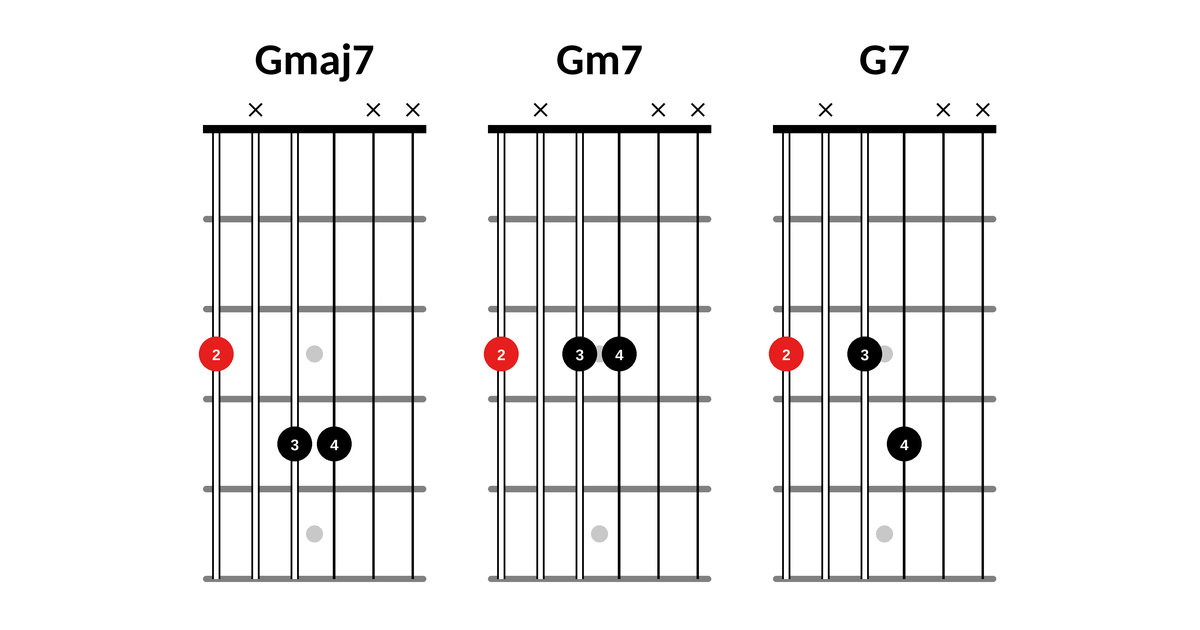
In the chord diagrams, the red dot is the root, and the number beside the first fret tells you where the shape sits. The numbers in the dots are suggested fingers: 1 is your index finger and 4 is your pinky.
The Five 6th-String Shell Voicings
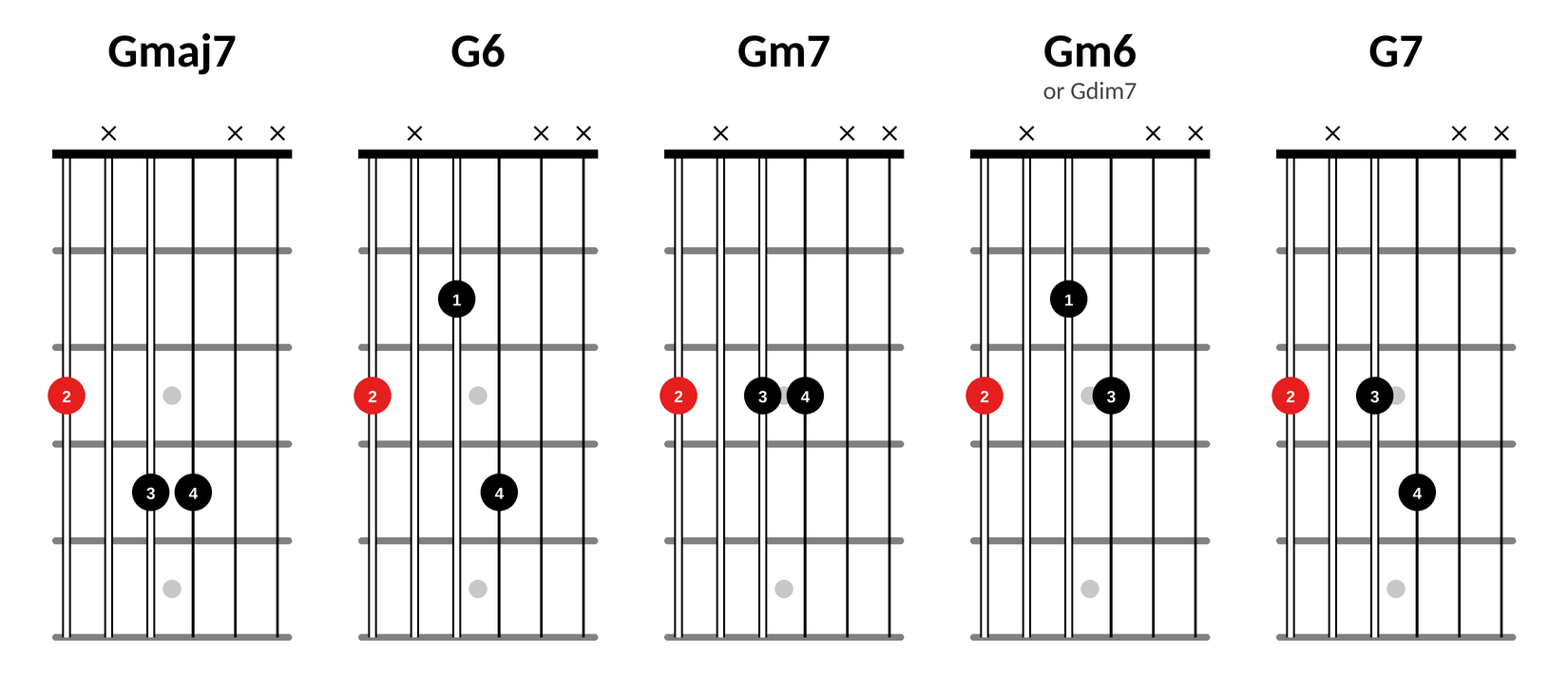
These five shapes have the root on the 6th string. They’re shown with a G root at the 3rd fret, so each one is a G chord.
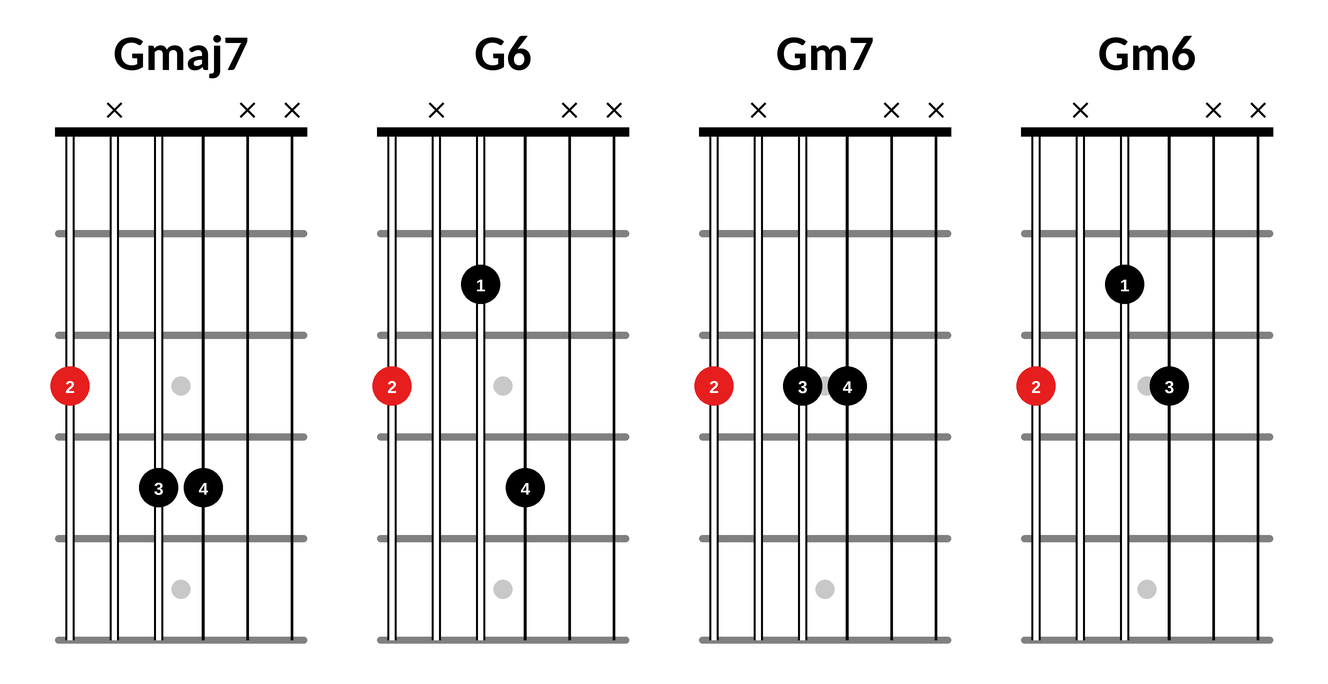
- Major 7 (Gmaj7): 3 x 4 4 x x. Middle finger on the root, ring and pinky on the D and G strings.
- Major 6 (G6): 3 x 2 4 x x. Middle finger on the root, index on the D string, pinky on the G string.
- Minor 7 (Gm7): 3 x 3 3 x x. Middle finger on the root, ring and pinky on the D and G strings.
- Minor 6 / Diminished 7 (Gm6 or Gdim7): 3 x 2 3 x x. Middle finger on the root, index on the D string, ring on the G string.
- Dominant 7 (G7): 3 x 3 4 x x. Middle finger on the root, ring on the D string, pinky on the G string.
Keep your middle finger on the root for all five. That way, your index finger is free to reach back a fret for the 6 shapes.
The Five 5th-String Shell Voicings
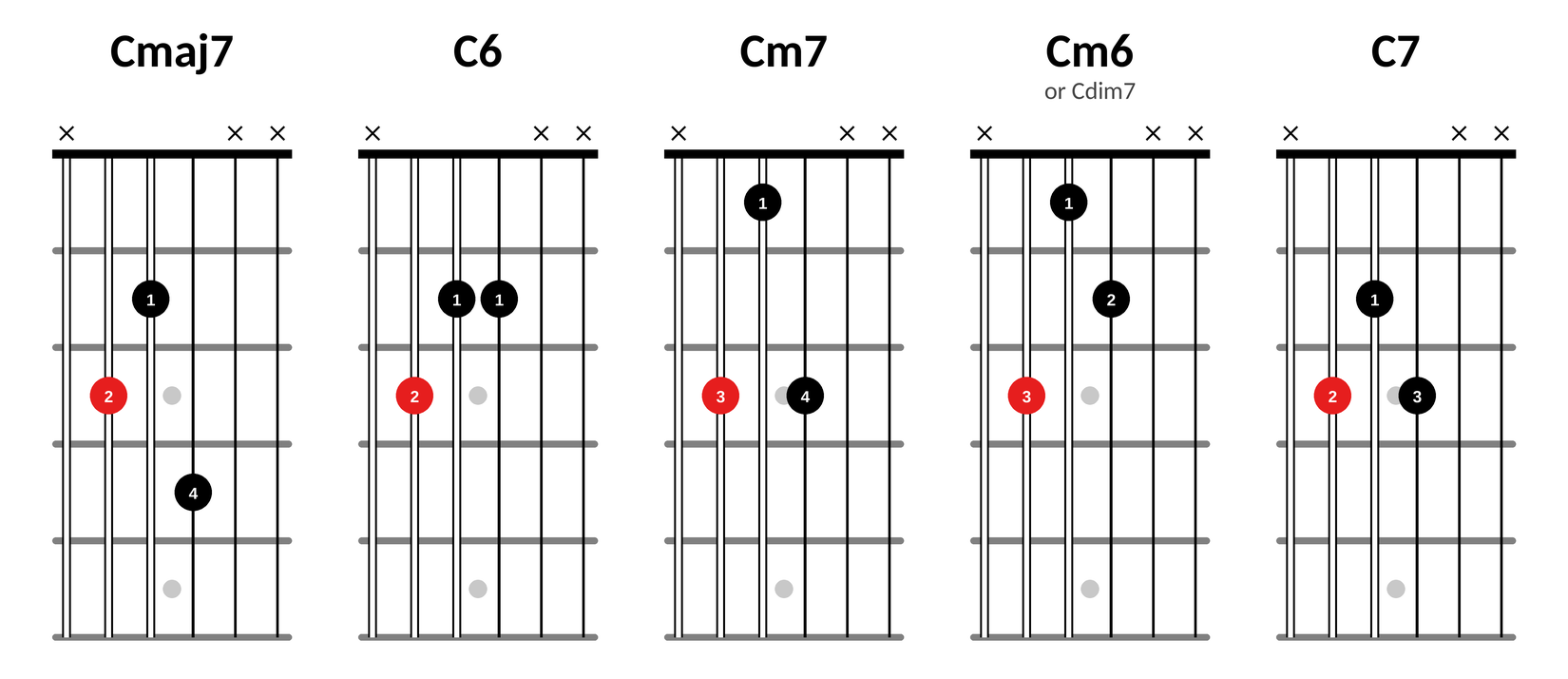
These shapes have the root on the 5th string. They’re shown with a C root at the 3rd fret.
- Major 7 (Cmaj7): x 3 2 4 x x. Middle finger on the root, index on the D string, pinky on the G string.
- Major 6 (C6): x 3 2 2 x x. Middle finger on the root, and lay your index finger flat across the D and G strings.
- Minor 7 (Cm7): x 3 1 3 x x. Ring finger on the root, index on the D string, pinky on the G string.
- Minor 6 / Diminished 7 (Cm6 or Cdim7): x 3 1 2 x x. Ring finger on the root, index on the D string, middle on the G string.
- Dominant 7 (C7): x 3 2 3 x x. Middle finger on the root, index on the D string, ring on the G string.
Moving Shell Voicings Up and Down the Neck
Every shape is movable, so you can play a different chord by sliding the shape until the root lands on the right note.
On the 6th string, the roots are F at the 1st fret, G at the 3rd, A at the 5th, B at the 7th, C at the 8th and D at the 10th. On the 5th string, they’re B-flat at the 1st fret, C at the 3rd, D at the 5th, E at the 7th, F at the 8th and G at the 10th. For example, the minor 7 shape with the root at the 5th fret of the 6th string is Am7.
Two Shortcuts That Cut the Work in Half
At first, ten shapes sounds like a lot. However, two shortcuts mean you’re really learning fewer.
Sixes Are Sevens With One Note Moved
Each 6 shape is a 7 shape with one note moved. For a major 6, move the 7th down two frets. For a minor 6, move the minor 7th down one fret.
For example, try it with G. Play Gmaj7 (3 x 4 4 x x), then drop the D-string note two frets to get G6 (3 x 2 4 x x). Then play Gm7 (3 x 3 3 x x) and drop the same note one fret to get Gm6 (3 x 2 3 x x).
One Shape for Minor 6 and Diminished 7
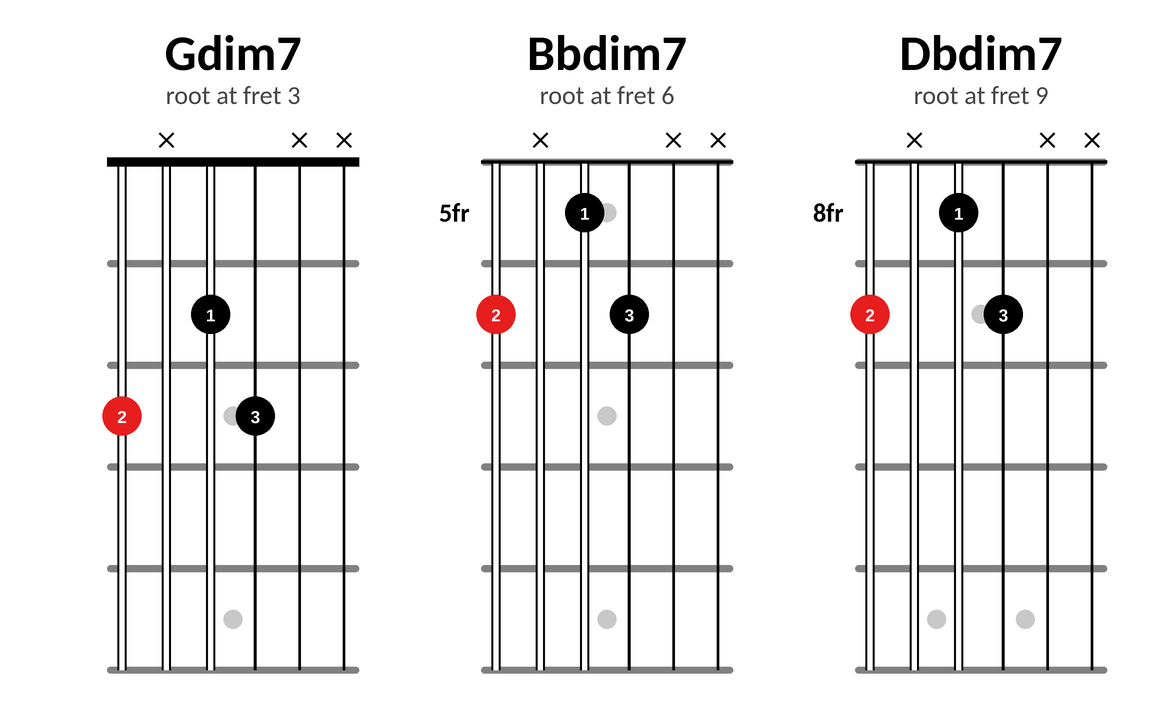
Also, the minor 6 shape and the diminished 7 shape share the same three notes. So one shape covers both chords.
Diminished 7 chords have another trick, too. Their notes are evenly spaced, so the same shape three frets higher plays the same chord. For instance, Gdim7 at the 3rd fret (3 x 2 3 x x), Bbdim7 at the 6th (6 x 5 6 x x) and Dbdim7 at the 9th (9 x 8 9 x x) are all one chord. Each shape simply leaves out a different note of the same four-note chord, so they all work the same way.
Using Shell Voicings to Comp Like Freddie Green
Comping means accompanying, or playing chords behind a soloist or singer. For about 50 years, Freddie Green held down the rhythm in Count Basie’s band with shell voicings like these.
His approach is simple to try, even if you’ve never comped before. Strum four even, light strokes per bar, one on every beat. Then ease off the fretting hand right after each strum, so the chord stops short. The result is a soft “chunk, chunk, chunk, chunk” that locks in with the bass and drums.
For more on this style, see our lesson on comping the blues with Freddie Green grips. Then our 12 free jazz comping lessons take it further.
Common Shell Voicing Mistakes
- Letting muted strings ring. Lay your fretting fingers slightly flat so they touch the strings marked “x.” Then strum lightly, aiming at the strings you need.
- Strumming too hard. That’s because shells sound best soft and short. If they sound harsh, use less pick and more release.
- Moving every finger. Between nearby chords, at least one finger often stays put or slides a fret. Look for those shortcuts before you jump.
- Skipping the 6 shapes. Older tunes are full of 6 chords, so learn them alongside the 7 shapes.
Keep Going With Shell Voicings
Next, put these shapes to work in the six jazz chord progressions behind most standards. To hear why the 6 shapes matter, read our guide to the G6 chord.
Then pick a tune from our list of 253 jazz standards you can play with shell chords. Every chord in it has a matching shell, so you can start right away.
Learn and Play 25 Jazz Standards on TrueFire!Start →
Continue Learning
Explore the rest of this series:
- Jazz Standards on Guitar: 253 Tunes You Can Play With 10 Shell Chords
- Jazz Chord Progressions: The 6 Patterns Behind Most Standards
- The G6 Chord: Three Easy Ways to Play the Sweet Sound of Swing
- Autumn Leaves Chords: Play the Classic Jazz Standard With Shell Voicings
- All of Me Chords for Jazz Guitar: Play the 1931 Standard With Shell Voicings
About the Education Team
Four music-industry veterans with decades of combined experience in music education, curation, and production at TrueFire and ArtistWorks. The TrueFire Studios Education Team plans and edits this content and works with our master-musician faculty to keep it accurate and genuinely useful.