

Jazz chord progressions can look complicated on paper, but most standards are built from the same few patterns. Learn six of them, and you’ll recognize whole sections of tunes before you read them. This guide shows each pattern with easy three-note shell chords, along with real standards that use it.
How to Read Jazz Chord Progressions
Jazz players often write progressions as Roman numerals instead of chord names. Each numeral stands for a note of the major scale, so the pattern works in any key.
In the key of C, for example, I is C, ii is D minor and V is G. Lowercase numerals mean minor chords, and uppercase numerals mean major or dominant chords. So “ii-V-I” in C is Dm7, G7, Cmaj7, while in F it’s Gm7, C7, Fmaj7.
Every chord in these jazz chord progressions is a shell: a three-note chord with the root, the 3rd and the 7th (or 6th). The codes read from the low E string to the high E string, and “x” means don’t play that string. If the shapes are new to you, start with our guide to shell voicings.
1. The Major ii-V-I
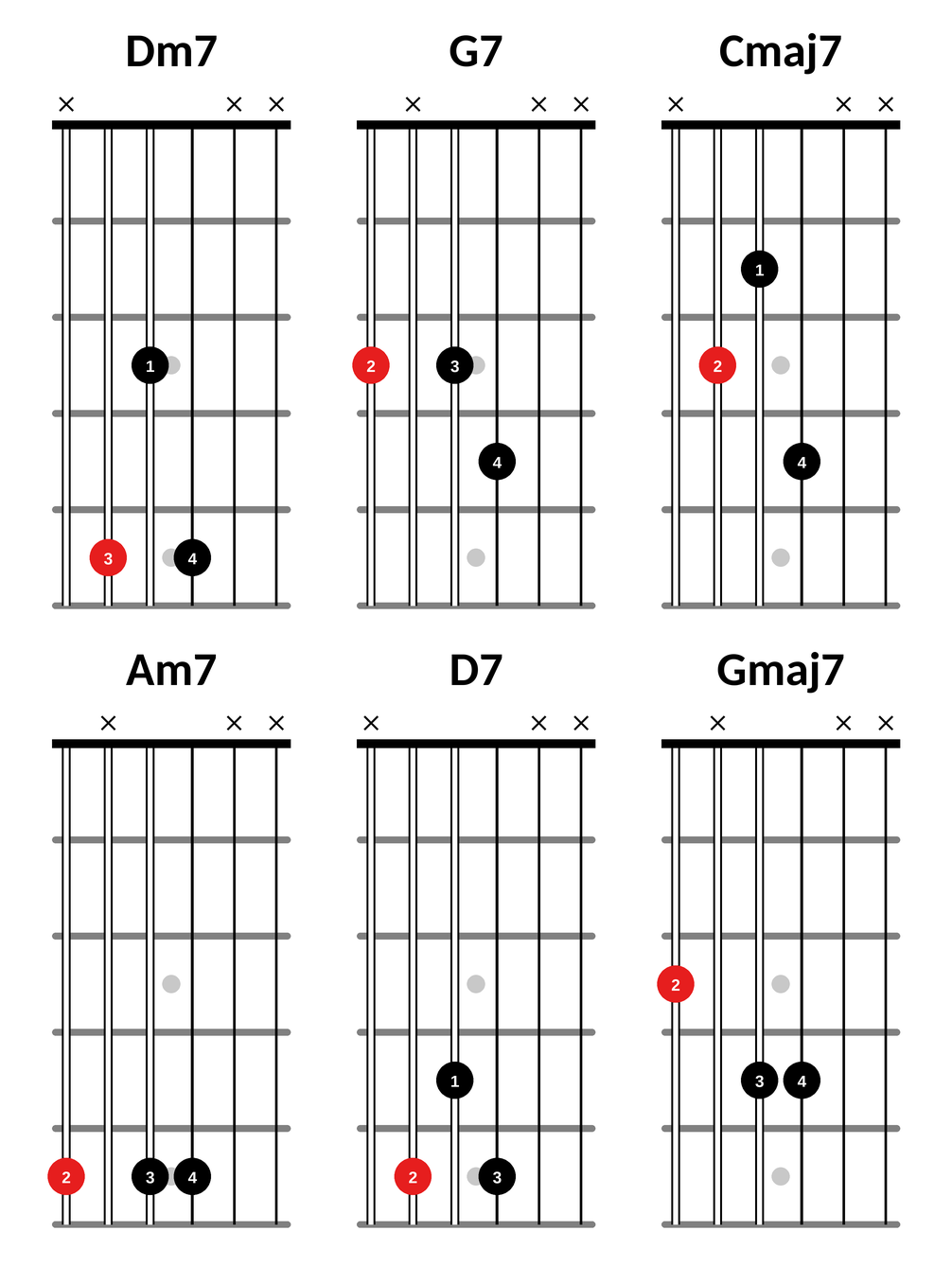
This is the most important move in jazz. The ii chord sets up tension, the V chord increases it, and the I chord resolves it. As a result, the ear hears a strong sense of arriving home.
In C, start on Dm7 (x 5 3 5 x x). Then play G7 (3 x 3 4 x x) and resolve to Cmaj7 (x 3 2 4 x x). Notice that each chord is only a fret or two from the last.
You can also start on the 6th string. In G, start on Am7 (5 x 5 5 x x). Then play D7 (x 5 4 5 x x) and resolve to Gmaj7 (3 x 4 4 x x). Tune Up and There Will Never Be Another You are full of this move, and Satin Doll is built from ii-V pairs.
2. The Minor ii-V-i
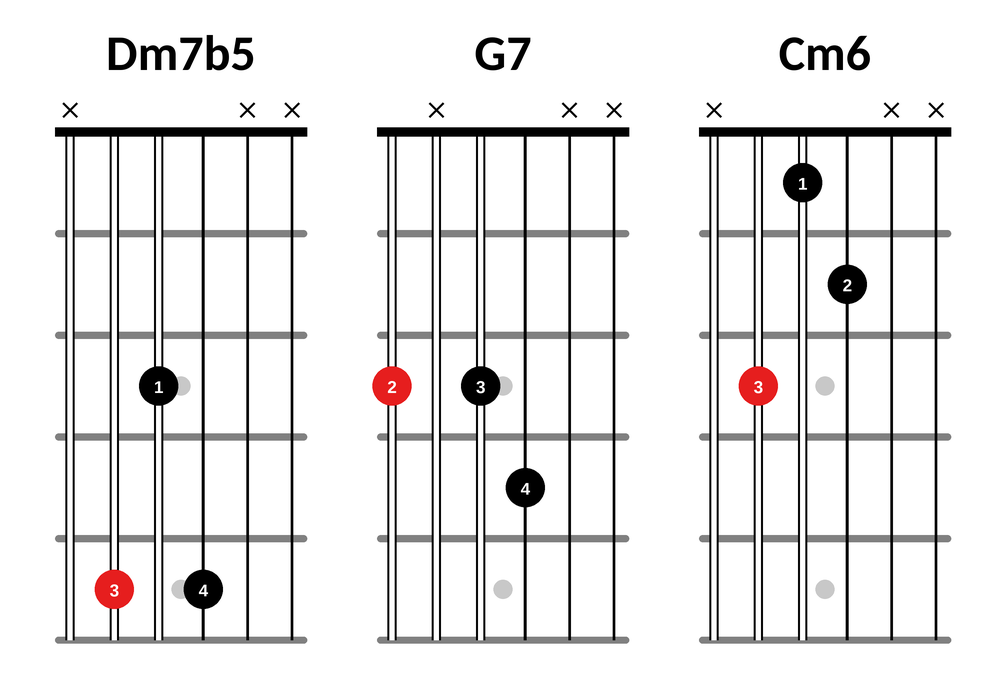
The minor version has a darker sound. Here the ii chord is a minor 7 flat 5 (m7b5), and the home chord is minor.
In C minor, start on Dm7b5 (x 5 3 5 x x). Then play G7 (3 x 3 4 x x) and resolve to Cm6 (x 3 1 2 x x). The m7b5 uses the plain minor 7 shell, because the shell leaves out the 5th, the only note that changes.
This is the sound of Autumn Leaves, Blue Bossa, Beautiful Love and Alone Together. For a complete tune built on it, see our guide to the Autumn Leaves chords.
3. The I-VI-ii-V Turnaround
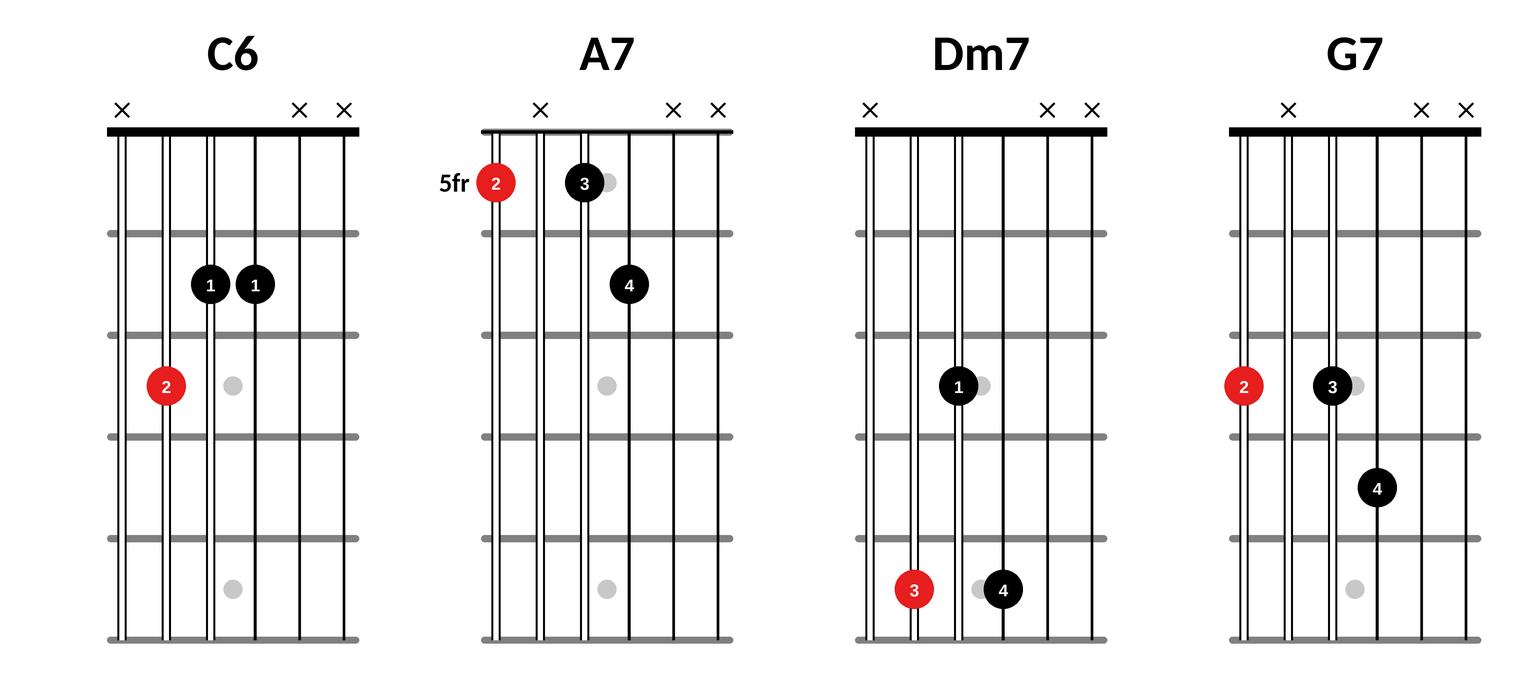
A turnaround leads from the end of one section back to the start of the next. In fact, many players simply call this one the turnaround, because it’s so common.
In C, play C6 (x 3 2 2 x x), then A7 (5 x 5 6 x x). Next, play Dm7 (x 5 3 5 x x) and G7 (3 x 3 4 x x). The VI chord is often a dominant 7 (A7) rather than a minor 7. That gives it a stronger push toward the ii.
You’ll hear it all through I Got Rhythm and Blue Moon, often with a minor vi chord instead of the dominant VI. For more variations, see our lesson on jazz guitar turnarounds.
4. The iii-VI-ii-V-I
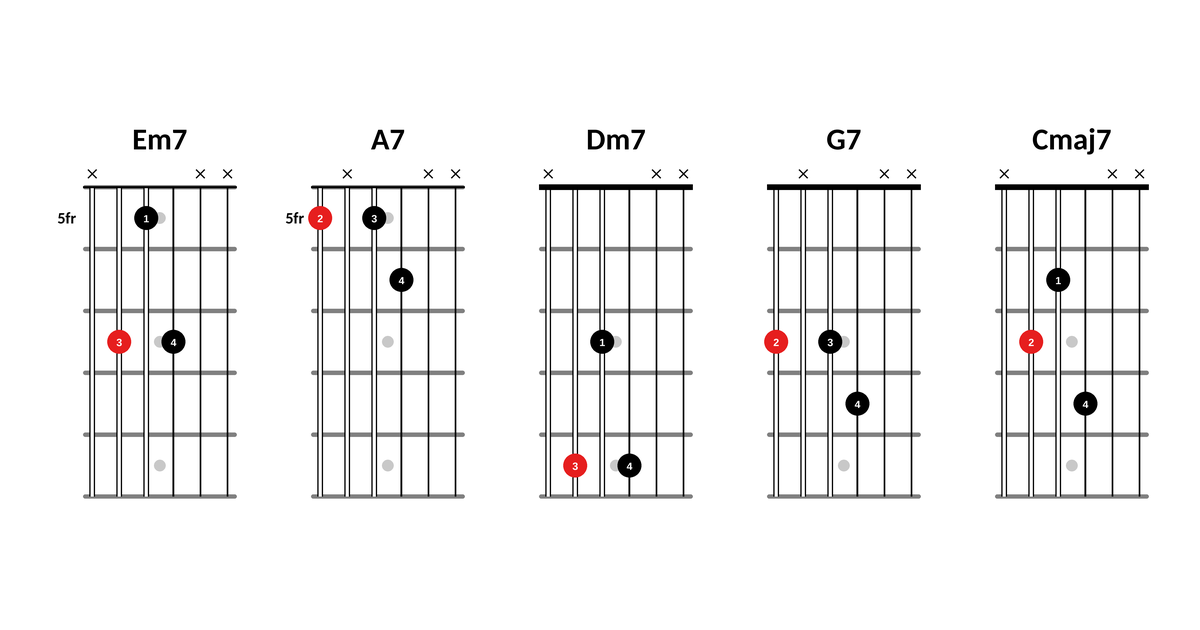
This pattern swaps the turnaround’s opening I chord for the iii chord, then lands on the I at the end. Em7 shares three notes with Cmaj7, so it’s a natural stand-in. Each chord moves to the next by the same distance, so the progression sounds like it’s rolling downhill toward home.
In C, start on Em7 (x 7 5 7 x x) and A7 (5 x 5 6 x x). Then play Dm7 (x 5 3 5 x x) and G7 (3 x 3 4 x x). Finally, land on Cmaj7 (x 3 2 4 x x). On the neck, the shapes walk down from the 7th fret to the 3rd.
The last few bars of All of Me use exactly this run. Our guide to the All of Me chords shows it in context.
5. The Jazz Blues
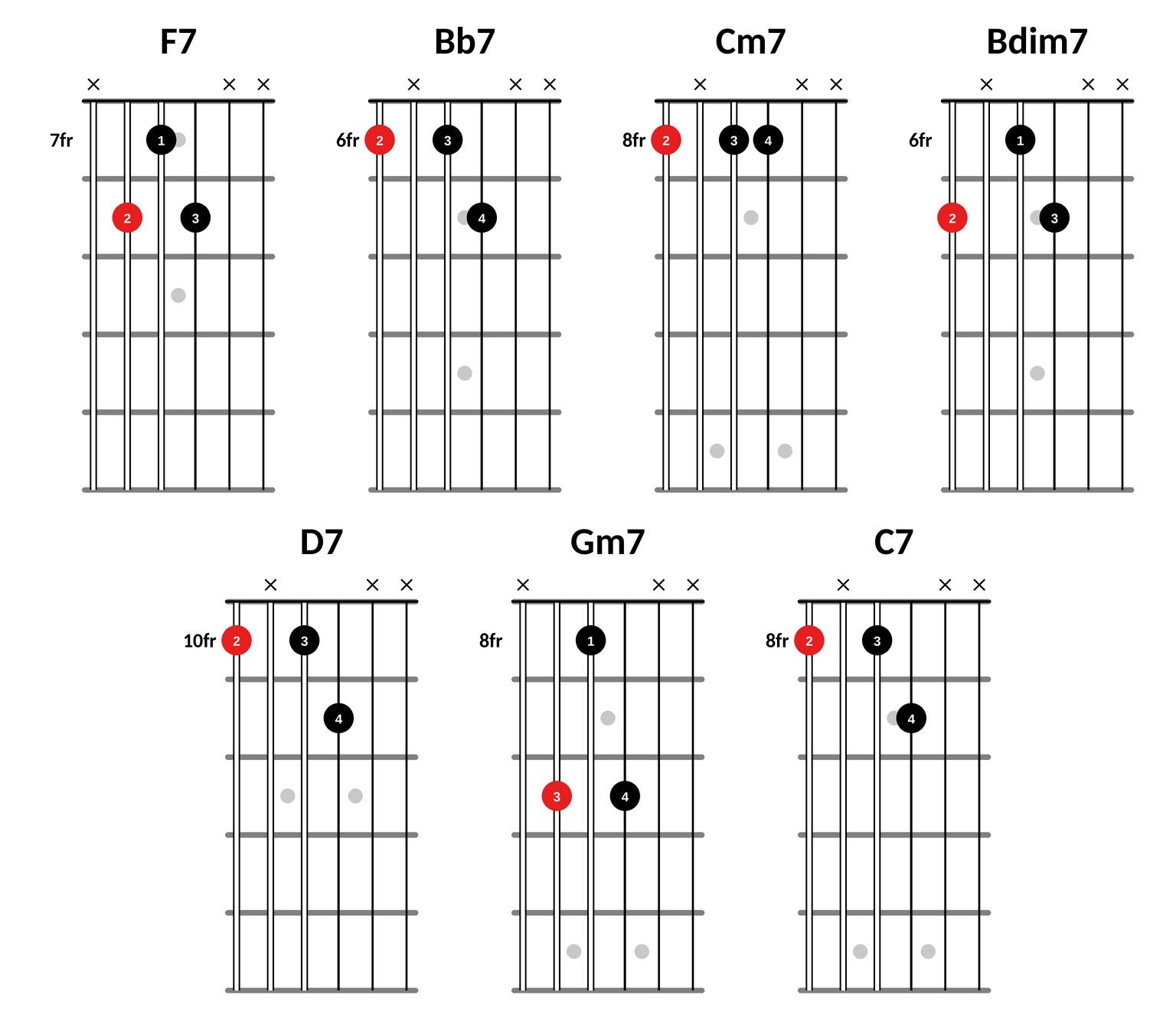
A jazz blues keeps the 12-bar blues form but adds ii-V moves and passing chords. Here’s a common version in F. Each bar has one chord unless two are shown.
- Bars 1-4: F7, Bb7, F7, Cm7 and F7.
- Bars 5-8: Bb7, Bdim7, F7, D7.
- Bars 9-12: Gm7, C7, F7 and D7, Gm7 and C7.
These shells keep the whole tune between the 6th and 11th frets.
- F7: x 8 7 8 x x.
- Bb7: 6 x 6 7 x x.
- Cm7: 8 x 8 8 x x.
- Bdim7: 7 x 6 7 x x.
- D7: 10 x 10 11 x x.
- Gm7: x 10 8 10 x x.
- C7: 8 x 8 9 x x.
Now’s the Time and Billie’s Bounce are jazz blues tunes in F, close to this version. Tenor Madness and Sonnymoon for Two use a simpler blues in B-flat. Our lesson on jazz rhythm guitar for C Jam Blues and Sweet Georgia Brown adds comping ideas.
6. Rhythm Changes
Rhythm changes are the chords of George Gershwin’s I Got Rhythm. Jazz players have written hundreds of new melodies over them, so they’re among the most useful jazz chord progressions to know by heart. The form is 32 bars: two A sections, a bridge, then a final A. Oleo, Anthropology, Moose the Mooche, Rhythm-a-Ning and Cotton Tail are all rhythm changes tunes.
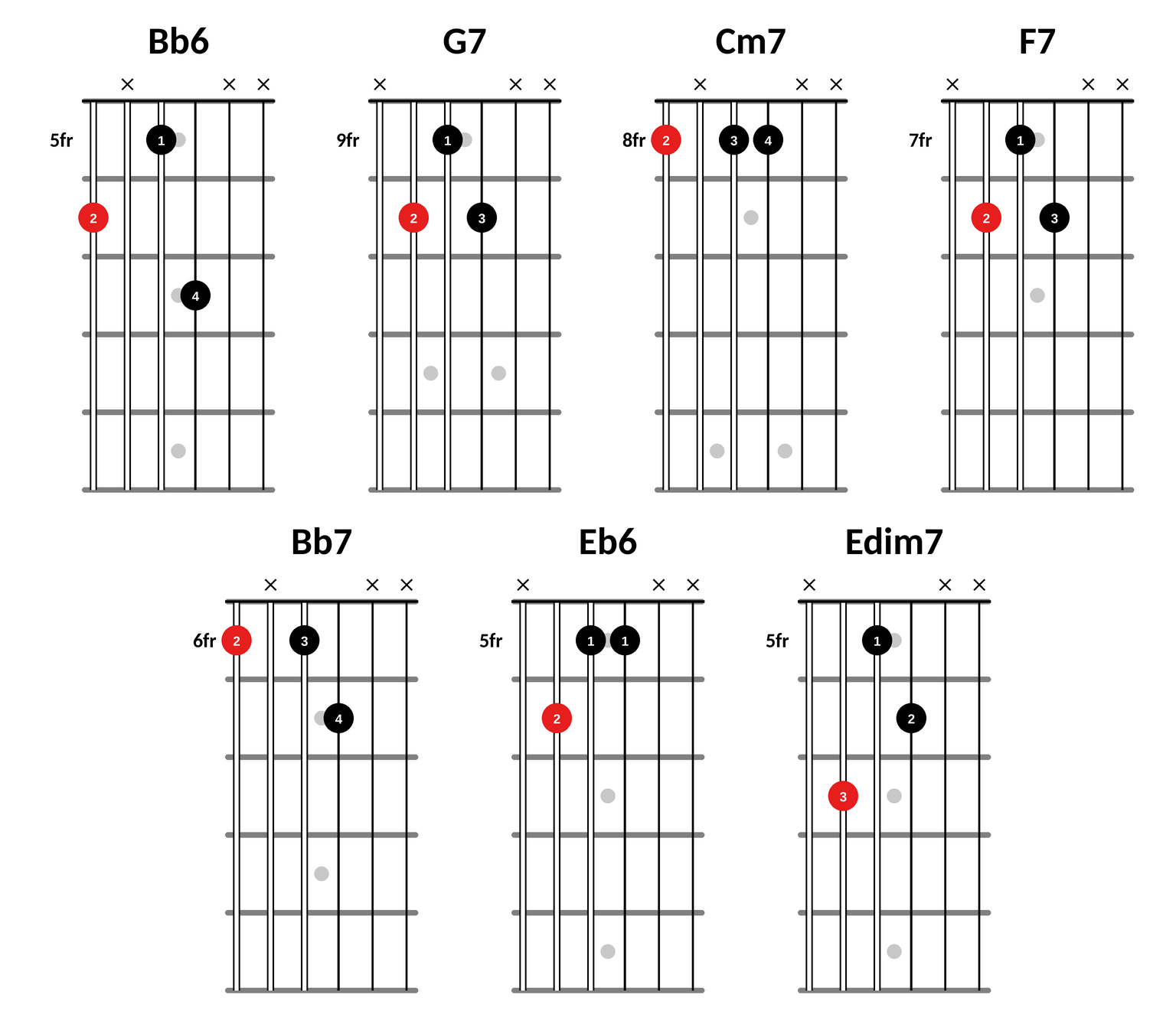
A simple version of the A section in B-flat starts Bb6 G7, Cm7 F7, Bb6 G7, Cm7 F7. Then it continues Bb6 Bb7, Eb6 Edim7, Bb6 F7, Bb6. Each pair shares one bar.
For the A section, try these shells.
- Bb6: 6 x 5 7 x x.
- G7: x 10 9 10 x x.
- Cm7: 8 x 8 8 x x.
- F7: x 8 7 8 x x.
- Bb7: 6 x 6 7 x x.
- Eb6: x 6 5 5 x x.
- Edim7: x 7 5 6 x x.
The Rhythm Changes Bridge
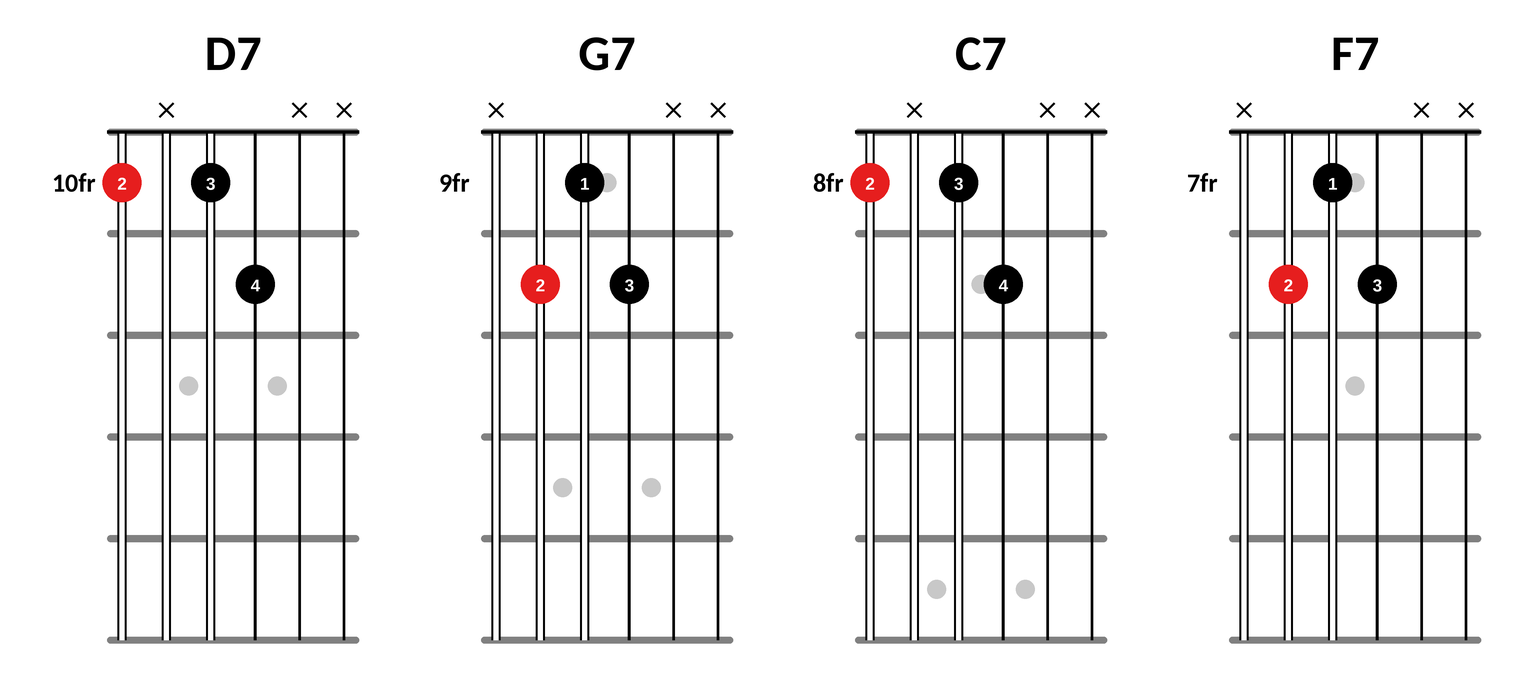
The bridge is a chain of dominant chords, two bars each: D7, G7, C7 and F7. For these, use D7 (10 x 10 11 x x), G7 (x 10 9 10 x x), C7 (8 x 8 9 x x) and F7 (x 8 7 8 x x). The root hops between the 6th and 5th strings. D7 and G7 share the 10th fret, and C7 and F7 share the 8th, two frets lower.
How to Practice Jazz Chord Progressions
When you practice jazz chord progressions, a little every day beats one long session. These steps keep it focused.
Practice Jazz Chord Progressions in More Than One Key
Once a pattern feels smooth in one key, slide the whole thing up two frets. Because shells are movable, the shapes stay the same and only the position changes.
Say the Chord Names Out Loud
As you play, name each chord. That way, you’re learning the music, not just the finger shapes. Soon you’ll spot a ii-V-I on a chart before you play it.
Then Play a Real Tune
Pick a tune from our list of 253 jazz standards that uses the pattern you’re working on. For hundreds more ways to play the most important pattern, see 90 ways to play a ii-V-I. And our 30 Jazz Progressions You MUST Know course goes even deeper.
Learn and Play 25 Jazz Standards on TrueFire!Start →
Continue Learning
Explore the rest of this series:
- Jazz Standards on Guitar: 253 Tunes You Can Play With 10 Shell Chords
- Shell Voicings for Jazz Guitar: The 10 Shapes Behind Hundreds of Standards
- The G6 Chord: Three Easy Ways to Play the Sweet Sound of Swing
- Autumn Leaves Chords: Play the Classic Jazz Standard With Shell Voicings
- All of Me Chords for Jazz Guitar: Play the 1931 Standard With Shell Voicings
About the Education Team
Four music-industry veterans with decades of combined experience in music education, curation, and production at TrueFire and ArtistWorks. The TrueFire Studios Education Team plans and edits this content and works with our master-musician faculty to keep it accurate and genuinely useful.