

FV
A 2nd inversion puts the 5th of a chord on the bottom, which gives it a floating sound that wants to move. This guide explains what this inversion is and where you’ve already heard it. Then it shows Frank Vignola’s C major and A minor triads on the two low string groups, with his video lessons from the Inversion Excursion course.
What Is a 2nd Inversion?
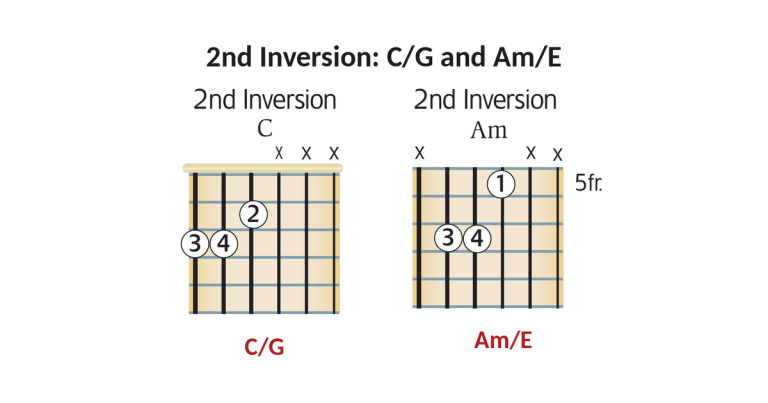
Every major or minor triad has a root, a 3rd and a 5th. In C major, those notes are C, E and G. When the 5th sits on the bottom, the chord is in 2nd inversion.
- C major: G on the bottom, then C and E. Songbooks write it as C/G.
- A minor: E on the bottom, then A and C. Songbooks write it as Am/E.
How a 2nd Inversion Sounds
Compared with root position, this inversion sounds a little unsettled, as if it’s leaning toward the next chord. That’s why it often shows up right before a chord change.
You’ve probably played one already, because country and folk players use C/G all the time. To try it, play 3 3 2 0 1 0. That’s your open C chord with an extra G on the low E string.
The 2nd Inversion in Every String Group
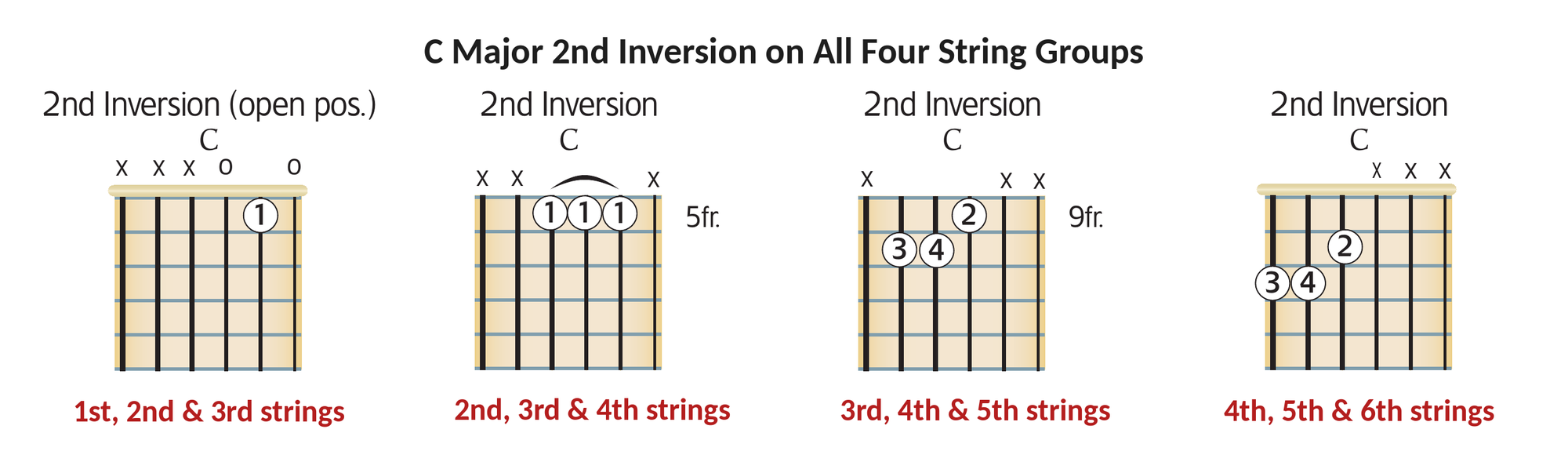
The chart above shows C in 2nd inversion on all four string groups. In every one, G is the lowest note.
- Top strings: x x x 0 1 0.
- Middle strings: x x 5 5 5 x.
- 3rd, 4th and 5th strings: x 10 10 9 x x.
- Low strings: 3 3 2 x x x.
Triads on the 3rd, 4th and 5th Strings
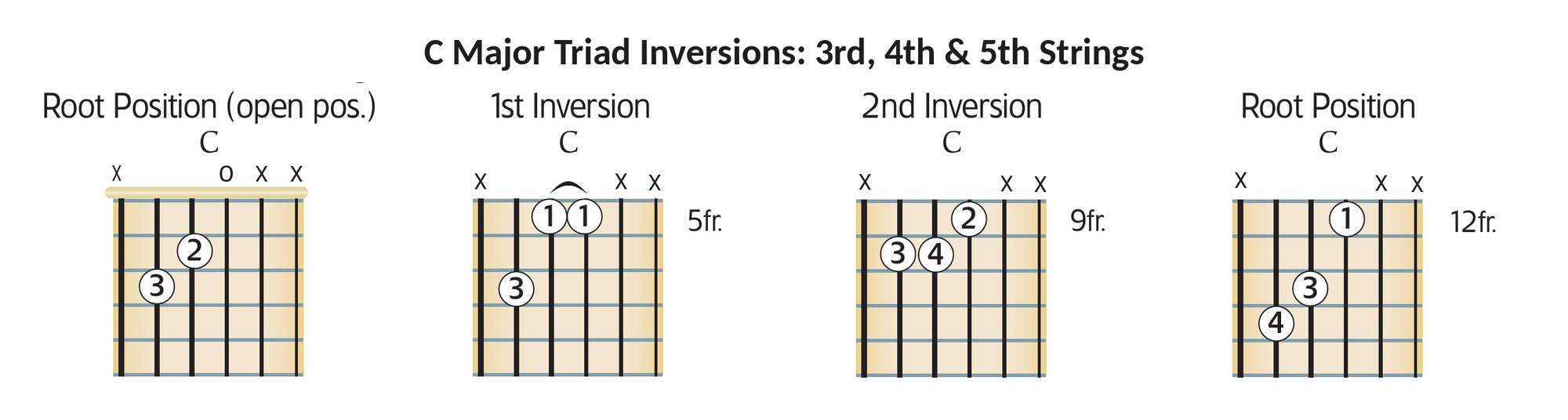
These are the G, D and A strings. Frank’s charts number strings from the thinnest, so they’re the 3rd, 4th and 5th strings. Also, each code runs from the low E string (left) to the high E string (right).
C Major on the 3rd, 4th and 5th Strings
- Root position, open: x 3 2 0 x x. It’s the bottom of your open C chord.
- 1st inversion: x 7 5 5 x x. Ring finger on the A string, then lay your index finger across the D and G strings.
- 2nd inversion: x 10 10 9 x x. Ring and pinky fingers at the 10th fret, middle finger on the G string.
- Root position, 12th fret: x 15 14 12 x x. Pinky, ring and index fingers.
In the video lesson below, Frank plays these C shapes on the 3rd, 4th and 5th strings.
-0:00 

This video is unavailable.
Watch Frank play these shapes:
-0:00 This video is unavailable.
This video is unavailable.
This video is unavailable.
A Minor on the 3rd, 4th and 5th Strings
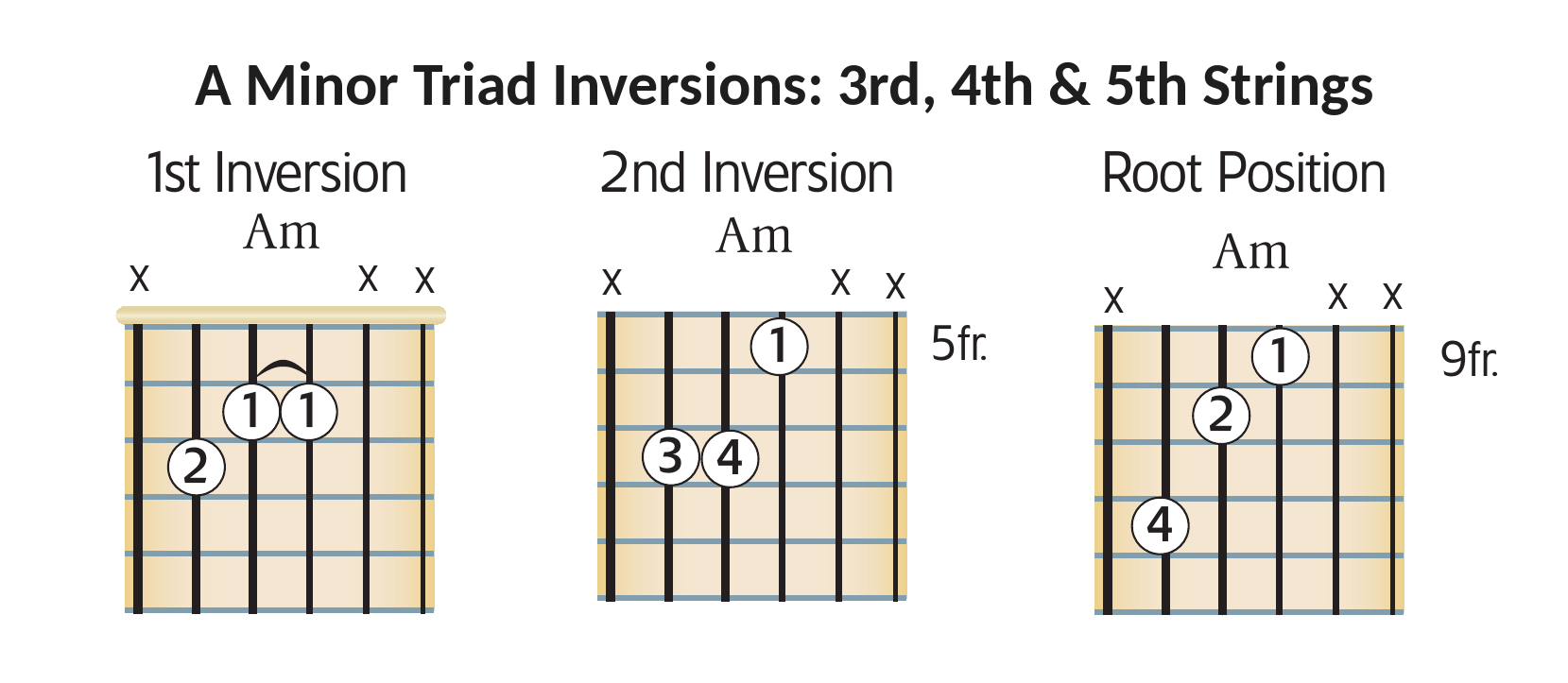
- 1st inversion: x 3 2 2 x x. Middle finger on the A string, then lay your index finger across the D and G strings.
- 2nd inversion: x 7 7 5 x x. Ring and pinky fingers at the 7th fret, index finger on the G string.
- Root position: x 12 10 9 x x. Pinky, middle and index fingers.
Next, watch Frank work through the A minor shapes on these strings in the video below.
-0:00 This video is unavailable.
Watch Frank play these shapes:
-0:00 This video is unavailable.
This video is unavailable.
This video is unavailable.
Triads on the 4th, 5th and 6th Strings
These are the three lowest strings: D, A and low E. As a result, they’re the deepest triads on the guitar.
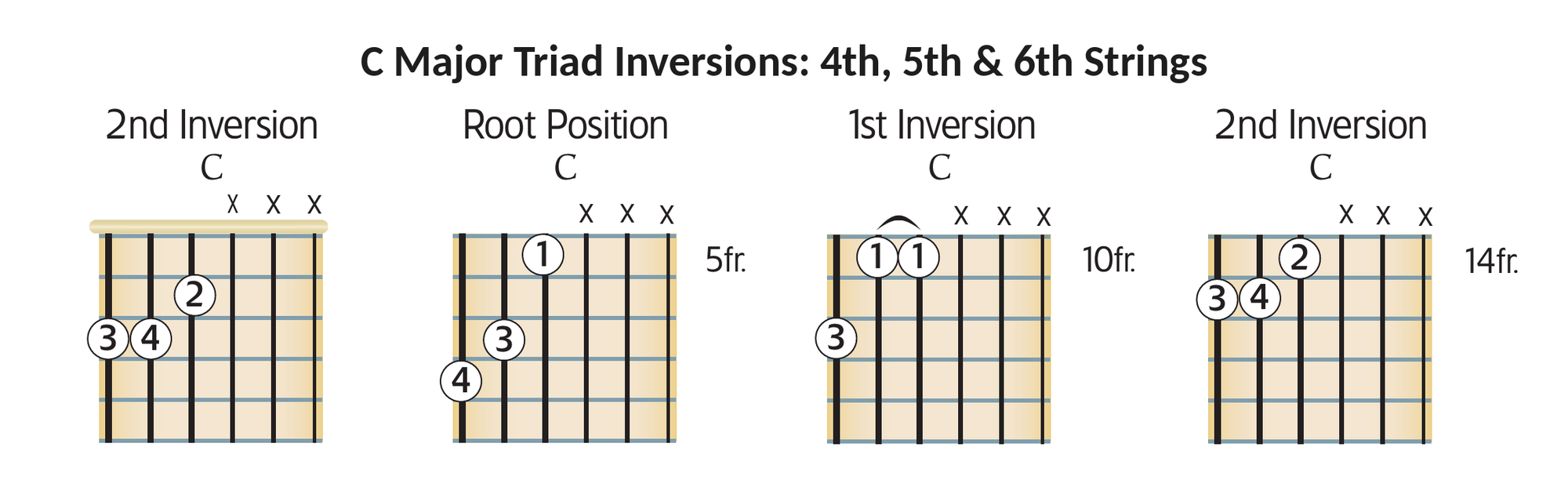
C Major on the 4th, 5th and 6th Strings
- 2nd inversion: 3 3 2 x x x. Ring finger on the low E string, pinky on the A string, middle finger on the D string.
- Root position: 8 7 5 x x x. Pinky, ring and index fingers.
- 1st inversion: 12 10 10 x x x. Ring finger on the low E string, then lay your index finger across the A and D strings.
- 2nd inversion, 14th fret: 15 15 14 x x x. The same fingering as the first shape, 12 frets higher.
Frank’s lesson on the lowest C shapes is in the video below.
-0:00 This video is unavailable.
Watch Frank play these shapes:
-0:00 This video is unavailable.
This video is unavailable.
This video is unavailable.
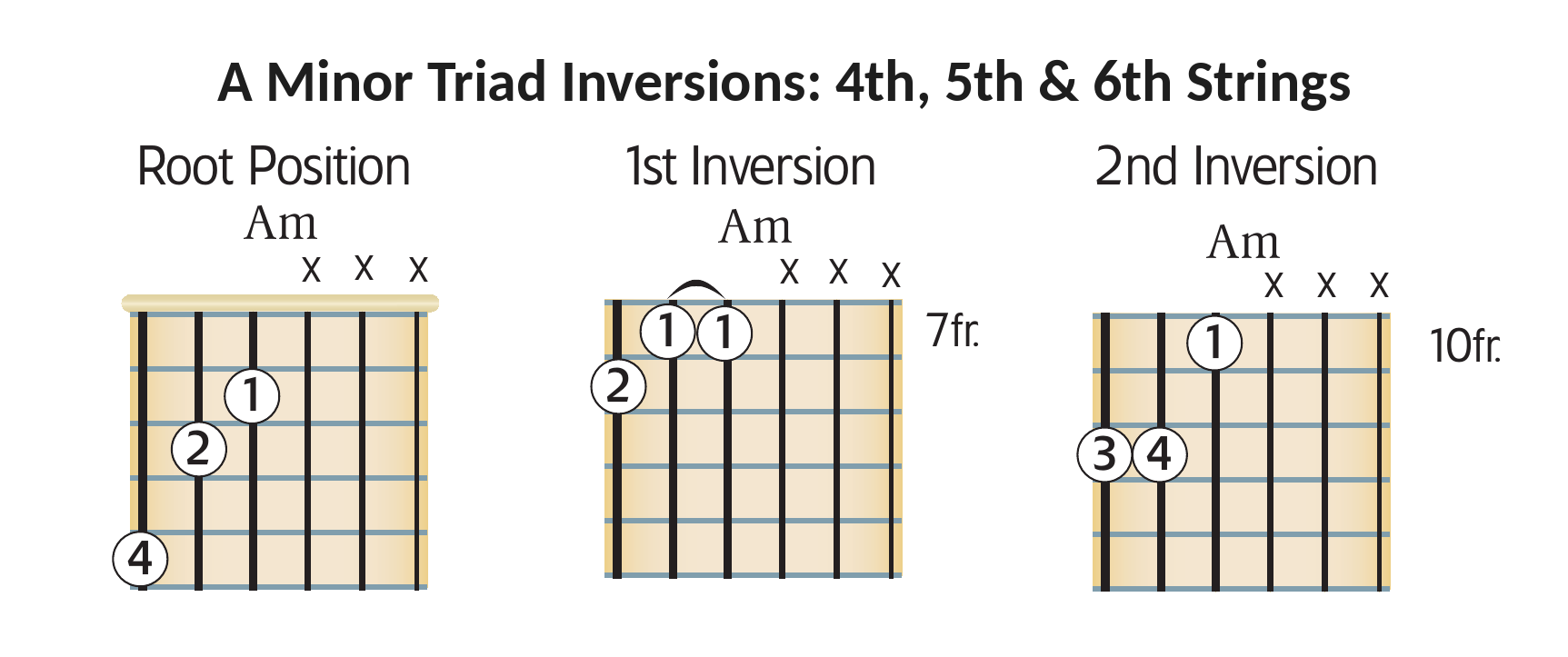
A Minor on the 4th, 5th and 6th Strings
- Root position: 5 3 2 x x x. Pinky, middle and index fingers.
- 1st inversion: 8 7 7 x x x. Middle finger on the low E string, then lay your index finger across the A and D strings.
- 2nd inversion: 12 12 10 x x x. Ring and pinky fingers at the 12th fret, index finger on the D string.
To finish, Frank plays the lowest A minor shapes in the video below.
-0:00 This video is unavailable.
Watch Frank play these shapes:
-0:00 This video is unavailable.
This video is unavailable.
This video is unavailable.
Keep Low Triads Clear
Low notes close together can sound muddy, especially with distortion. So strum these shapes lightly, or pick the notes one at a time. They also work best when there’s no bass player, since they fill that low space themselves.
Switching Between C and Am
The trick from the higher strings still works. Because C and Am share C and E, you can turn any C shape into Am by raising its G two frets to A.
- Open position: C (x 3 2 0 x x) becomes Am (x 3 2 2 x x).
- Around the 7th fret: C (x 7 5 5 x x) becomes Am (x 7 7 5 x x).
- Low strings, 3rd fret: C (3 3 2 x x x) becomes Am (5 3 2 x x x).
- Low strings, 8th fret: C (8 7 5 x x x) becomes Am (8 7 7 x x x).
How to Practice the 2nd Inversion
To begin with, learn the easiest 2nd inversion shapes, then build from there.
- Play C/G as 3 3 2 0 1 0, your open C with a G added on the low E string.
- Next, play the low-string C shapes up the neck: 3 3 2, then 8 7 5, then 12 10 10.
- Then switch between C (3 3 2 x x x) and Am (5 3 2 x x x).
- Finally, find the G on the bottom of each 2nd inversion shape and say its name out loud.
Keep Going
Frank also adds single bass notes to these triads, which turns them into slash chords like C/G and C/E. Our guide to slash chords covers those shapes. If you missed the middle strings, read our guide to the 1st inversion.
For the full picture, see our pillar guide to chord inversions. Then, to see how shapes like these link up across the neck, read CAGED system explained.
Inversion Excursions – 124 video lessons and 800+ pages of charts! Start →
Continue Learning
Explore the rest of this series:
- Easy Chord Inversions: Guitar Shapes That Move Up the Neck
- Triad Inversions: 3 Easy Shapes on the Top 3 Strings
- 1st Inversion Chords: Easy Triads on the Middle Strings
- Slash Chords: Easy Inversions With a New Bass Note
- Voice Leading: Smooth Chord Changes With Easy Inversions
About the Education Team
Four music-industry veterans with decades of combined experience in music education, curation, and production at TrueFire and ArtistWorks. The TrueFire Studios Education Team plans and edits this content and works with our master-musician faculty to keep it accurate and genuinely useful.
Featured Contributor
FV
Frank’s stunning virtuosity has made him the guitarist of choice for many of the world’s top musicians, including Ringo Starr, Madonna, Donald Fagen, Hank Jones, Lionel Hampton, John Lewis, the Boston Pops, the New York Pops, and guitar legend Les Paul, who named Vignola to his “Five Most Admired Guitarists List” for the Wall Street Journal.