

FV
Slash chords tell you to play a chord over a specific bass note. C/E, for example, means a C chord with E on the bottom. They look tricky on a chord sheet, but most of them are just inversions with a new name. This guide shows how to read slash chords, then teaches Frank Vignola’s bass-note shapes from his Inversion Excursion course, with a video lesson for each.
What Are Slash Chords?
A slash chord has two parts. The chord comes first, and the bass note comes after the slash. Also, you say C/E as “C over E.”
Most slash chords use a bass note that’s already in the chord. In this case, the slash chord is simply an inversion. However, other slash chords use a bass note from outside the chord, such as D/C. This guide sticks to the first kind, since those come straight from inversions.
Slash Chords and Inversions Side by Side
- Root position: C and Am, with the root on the bottom.
- 1st inversion: C/E and Am/C, with the 3rd on the bottom.
- 2nd inversion: C/G and Am/E, with the 5th on the bottom.
Our pillar guide to chord inversions explains root position and inversions in more detail.
How Frank’s Bass-Note Shapes Work
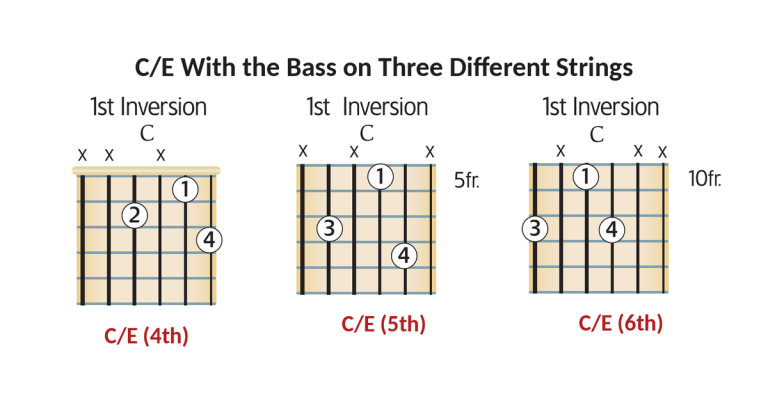
In these shapes, the bass note sits on the 4th, 5th or 6th string. Then two higher notes sit on top, with one string skipped in between. Because the notes are spread out, the chord sounds fuller and more open than a close triad.
Of course, that skipped string needs to stay quiet. So the easiest way to play these slash chords is to pluck them. Use your thumb or pick for the bass note, and two fingers for the top notes. Alternatively, let the finger on the bass string lean over to mute the skipped string, then strum.
Each code below runs from the low E string (left) to the high E string (right). A number is the fret, “0” is an open string, and “x” means don’t play that string.
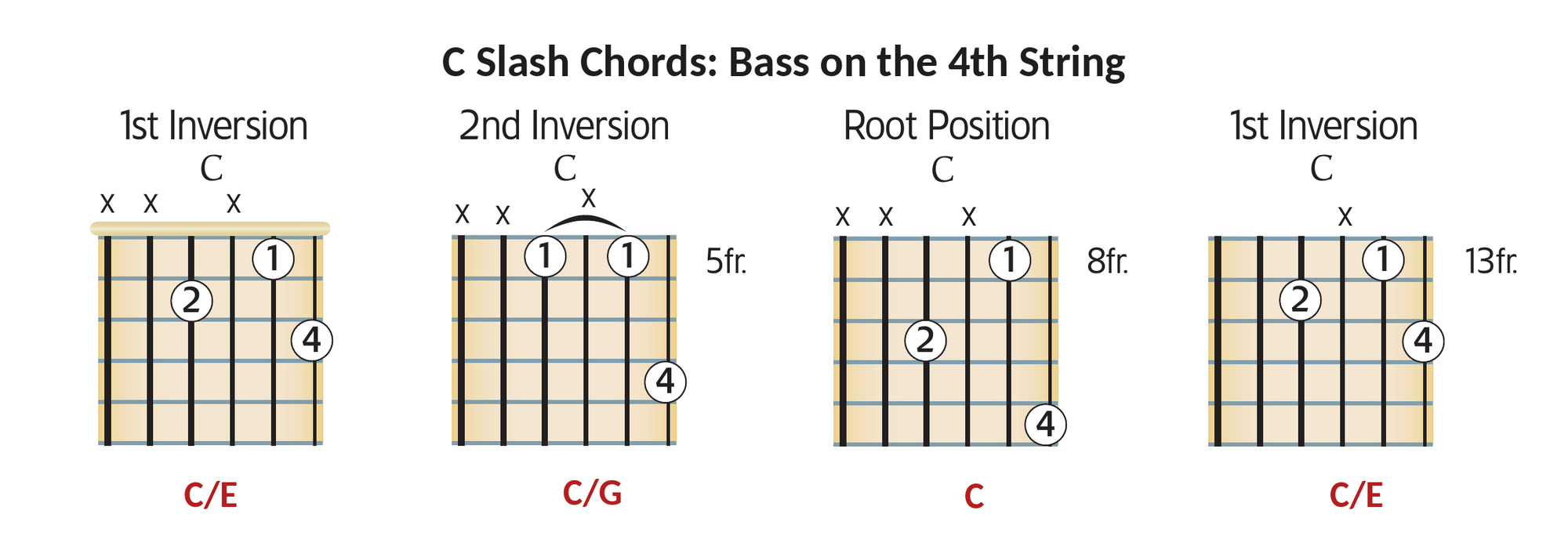
C Slash Chords With the Bass on the 4th String
The 4th string is the D string, so these shapes have a mid-range bass note. Here are Frank’s four shapes, from low to high on the neck.
- C/E: x x 2 x 1 3. Middle finger on the D string, index finger on the B string, pinky on the high E string.
- C/G: x x 5 x 5 8. Index finger covers the D and B strings at the 5th fret, and your pinky takes the high E string.
- C: x x 10 x 8 12. Middle finger on the D string, index finger on the B string, pinky on the high E string.
- C/E, 13th fret: x x 14 x 13 15. The same fingering as the first shape, 12 frets higher.
In the video lesson below, Frank teaches the 4th-string bass shapes.
-0:00 

This video is unavailable.
Watch Frank play these shapes:
-0:00 This video is unavailable.
This video is unavailable.
This video is unavailable.
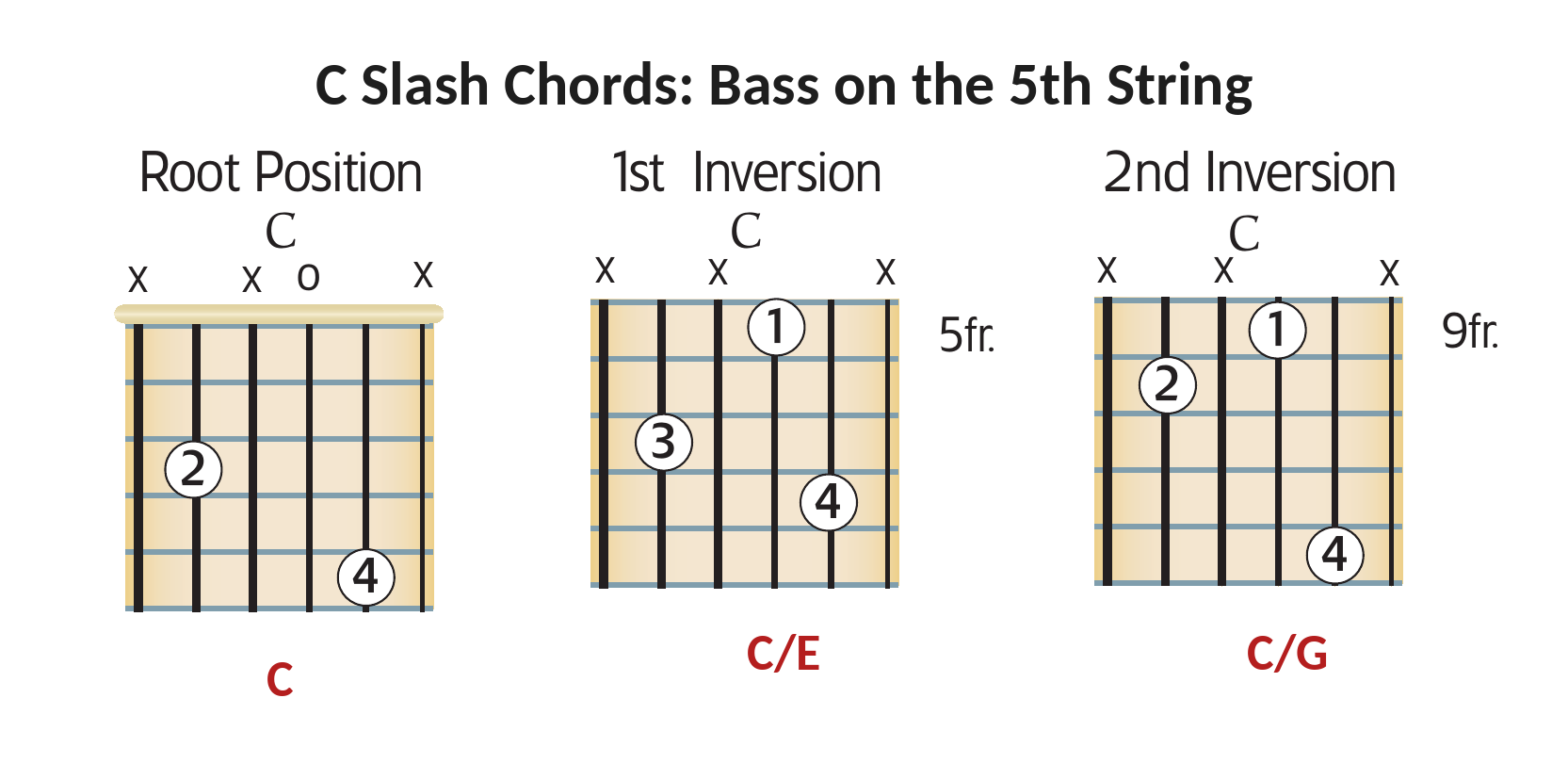
C Slash Chords With the Bass on the 5th String
The 5th string is the A string. Frank uses three shapes here.
- C: x 3 x 0 5 x. Middle finger on the A string, open G string, pinky on the B string.
- C/E: x 7 x 5 8 x. Ring finger on the A string, index finger on the G string, pinky on the B string.
- C/G: x 10 x 9 13 x. Middle finger on the A string, index finger on the G string, pinky on the B string.
Frank plays the 5th-string bass shapes in the video below.
-0:00 This video is unavailable.
Watch Frank play these shapes:
-0:00 This video is unavailable.
This video is unavailable.
This video is unavailable.
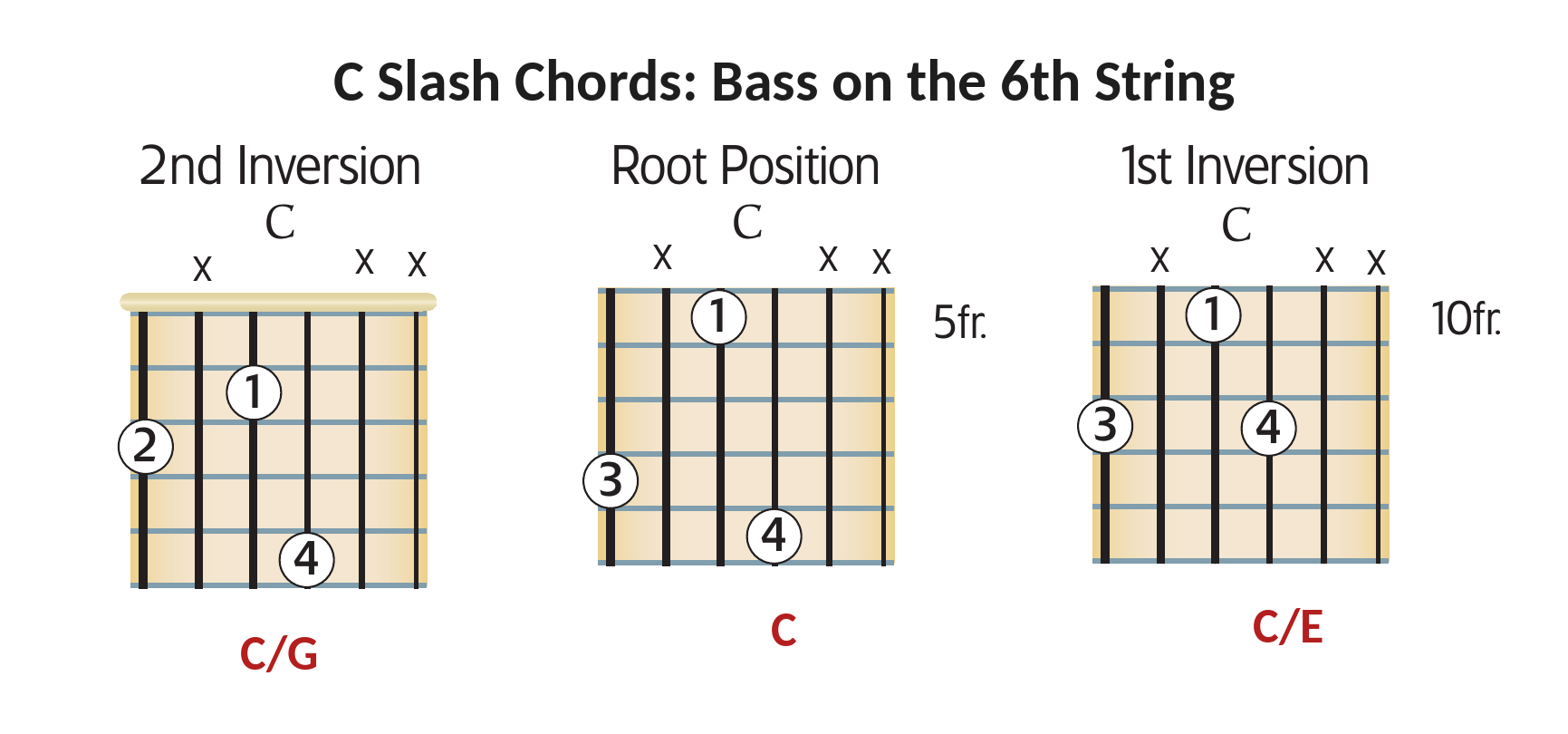
C Slash Chords With the Bass on the 6th String
The 6th string is the low E string, so these slash chords have the deepest bass notes.
- C/G: 3 x 2 5 x x. Middle finger on the low E string, index finger on the D string, pinky on the G string.
- C: 8 x 5 9 x x. Ring finger on the low E string, index finger on the D string, pinky on the G string.
- C/E: 12 x 10 12 x x. Ring finger on the low E string, index finger on the D string, pinky on the G string.
The video below has Frank’s lesson on the 6th-string bass shapes.
-0:00 This video is unavailable.
Watch Frank play these shapes:
-0:00 This video is unavailable.
This video is unavailable.
This video is unavailable.
A Minor Slash Chords
Likewise, A minor slash chords work the same way. Remember that Am uses A, C and E, so Am/C and Am/E are its two inversions.
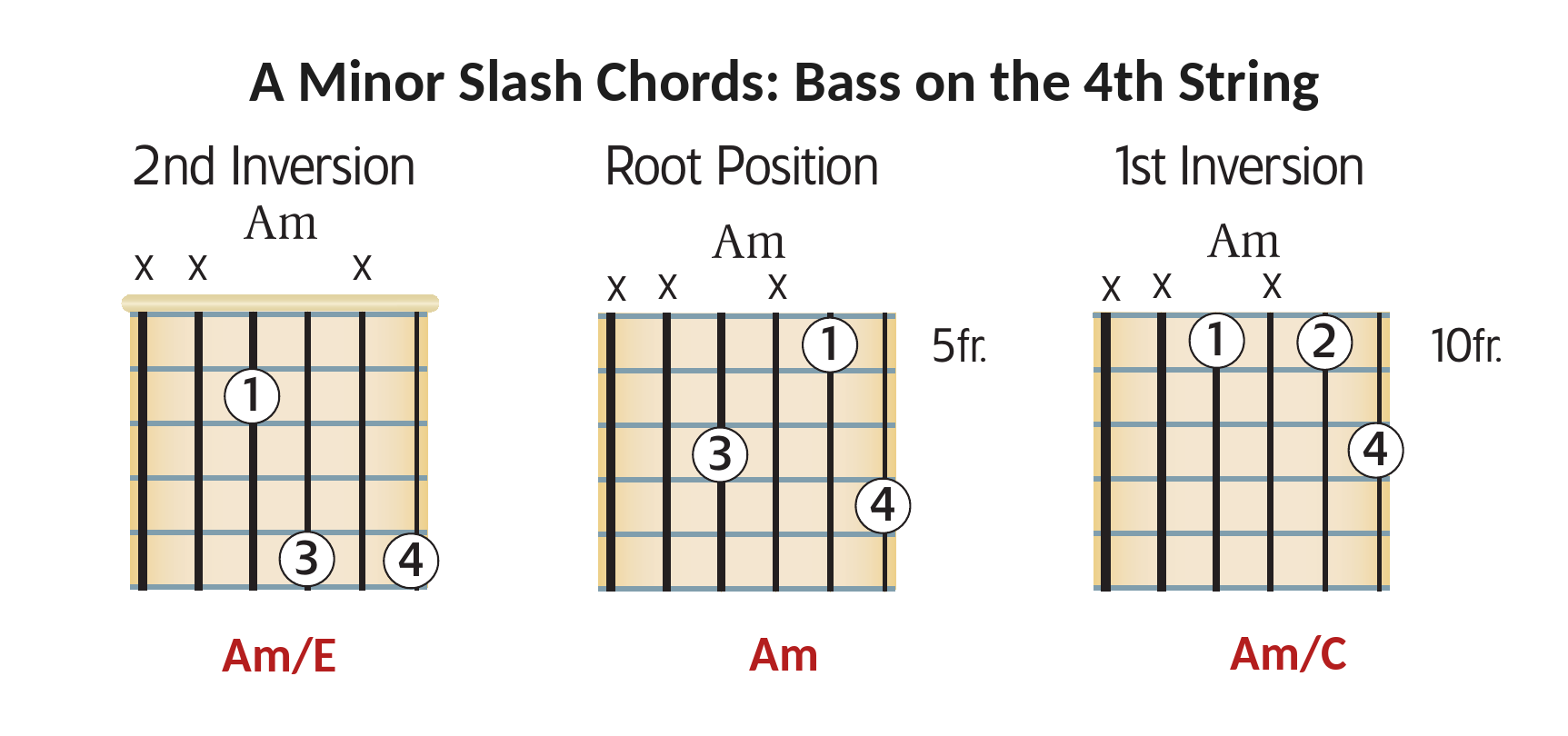
Am Slash Chords: Bass on the 4th String
- Am/E: x x 2 5 x 5. Index finger on the D string, ring finger on the G string, pinky on the high E string.
- Am: x x 7 x 5 8. Ring finger on the D string, index finger on the B string, pinky on the high E string.
- Am/C: x x 10 x 10 12. Index finger on the D string, middle finger on the B string, pinky on the high E string.
Watch Frank’s lesson on the A minor 4th-string shapes below.
-0:00 This video is unavailable.
Watch Frank play these shapes:
-0:00 This video is unavailable.
This video is unavailable.
This video is unavailable.
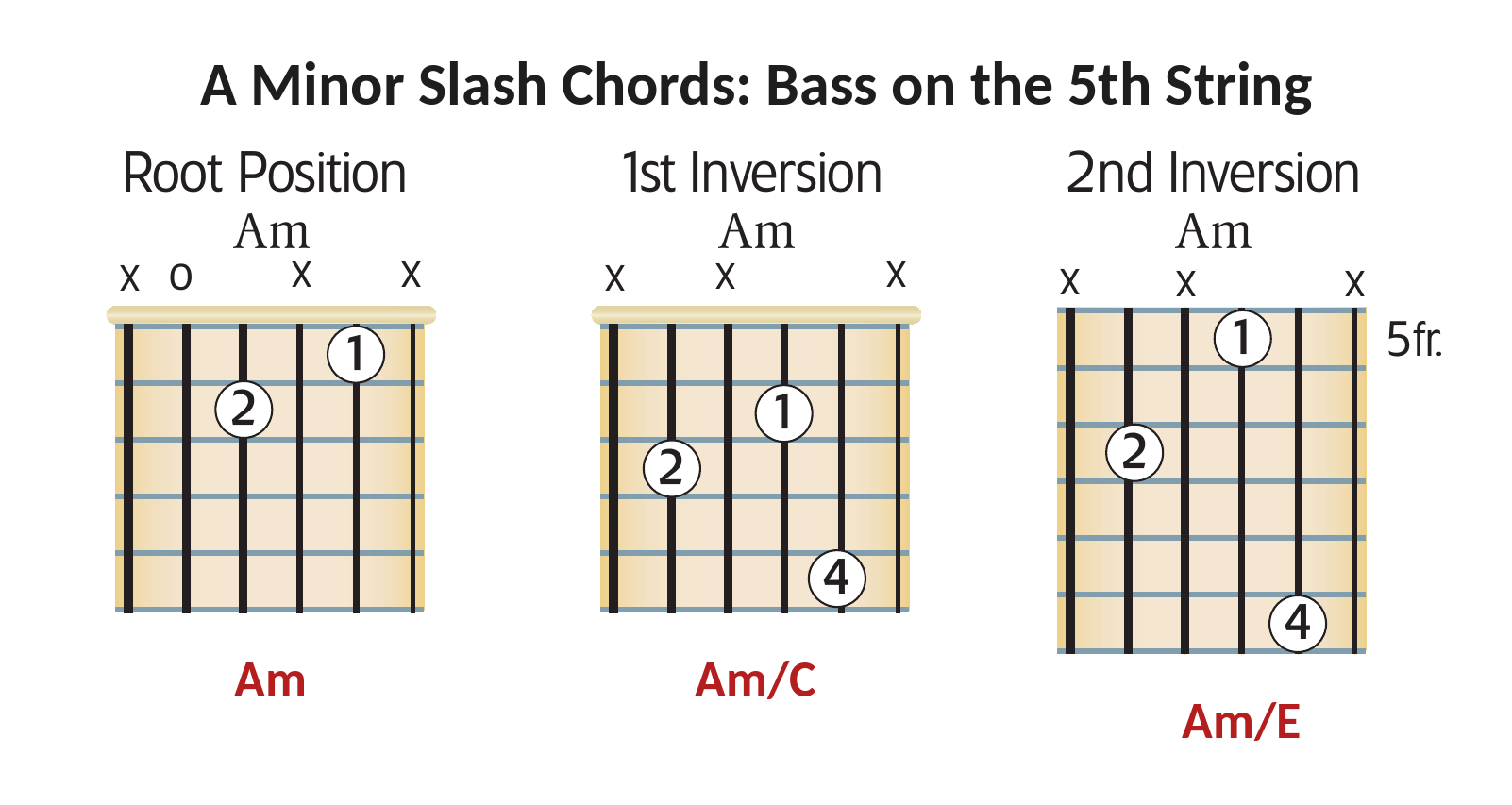
Am Slash Chords: Bass on the 5th and 6th Strings
- Am: x 0 2 x 1 x. Open A string, middle finger on the D string, index finger on the B string.
- Am/C: x 3 x 2 5 x. Middle finger on the A string, index finger on the G string, pinky on the B string.
- Am/E: x 7 x 5 10 x. Middle finger on the A string, index finger on the G string, pinky on the B string.
Frank also shows versions with the bass on the low E string, such as Am at 5 x 2 5 x x. You’ll find them in his lesson on the A minor 5th- and 6th-string shapes below.
-0:00 This video is unavailable.
Watch Frank play these shapes:
-0:00 This video is unavailable.
This video is unavailable.
This video is unavailable.
Using Slash Chords in Songs
Slash chords really shine when the bass line moves. For example, play C, then C/E, then F. The chord stays C for two beats while the bass climbs C, E, F.
Similarly, the move works in minor. Play Am, then Am/C, then Dm, and the bass climbs A, C, D. In other words, slash chords let one chord carry a moving bass line.
How to Practice Slash Chords
- First, learn one shape for each name: C, C/E and C/G on the 5th string.
- Next, pluck each one slowly, thumb on the bass and fingers on top.
- Then play C, C/E and F, and listen for the climbing bass.
- Finally, do the same with Am, Am/C and Dm.
Keep Going
Slash chords are one way to make chord changes smoother. Our guide to voice leading shows the other side of that idea, using Frank’s lessons on I–IV–V progressions. For the close triads behind these shapes, see our guide to the 2nd inversion.
For every open chord you’ll pair with these, keep our complete chord chart handy. And for the full series, start at our pillar guide to chord inversions.
Inversion Excursions – 124 video lessons and 800+ pages of charts! Start →
Continue Learning
Explore the rest of this series:
- Easy Chord Inversions: Guitar Shapes That Move Up the Neck
- Triad Inversions: 3 Easy Shapes on the Top 3 Strings
- 1st Inversion Chords: Easy Triads on the Middle Strings
- 2nd Inversion Chords: Easy Triads on the Low Strings
- Voice Leading: Smooth Chord Changes With Easy Inversions
About the Education Team
Four music-industry veterans with decades of combined experience in music education, curation, and production at TrueFire and ArtistWorks. The TrueFire Studios Education Team plans and edits this content and works with our master-musician faculty to keep it accurate and genuinely useful.
Featured Contributor
FV
Frank’s stunning virtuosity has made him the guitarist of choice for many of the world’s top musicians, including Ringo Starr, Madonna, Donald Fagen, Hank Jones, Lionel Hampton, John Lewis, the Boston Pops, the New York Pops, and guitar legend Les Paul, who named Vignola to his “Five Most Admired Guitarists List” for the Wall Street Journal.