

CB
Harp harmonics are one of those techniques that stops listeners cold. You play a simple melody, and suddenly the guitar sounds like three instruments at once. No pedals. No overdubs. Just one player creating a cascading wash of overtones that genuinely resembles a harp or a small orchestra. If you’ve read the complete guide to picked harmonics on guitar, you already know this technique fits into a broader family of harmonic approaches.
This article goes deep on harp harmonics specifically: what they are, how they work conceptually. Why so many players get them wrong. It also covers how to build the right practice mindset before you ever sit down with the video instruction. Chris Buono covers the physical mechanics on camera. Your job right now is to understand the concept well enough that when you watch, it clicks immediately.
What Harp Harmonics Actually Are
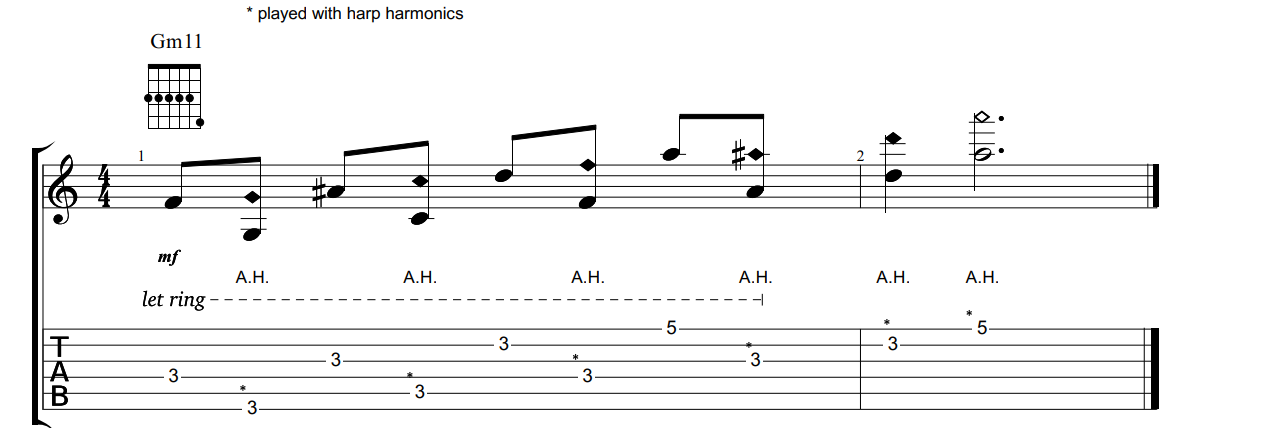
The name says it all, but it helps to unpack it. A harp resonates because multiple strings ring simultaneously. Each string carries its own overtone series. Harp harmonics replicate that on guitar by weaving two different sounds together in a single gesture. Your fretting hand produces a fretted tone. Meanwhile, your picking hand touches a node on an adjacent string while another finger plucks it to create a harmonic tone.
The result is a note that arrives with its own overtone companion. Because each melodic note gets that doubling, a slow passage starts to feel layered and orchestral. Standard single-note playing simply cannot achieve that. The technique is a cornerstone of classical and fingerstyle guitar. However, it also shows up in acoustic jazz and singer-songwriter contexts wherever a player wants something more lush than a plain melody line.
The Right-Hand Mechanism (Before You Touch a Node)
Understanding what each part of your picking hand does is essential before you start experimenting. Your index finger lightly touches a specific point on a string, a node, without pressing down. Meanwhile, your thumb or another free finger plucks an adjacent string to produce the harmonic. Those two actions happen together in a single coordinated gesture.
That coordination is the whole game. If the touch and the pluck are slightly out of sync, the harmonic either doesn’t speak or gets muffled. So before you think about melody or tempo, focus on synchronizing those two right-hand movements. Practice the gesture on a single string pair. Keep at it until it feels like one motion, not two.

This video is unavailable.
Learn 59 more electric guitar techniques with Chris Buono!Start →
Why Rushing Destroys the Effect
Here is the most common mistake: guitarists treat harp harmonics like a speed technique. They hear the cascading quality and assume momentum is what creates it. In reality, the opposite is true. Each harmonic note needs time to bloom and linger in the air. When you move too quickly, the overtones don’t have space to develop. Instead of a lush wash, you get a muddy cluster of half-formed sounds.
Think of it this way: the cascading effect comes from notes overlapping naturally as they decay. It does not come from rushing to the next one. Therefore, a slower tempo isn’t a beginner’s compromise. It’s the correct approach for the technique. Even experienced players return to a slower tempo range when introducing harp harmonics into a new passage. Give each note room, and the guitar does the rest.
Harp Harmonics as an Arranging Tool
Here is the reframe that changes how you practice this technique. Stop thinking of harp harmonics as an extended technique. Start thinking of them as an arranging decision. When you apply them to a melody, you are effectively orchestrating that melody for a richer ensemble sound. Each note becomes two voices at once.
For example, a simple melody played plainly sounds like one guitar. That same melody played with harp harmonics sounds like a guitar and something else, something bell-like and resonant. As a result, the technique is less about showing off and more about composition. You are choosing a different color for your melodic brush. Chris Buono emphasizes this perspective in his instruction. It’s worth internalizing before you try to execute the mechanics.
Building the Technique in Stages
The most effective way to learn harp harmonics is to break the gesture apart, then reassemble it. Start by playing your target melody with the right-hand position you’ll eventually use for the harmonic touch. Don’t actually touch any node yet. Just get comfortable with the hand placement and the plucking motion. Your fretting hand plays normally. Your picking hand gets used to hovering in the correct position.
Next, introduce the harmonic touch on a single note. Don’t attempt a full melodic passage yet. Instead, confirm that the single harmonic speaks cleanly before moving on. Once that single note is reliable, add a second, then a third. Build the passage note by note rather than attempting the whole thing at once. This staged approach prevents the most common frustration. That frustration is a muddy technique caused by hand coordination that hasn’t been established yet.
Connecting Harp Harmonics to the Broader Harmonic Family
Harp harmonics sit in a specific corner of the picked harmonics world. They share some DNA with natural harmonics and how to make them sing. Both rely on the node-touch principle. However, natural harmonics are usually played with the fretting hand alone. Harp harmonics require active coordination between both hands simultaneously. That distinction matters for how you practice them.
They are also quite different from pinch harmonics, which are percussive and aggressive. Similarly, tapped harmonics add a staccato sparkle rather than a flowing wash. Harp harmonics are, above all, a legato technique. In addition, if you want to place any harmonic freely across the neck, the artificial harmonics approach is the closer relative to study alongside this one. Understanding where harp harmonics fit in that family helps you choose the right tool for each musical situation.
A Simple Starting Exercise
Take a slow, familiar melody you already know well. The simpler, the better. Apply harp harmonics to it one note at a time. Focus entirely on letting each note bloom and overlap slightly with the next. Don’t think about speed. Don’t think about impressing anyone. Think only about the space between notes and whether each harmonic is speaking with full resonance.
That exercise teaches your hands the gesture. It also trains your ear to hear what the technique sounds like when it’s working. Once you hear a clean, ringing cascade on even two or three consecutive notes, the payoff becomes obvious. You’ll understand immediately why this technique surprises listeners who don’t realize a single player is making that sound.
Making Harp Harmonics Work in Real Playing
The goal isn’t to play harp harmonics constantly. The technique has the most impact when used intentionally, as a textural contrast or an orchestral moment within a larger arrangement. Consider using them at the start of a chord melody passage. They also work well as a melodic interlude between more driven sections. Because they require space and patience, they tend to suit relaxed, fingerstyle-oriented contexts over up-tempo settings.
If you want to go further with the full family of harmonic techniques, return to the complete picked harmonics guide. Then hit play on Chris Buono’s video instruction, where every physical detail of the gesture gets demonstrated up close. The concept is clear. Now go make it ring.
Dig deep with Chris Buono in his massive TrueFire library!Start →
About the Education Team
Four music-industry veterans with decades of combined experience in music education, curation, and production at TrueFire and ArtistWorks. The TrueFire Studios Education Team plans and edits this content and works with our master-musician faculty to keep it accurate and genuinely useful.
Featured Contributor
CB
Chris Buono is a prolific guitar player and educator. Chris has made an impact on guitarists all over the world through his time at Berklee College of Music as a professor and 50 course titles including the celebrated Guitar Gym series.