


CB
Tapped harmonics are one of those techniques that rewards you twice. First, you already know how to tap, so the hand motion feels familiar. Second, the sound you get is nothing like regular tapping. It is clean, bell-like, and percussive in a way that no other harmonic method can produce. If you have been exploring the broader world of harmonic techniques across the neck, tapped harmonics belong near the top of your list.
This article breaks down what they are, why they work, where they fit, and how to practice them efficiently. The video handles the exact mechanics and demonstrations. Your job here is to understand the logic. When you hit play, you will know exactly what to watch for and why it matters.
What Tapped Harmonics Actually Are (And Why the Tap Is a Trigger)
Most guitarists first encounter tapped harmonics and think, “this is just tapping with a twist.” That framing is close, but it misses something critical. In standard tapping, the tap itself frets the note. In tapped harmonics, the tap does not fret anything. Instead, it strikes the string at a precise node point above the fretted note. That contact excites the string’s overtone series. Then the finger lifts immediately. The actual pitch you hear comes from the harmonic that rings on after the tap is gone.
This distinction changes everything about how you practice the technique. Your focus shifts away from the tap itself and onto the release. The bounce and release is non-negotiable. If your tapping finger lingers on the string even briefly, it mutes the harmonic and you hear nothing. Think of it less like fretting and more like a gentle hammer strike on a bell.
Finding the Node: The Geometry Behind the Sound
The node is the location where tapping produces a harmonic rather than a thud. For most players, the most useful node sits at the interval of an octave above whatever the fretting hand is holding. Your fretting hand holds a note at a particular position. You then measure that same interval distance up the neck with your tapping finger. That is the spot.
Because the fretting hand sets the reference point, the node position changes every time you move to a different fret. This is what separates tapped harmonics from natural harmonics, which live at fixed points on an open string. Tapped harmonics move with you. That mobility is the whole point. It means you can generate a harmonic version of any fretted note anywhere on the neck. That opens up melodic and chordal possibilities that fixed-node techniques simply cannot offer.

This video is unavailable.
Learn 59 more electric guitar techniques with Chris Buono!Start →
The Bounce-and-Release Technique in Practice
The physical motion is compact and decisive. Your tapping finger approaches the string from above, makes firm and precise contact at the node, and immediately springs back. There is no follow-through, no lingering. The contact is short enough that the string is still vibrating freely when the finger leaves. That free vibration is what you hear as the harmonic.
A common early mistake is tapping too softly. Players who are nervous about muting the harmonic sometimes tap so lightly that they never excite it properly. The solution is counterintuitive: tap more firmly, but lift faster. A confident, decisive strike followed by a clean release gives the harmonic the energy it needs to bloom. Think of the motion as a quick, controlled bounce rather than a press.
In contrast to pinch harmonics, which require a specific pick-plus-thumb contact, tapped harmonics are available to both pick-style and fingerstyle players. The fretting hand handles the chord or melodic work. The tapping hand is entirely free to serve as the trigger.
From Single Notes to Full Chord Shapes
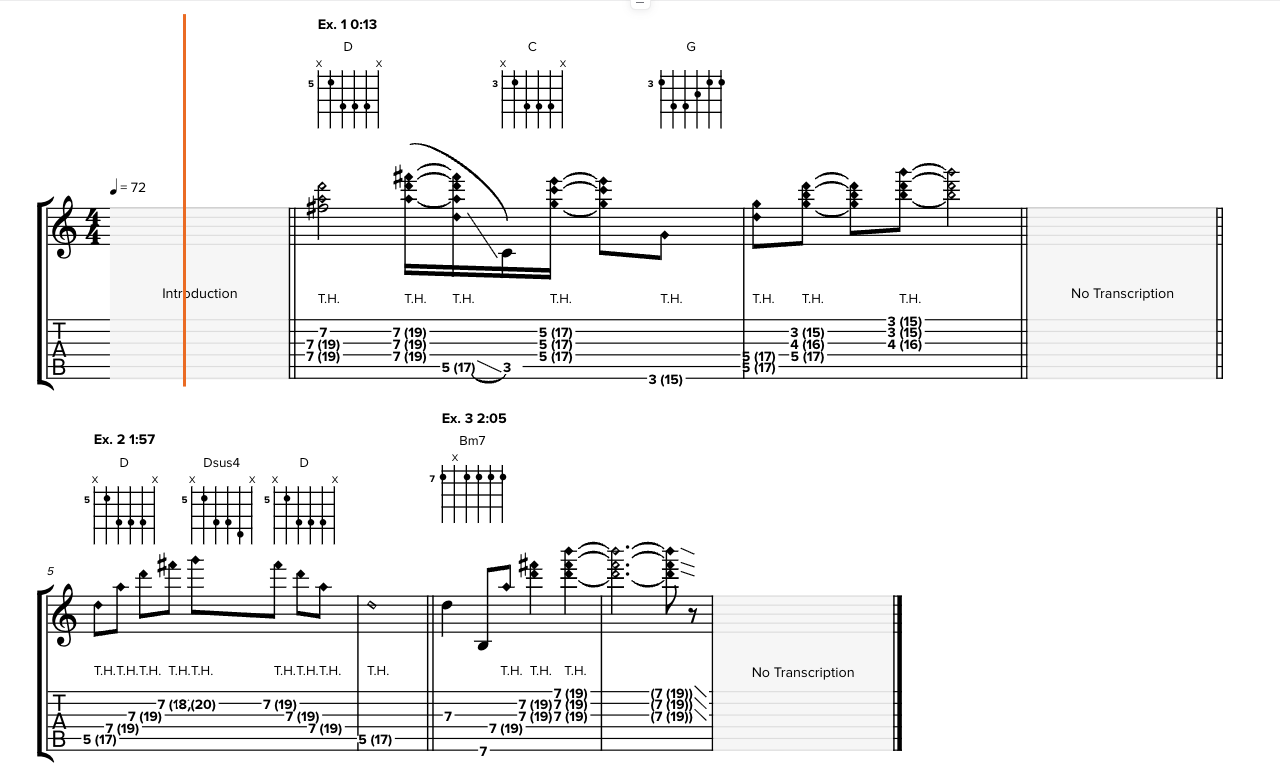
Here is where tapped harmonics become genuinely interesting. The fretting hand can hold a full chord shape while the tapping hand moves string by string. So you can arpeggiate an entire chord in harmonics. Each string the tapping finger visits rings out its own overtone color. The result is a shimmering, layered texture that sounds orchestral, even when played solo.
Start with a chord shape you already know well. Fret it cleanly and hold it. Then, one string at a time, tap the node interval above each note in the chord. Listen to how each string contributes a different overtone quality to the overall sound. Some strings will ring more easily than others at first. That variation is useful information. It trains your ear to hear the relationship between fretted position and harmonic resonance.
Once individual strings speak cleanly, begin arpeggiating through the chord shape with tapped harmonics in sequence. Start slowly. Each harmonic needs time to fully bloom before the next tap lands. Rushing through the sequence causes harmonics to overlap and blur. Gradually increase speed only after each note rings distinctly at a slower tempo range. This is exactly the kind of progressive approach Chris Buono brings to technique development across his TrueFire work: build the ear-to-hand connection first, then add speed.
Where Tapped Harmonics Fit Stylistically
Tapped harmonics appear most naturally in progressive rock, fusion, and fingerstyle contexts. In those styles, the technique’s percussive shimmer and bell-like clarity sit perfectly in a mix without additional processing. That said, the technique transfers well to blues and country when used sparingly. A single tapped harmonic on the final note of a phrase can be all you need.
For a broader look at how different harmonic techniques complement each other stylistically, the full guide to harmonic techniques is the right place to start. If you are interested in the lush, cascading texture that comes from combining harmonics and open strings, the approach covered in harp harmonics pairs naturally with what you are building here. Similarly, artificial harmonics offer another way to access harmonics across fretted positions, using a completely different hand configuration.
A Practice Sequence That Actually Works
Approach this in three stages. First, spend time just finding the node reliably on a single held note. Tap, lift, listen. If the harmonic rings clearly, you have the location. If it thuds or mutes, adjust slightly up or down the neck and try again. Second, move to a simple melodic line. Tap the harmonic version of each note in sequence, pausing between each tap to confirm the harmonic fully rings out. Third, introduce a chord shape and arpeggiate through it as described above.
Practice each stage at a comfortable tempo before moving forward. The technique rewards patience because the ear calibration required to find nodes consistently takes repetition to develop. However, once that calibration is in place, the technique becomes remarkably intuitive. The nodes start to feel predictable. Your tapping hand learns to find them without conscious calculation.
Why Tapped Harmonics Deserve a Permanent Place in Your Toolkit
Tapped harmonics give you something no other harmonic method does: percussive attack combined with a sustained, bell-like tone, available at any fretted position, across full chord shapes. The technique transforms the fretting hand into a chord-holding anchor. The tapping hand becomes a melodic trigger. That division of labor opens up a chordal harmonic vocabulary that is genuinely distinct from what natural harmonics, pinch harmonics, or any other single-hand technique can offer.
Return to the complete guide to harmonic techniques when you are ready to place tapped harmonics in context with the rest of the family. The fuller picture makes each technique sharper and easier to deploy intentionally.
Dig deep with Chris Buono in his massive TrueFire library!Start →
About the Education Team
Four music-industry veterans with decades of combined experience in music education, curation, and production at TrueFire and ArtistWorks. The TrueFire Studios Education Team plans and edits this content and works with our master-musician faculty to keep it accurate and genuinely useful.
Featured Contributor
CB
Chris Buono is a prolific guitar player and educator. Chris has made an impact on guitarists all over the world through his time at Berklee College of Music as a professor and 50 course titles including the celebrated Guitar Gym series.