


CB
Artificial harmonics solve a problem that every guitarist eventually runs into. You love the shimmer of natural harmonics, but they only land on fixed pitches determined by open-string physics. If the note you need is not sitting at one of those nodes, you are out of luck. Artificial harmonics change that completely. By combining a fretted note with a right-hand touch at the corresponding node above it, you relocate the entire technique to any position on the neck. That portability is the key insight. For a full map of where artificial harmonics fit within the broader harmonic toolkit, check out the complete guide to picked harmonics and use this article to go deep on this specific technique.
Why Natural Harmonics Leave You Stranded
Natural harmonics are beautiful, but they are stationary. The nodes that produce them are tied to the open string’s length. Because of this, you only get a handful of usable pitches spread across the neck in predictable spots. That works for certain figures. It falls apart the moment you want to harmonize a melody or follow a chord progression with that glassy, chiming tone.
That limitation is precisely what makes artificial harmonics worth learning. Instead of asking “which harmonics are available here,” you start asking “where is the node for this note I am already fretting.” The shift in thinking is subtle but important. You move from finding harmonics to placing them.

This video is unavailable.
Learn 59 more electric guitar techniques with Chris Buono!Start →
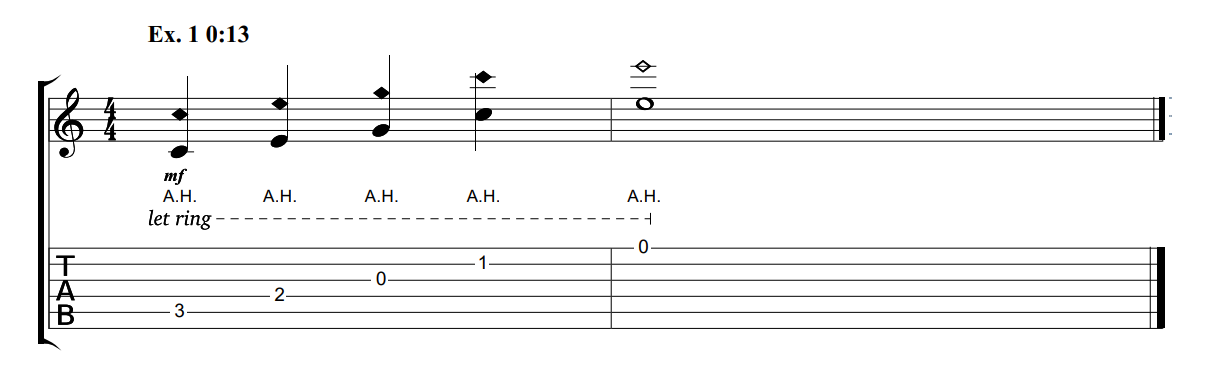
The Mechanism: Two Jobs, One Hand
The right hand carries the entire technical weight of artificial harmonics. While your fretting hand holds a note normally, the picking hand has to do two things at once. One finger, typically the index, lightly touches the string at the node interval above the fretted pitch. Then the pick, held between the thumb and middle finger, fires the string just behind that touch point.
That coordination is the real challenge here. Both actions have to happen simultaneously and with precision. The touch has to be light enough not to stop the string but firm enough to define the node. The pick has to clear the touch finger cleanly and catch enough string to produce a full tone. Chris Buono describes this kind of picking hand economy as a defining skill for guitarists who want advanced technique to feel natural rather than forced.
Think of it this way. Your touching finger acts as a movable nut. It temporarily relocates the harmonic-producing point anywhere your fretting hand places it. Once that mental model settles in, the coordination starts to feel logical rather than awkward. The two actions are not fighting each other. Instead, they are partners in a single gesture.
Where the Node Actually Falls
Understanding node placement is essential for artificial harmonics to speak clearly. The most common node sits at the interval of an octave above the fretted note. That means your touch finger targets a position exactly one octave higher along the same string. There are other node positions too, producing different overtones. The octave node is the most reliable and the one to master first.
When the touch lands even slightly off that target, the harmonic collapses. You get either a muted thud or a thin, choked sound. This is not a strength problem. It is a placement problem. Precision matters far more than force, and at first, even a millimeter of drift can cost you the note entirely.
Because of this, consistency of placement is more important than speed, especially early in your practice. Slow the whole thing down. Find the node on one fretted position, confirm the harmonic rings clearly, then move. Build the muscle memory for accurate placement before you try to chase any kind of tempo.
The Practice Approach That Actually Works
Start on a single fretted note. Do not move the fretting hand at all yet. Just work on finding and locking in the node touch with your picking hand. Listen carefully to whether the harmonic rings or collapses, and adjust your touch position accordingly. This isolated repetition builds the spatial sense your hand needs before any melodic movement enters the picture.
Once the single-note harmonic feels reliable, try converting a melody you already know into artificial harmonics, one note at a time. This approach is more effective than practicing scales in the abstract. Because your ear already knows where the melody is going, it guides your hands to the correct node position instead of leaving you to calculate each one from scratch. You are using musical knowledge to support technical accuracy.
For more ways to build the kind of right-hand precision artificial harmonics demand, the pinch harmonic deep dive covers overlapping right-hand mechanics from a different angle and is worth reading alongside this technique. Similarly, if you want to see how the right hand can juggle multiple simultaneous roles in an extended way, the approach in the harp harmonics article is directly related.
Common Mistakes and How to Catch Them
The most common mistake is pressing too hard with the touch finger. Any downward pressure converts the touch into a fret, and the harmonic vanishes. The contact should feel more like resting on the string than pressing into it.
The second common mistake is letting the node position drift as you move through a phrase. Because your fretting hand is shifting positions, it is easy to lose track of where your touch finger needs to be relative to the new note. In practice, this means you need to think about both hands moving together, not sequentially.
Finally, many players try to go too fast too soon. Artificial harmonics reward patience. The technique has a specific feel once it clicks, and chasing speed before that click happens only reinforces sloppy placement. Slow practice with a clear sound is always more productive than fast practice with a collapsed one.
Putting Artificial Harmonics Into Musical Context
Once the mechanics feel stable, the real reward appears. You can take any melody, any scale run, any arpeggio figure, and render it entirely in harmonics. That shimmer and bell-like quality is no longer limited to a few fixed pitches. It follows your musical ideas wherever they go.
This is what makes artificial harmonics the most melodically flexible technique in the harmonic family. Natural harmonics are beautiful. Stationary. Tapped harmonics have their own expressive logic. Artificial harmonics are the ones that let you write a real melody and play it entirely in that otherworldly register.
As the complete guide to picked harmonics outlines, each technique in this family has a distinct personality. Artificial harmonics are the melodic workhorse. They demand patience with coordination, but they reward you with something no other technique can offer: the ability to shimmer any line you can play into a completely different dimension of tone.
Dig deep with Chris Buono in his massive TrueFire library!Start →
About the Education Team
Four music-industry veterans with decades of combined experience in music education, curation, and production at TrueFire and ArtistWorks. The TrueFire Studios Education Team plans and edits this content and works with our master-musician faculty to keep it accurate and genuinely useful.
Featured Contributor
CB
Chris Buono is a prolific guitar player and educator. Chris has made an impact on guitarists all over the world through his time at Berklee College of Music as a professor and 50 course titles including the celebrated Guitar Gym series.