


CB
Natural harmonics are one of those techniques most guitarists discover by accident. Your finger grazes a string at the wrong spot, and suddenly something pure and bell-like rings out. Then you chase that sound for ten minutes trying to reproduce it. Sound familiar? This article replaces that accidental discovery with intention. You’ll understand exactly what’s happening physically and why it works. You’ll also learn how to practice it so the technique lands every time. For a full picture of where natural harmonics fit among all the harmonic techniques available to you, check out the complete guide to picked harmonics. Here, though, the focus is tight: natural harmonics, how they work, and how to make them genuinely expressive.
What Natural Harmonics Actually Are
A natural harmonic is not a fretted note played softly. It’s a completely different physical event. When you lightly touch a vibrating string at a resonant point called a node, you divide the string into equal vibrating segments. Each segment produces an overtone. That overtone rings higher and purer than anything you’d get by pressing the string to the neck. The result is that glassy, bell-like tone players associate with shimmering intros and ambient passages.
The key word is “node.” Not every spot on the string produces a harmonic. Nodes fall at mathematically precise division points: halfway along the string, a third of the way, a quarter, and so on. Because of this geometry, the harmonic positions are fixed. They don’t move based on tuning or style. In other words, you’re working with the natural physics of the string itself.
Why the Touch Has to Be Feather-Light
The single biggest mistake beginners make is pressing down out of habit. Your fretting hand has spent years learning that contact means pressure. Natural harmonics require you to unlearn that reflex completely. The touch needs to be just enough to interrupt the string’s vibration at the node, nothing more.
Even slight downward pressure kills the harmonic immediately. Instead of a clear bell tone, you get a muffled, dead sound. Therefore, think of it less like fretting and more like resting. Your fingertip sits on the string as lightly as possible, directly above the relevant position. Then, the instant the string sounds, lift your finger away. That lift is not optional. It’s what allows the harmonic to bloom and sustain fully.
This is the physical discipline that separates guitarists who occasionally stumble onto natural harmonics from those who deploy them with confidence and consistency.

This video is unavailable.
Learn 59 more electric guitar techniques with Chris Buono!Start →
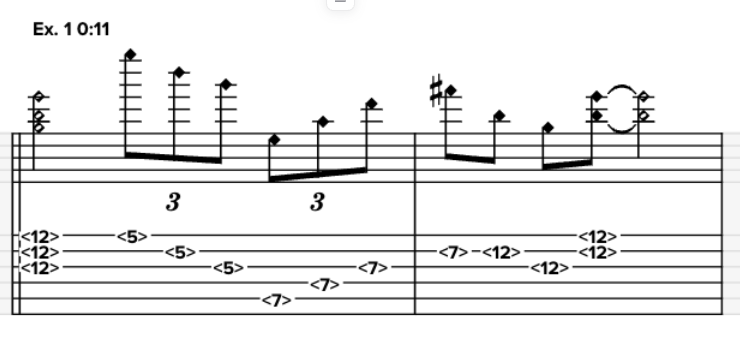
Finding Your Strongest Nodes First
Some nodes are stronger than others. The strongest nodes sit at the most symmetrical division points along the string. These are also the most likely to produce a clear harmonic on your first attempt. Start there, because early wins build the confidence you need.
Practice on each string individually. Listen for clarity and sustain. A harmonic that rings for two or three full seconds with no pick-hand babysitting is a well-executed one. If the tone blooms and then collapses quickly, something was slightly off. Either the touch position was imprecise, or you held contact a fraction too long after picking.
One practical drill: pick the string, touch the node lightly, and lift immediately. Then do nothing. Just listen. Let the harmonic decay on its own. Over time, your ear will learn to hear the difference between a harmonic that’s fully alive and one that’s slightly choked.
How Natural Harmonics Sit in a Mix
Here’s something worth understanding about the sound itself. Natural harmonics produce overtone-derived pitches. Because of that, they carry a harmonic content that’s fundamentally different from any fretted note. They sit in a higher, airier register. In a mix, they don’t compete with other instruments the way a fretted melody line does. Instead, they float above it.
That’s exactly why they appear across such different styles. Folk guitarists use them in acoustic intros. Rock players use them to add shimmer between riffs. Jazz players, including TrueFire educator Chris Buono, incorporate them as melodic color within improvised lines. Classical guitarists treat them as a formal extended technique with their own notation system. The sound is universally distinctive. No other technique sounds quite like it.
Because of that distinctive quality, natural harmonics also work beautifully as substitution tools within a melody. Not every note in a line can be replaced by a harmonic, since the positions are fixed. But when a harmonic is available, swapping it in changes the texture of that moment entirely without changing the melodic shape.
Turning Accident Into Intention: A Practice Approach
Once you know where the strong nodes are and your touch is reliable, the next step is applying natural harmonics inside actual music. Here’s a concrete way to approach it.
Pick a simple melody you already know well. Play it normally once. Then play it again. This time, challenge yourself to replace specific notes with natural harmonics wherever the available positions allow. You’re not trying to harmonize the whole melody. Instead, you’re training your ear to identify harmonic substitution opportunities in real time.
This exercise does two things simultaneously. First, it maps your knowledge of node positions onto real melodic contexts. Second, it develops the expressive judgment you need to decide when a harmonic serves the music. That judgment matters as much as the technique itself.
For a deeper look at how to extend harmonic thinking across any position on the neck, the approach covered in artificial harmonics builds directly on this foundation. Similarly, if you’re curious about pinch harmonics and their aggressive edge, or the cascading orchestral sound of harp harmonics, each of those techniques shares the same underlying principle: the node matters, and the touch determines everything.
Patience Is the Actual Technique
Natural harmonics reward a specific kind of practice. They don’t respond well to effort and force. They respond to precision, listening, and patience. For most guitarists, that runs counter to how technique is usually built. Normally, more practice means more repetitions and more physical refinement. Here, it means more careful listening and less physical intervention.
Think of it this way: every wasted movement your fretting hand makes after the string sounds is working against you. The harmonic needs freedom to vibrate. Therefore, practice economy of movement deliberately. Pick, touch, and lift. Nothing else. Over time, that sequence becomes reflexive. When it does, natural harmonics stop feeling like a special move you have to set up. Instead, they start feeling like a natural extension of your vocabulary.
Once that lightness becomes muscle memory, you’ll find yourself reaching for natural harmonics in solos, intros, and transitions without consciously planning it. That’s the goal: not just knowing the technique, but owning it. For the full picture of how natural harmonics connect to every other harmonic approach available, return to the complete harmonic techniques guide and explore from there.
Dig deep with Chris Buono in his massive TrueFire library!Start →
About the Education Team
Four music-industry veterans with decades of combined experience in music education, curation, and production at TrueFire and ArtistWorks. The TrueFire Studios Education Team plans and edits this content and works with our master-musician faculty to keep it accurate and genuinely useful.
Featured Contributor
CB
Chris Buono is a prolific guitar player and educator. Chris has made an impact on guitarists all over the world through his time at Berklee College of Music as a professor and 50 course titles including the celebrated Guitar Gym series.