

DI
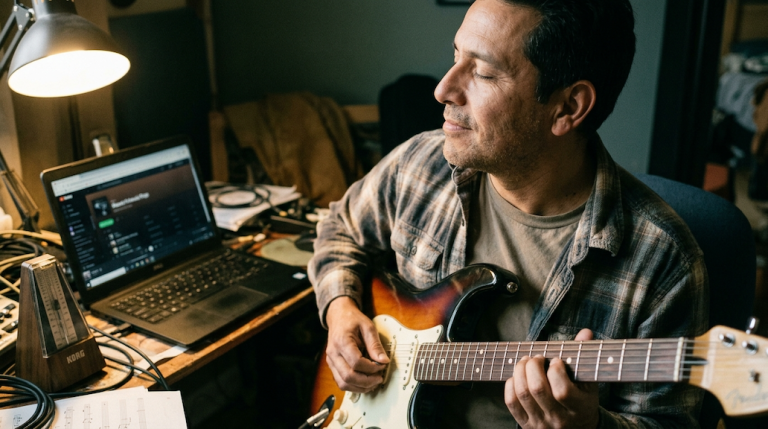
“Your body knows what steady FEELS like. Don’t focus on counting, just the sensation of a consistent steady pulse. Don’t worry about coordinating exactly. Whether it’s a foot tap, head bob, or a chair dance, there is a way you can move your body naturally with the music. Many people find this happens more naturally when you pay attention to relaxing your neck and shoulders.”
To feel the pulse as a physical reality rather than a mental calculation is the whole game. If you have ever tried to feel the pulse and found yourself counting silently instead, losing track mid-phrase, or tensing up when the music gets faster, this article is written for you. Dave Isaacs, a Nashville-based guitarist and educator, has built a teaching philosophy around exactly this problem. His approach, explored in depth in the movement-based rhythm guide on TrueFire, starts with a simple premise: the beat belongs in your body first, and your hands second.
Why Counting Beats Keeps You From Being Able to Feel the Pulse
Counting is a tool, not a destination. Most players learn rhythm by counting because it gives the brain a scaffold to hang notes on. The problem is that the brain is slow. By the time you have counted to three and verified you are in the right place, the music has already moved. Counting keeps rhythm in the arithmetic zone, and arithmetic does not groove.
When rhythm lives in your head, your body stays rigid. You hold your breath. Your shoulders creep up toward your ears. Your strumming arm locks at the wrist. None of these things help the music feel good. In fact, all of them get in the way of finding a natural pulse.
The reframe is straightforward. Instead of counting the beat, you feel the pulse. That shift sounds small, but it changes everything about how your body relates to the music. You move from calculating to sensing.
Feel the Pulse Before You Play a Single Note
Here is a practice move worth trying right now. Put the guitar down. Do not pick it up yet. Instead, put on a song you know well, or simply clap a steady pulse yourself. Then pick one physical movement and stay with it.
A foot tap works well for most players. A head bob is equally valid. Some people find that a slight side-to-side sway in the chair is the most natural option. The specific movement does not matter at all. What matters is that the movement is steady, relaxed, and fully owned by your body. Do this for a full minute before you touch the instrument.
This is not a warm-up drill. This is the actual practice. You are teaching your nervous system what steady feels like from the inside, not from a chart or a count. Once that sensation is in your body, you carry it into your playing rather than constructing it beat by beat in your mind.
Release the Shoulders So You Can Feel the Pulse Freely
Dave Isaacs points specifically to the neck and shoulders as the place where tension most often blocks the physical pulse. This is not coincidental. When you are stressed about staying in time, your body reads that stress as a physical threat. As a result, your muscles respond by tightening. The very act of trying too hard to feel the pulse can actually lock it out.
So pay attention to your neck and shoulders before and during playing. Consciously let them drop. Breathe out slowly. If your jaw is clenched, release it. These small physical adjustments open a channel between the music and your body that counting never can.
You might notice, once the tension releases, that the movement comes on its own. For example, the foot starts tapping without a deliberate command. The head follows the groove without you deciding to move it. That involuntary response is exactly what you are after. It means the pulse has found a home in your body.
The Math Is Only Half the Music
Dave Isaacs makes the stakes of this clear. He puts it directly: “All that really matters is that you move your body to the beat in some way. Otherwise, you will only understand the mathematical parts of the music, and you will not be able to really feel it.”
That distinction between the mathematical and the felt is worth sitting with. You can know, intellectually, that a measure has four beats. You can count them correctly every single time. However, knowing the structure does not automatically produce the sensation of groove. The felt part comes from the body moving with the pulse, not from the mind tracking it. Without that physical connection, your playing stays technically correct but rhythmically flat.
This is why two guitarists can play the same phrase and one sounds alive while the other sounds mechanical. The notes are identical. The timing is technically accurate. But one player has the pulse living in their body and the other is still doing math. In short, you cannot count your way into feel.
What This Looks Like in Practice
Watch any great rhythm player and you will see this principle in action. The body is almost always in motion. Even subtle motion counts. A gentle lean into a chord. A small nod at the top of the measure. A relaxed bob that rides just under the surface of the playing. These are not affectations. Instead, they are the physical expression of a pulse the player genuinely feels.
When you watch the video in this course, look for the moment the body leads rather than the mind calculating. That visual cue is the lesson made visible. You are not watching technique. You are watching someone who has internalized the beat so fully that the body cannot help but move with it.
For more on how natural movement translates directly to steady time, the article on keeping time the way your body already knows how extends this idea into everyday physical patterns. And when you are ready to understand how grouping beats into strong and weak changes the feel of the groove, this breakdown of where groove really lives picks up from there.
Trust the Beat That Was Already There
The beat is not something you build from scratch every time you play. It is already in you. Your heartbeat is steady. Your walking pace is steady and breathing is steady. These are all, in fact, expressions of the same rhythmic capacity that music asks you to access.
The practice, then, is not about installing something new. It is about learning to trust what is already working. First, you feel the pulse. Then you move with it. Finally, you bring your hands along for the ride. The coordination follows the sensation, not the other way around.
As you go deeper into the ideas in the full rhythm course guide, you will find that this body-first approach carries through every technique Dave Isaacs teaches. The foundation, though, is always this: move first, play second, and let the counting take care of itself.
Continue Learning
Work through these in order. Each one picks up where the previous leaves off, and together they build the complete foundation for rhythm you feel rather than calculate.
- Build a physical sense of pulse before you pick up the guitar
- Use your own walking stride to lock in steady time
- Learn how strong and weak beats are the source of groove
- Apply the drum-set concept to your strumming dynamics
- Practice with a metronome in a way that actually feels good
Dave Isaacs’ RHYTHM ROOM LIVE Workshop
1-Rhythm Room LIVE Workshop PART 1:
2-Rhythm Room LIVE Workshop PART 2:
3-Rhythm Room LIVE Workshop PART 3:
4-Rhythm Room LIVE Workshop PART 4:
5-Rhythm Room LIVE Workshop PART 5:
6-Rhythm Room LIVE Workshop PART 6:
7-Rhythm Room LIVE Workshop PART 7:
8-Rhythm Room LIVE Workshop PART 8:
Dig deep with Dave Isaacs with his Top-Ranked TrueFire library!Start →
About the Education Team
Four music-industry veterans with decades of combined experience in music education, curation, and production at TrueFire and ArtistWorks. The TrueFire Studios Education Team plans and edits this content and works with our master-musician faculty to keep it accurate and genuinely useful.
Featured Contributor
DI
Isaacs is heralded in the music community as the Nashville GuitarGuru for his work as a teacher and coach to professional performers, hit songwriters, and the next generation of Nashvilles rising stars.