

DI
“The metronome tempo in BPM establishes the pulse. We’ve established that the sense of movement in the music comes from your sense of stronger and weaker accents. The steady pulse is useful for establishing the timeline and speed, but feeling ‘grouped beats’ is where you find the groove. In other words: you can be aware of the steady pulse — 1 2 3 4 — while also accenting every OTHER beat: ONE two THREE four. This creates the hierarchy of stronger and weaker, louder and softer.”
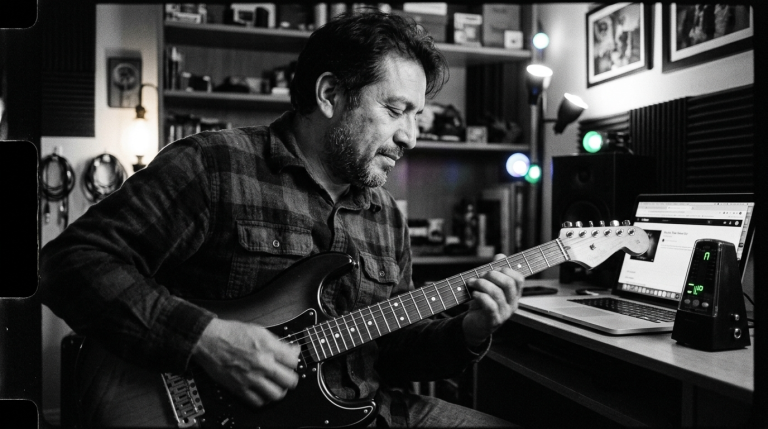
That opening comes from Dave Isaacs, a Nashville guitarist and educator whose approach to rhythm cuts through the confusion that traps most players. If you’ve been trying to find the groove by counting more carefully, this idea reframes the whole problem. Tempo is speed. Groove is something else entirely. And understanding that difference is what this article is about. For a broader look at the movement-based approach behind all of this, check out the full guide to feeling rhythm instead of counting it.
Why Counting Beats Evenly Kills the Feel
Most players learn rhythm as a number line. You count one, two, three, four. Every number gets equal weight. Equal time. Equal emphasis. That works for learning where notes fall. But it does something damaging to the feel: it flattens everything out.
When every beat lands with the same weight, there is no pull. There is no sense of arrival. There is no cycle. You get time, but you do not get groove. The music moves forward the way a machine moves forward, without personality.
Because the feel lives in the difference between beats, not in the beats themselves. Loud and soft, heavy and light, strong and weak. That contrast is what your ear responds to. That contrast is what makes a rhythm feel inevitable rather than mechanical.
Stronger and Weaker: The Actual Architecture of Groove
So what does it mean to group beats? Think of it this way. Instead of hearing four equal pulses, you start accenting every other one. You push into the odd beats and let the even beats soften. One becomes heavier. Two becomes lighter. Three comes back strong. Four relaxes again.
Suddenly those four beats are not a row of identical clicks. They are a shape. There is a beginning, a middle, and a return. The group has weight and direction. That is where you find the groove.
This is not a theory exercise. It is a physical one. Try it away from the guitar first. Clap a steady pulse. Then, without speeding up or slowing down, gradually make every other clap physically heavier. Lean into it. Let the lighter claps get genuinely softer. After a few repetitions, notice what happens: you stop counting and start feeling a cycle. That cycle is the groove.
The Downbeat Is Your Anchor, Not Your Starting Count
Here is where Dave Isaacs sharpens this into something immediately practical. He describes navigating a groove not as counting through a sequence, but as moving from one arrival point to the next. As he puts it: “I’m not counting to eight. It’s finding a downbeat — land on the next downbeat.”
That sentence changes your whole orientation. Instead of tracking every number between beats, you are simply feeling your way from one strong arrival to the next. The downbeat is your anchor. Everything between it and the next downbeat is the journey. You navigate that journey by feel, not by arithmetic.
This is the shift from sequence thinking to cycle thinking. A sequence has a beginning and an end. A cycle has a pulse and a return. When you start hearing the groove as a cycle, you stop worrying about losing your place. Because the next downbeat is always coming. Your job is just to feel it arrive.
What This Feels Like in Practice
Apply this directly to your playing. When you strum a chord progression, try not to count individual beats. Instead, feel for the strong beat at the top of the pattern. Let that beat land with a little more weight. Then ride the energy through the weaker beats until the strong one returns.
You will notice that your strumming arm starts to move differently. It becomes more fluid. The motion carries through rather than stopping and restarting at each number. That fluidity is a sign you are feeling the group rather than counting the sequence.
For more on how physical movement locks in steady time, the walking analogy in Support 2 is worth your time. And if you want to go deeper into how accent and dynamics connect to the drummer’s perspective, the Support 4 article on strumming like a drummer picks up exactly where this idea leaves off.
In the meantime, try this: strum through a simple progression and focus only on two moments per measure. Feel the strong beat land, then feel it return. Everything else is texture. You are not counting. You are navigating.
From a Number Line to a Living Cycle
The reason this reframe matters so much is practical. When you count beats as numbers, your attention splits. Part of you is playing; part of you is tracking a score. That split pulls you out of the music. You play accurately but you do not lock in.
When you feel beats as a group with a natural shape, your attention unifies. You are inside the cycle, not watching it from outside. As a result, your timing actually improves, because you are responding to feel rather than calculating position.
This is also why learning to feel the pulse in your body first matters so much before you try to apply it to an instrument. The hierarchy of strong and weak needs to be physical before it can be musical. Once it is in your body, it transfers to your hands naturally.
Groove Is a Feeling, Not a Formula
Tempo tells you how fast the music moves. Grouping tells you how it feels. Those are two different things, and most rhythm problems come from treating them as the same thing.
The fix is not counting more carefully. The fix is hearing the hierarchy. Strong beats give the groove its shape. Weak beats give it its forward motion. Together they create the push and pull that makes rhythm feel alive instead of mechanical. That is where you find the groove, every time.
When you bring this understanding to the full rhythm approach Dave Isaacs lays out, everything else starts to make sense. The metronome, the dynamics, the physical feel of the pulse: they all connect to this one idea. Find the group. Feel the cycle. Land on the downbeat.
Dig deep with Dave Isaacs with his Top-Ranked TrueFire library!Start →
Continue Learning
Work through these in order. Each one picks up where the previous leaves off, and together they build the complete foundation for rhythm you feel rather than calculate.
- Build a physical sense of pulse before you pick up the guitar
- Use your own walking stride to lock in steady time
- Learn how strong and weak beats are the source of groove
- Apply the drum-set concept to your strumming dynamics
- Practice with a metronome in a way that actually feels good
Dave Isaacs’ RHYTHM ROOM LIVE Workshop
1-Rhythm Room LIVE Workshop PART 1:
2-Rhythm Room LIVE Workshop PART 2:
3-Rhythm Room LIVE Workshop PART 3:
4-Rhythm Room LIVE Workshop PART 4:
5-Rhythm Room LIVE Workshop PART 5:
6-Rhythm Room LIVE Workshop PART 6:
7-Rhythm Room LIVE Workshop PART 7:
8-Rhythm Room LIVE Workshop PART 8:
About the Education Team
Four music-industry veterans with decades of combined experience in music education, curation, and production at TrueFire and ArtistWorks. The TrueFire Studios Education Team plans and edits this content and works with our master-musician faculty to keep it accurate and genuinely useful.
Featured Contributor
DI
Isaacs is heralded in the music community as the Nashville GuitarGuru for his work as a teacher and coach to professional performers, hit songwriters, and the next generation of Nashvilles rising stars.